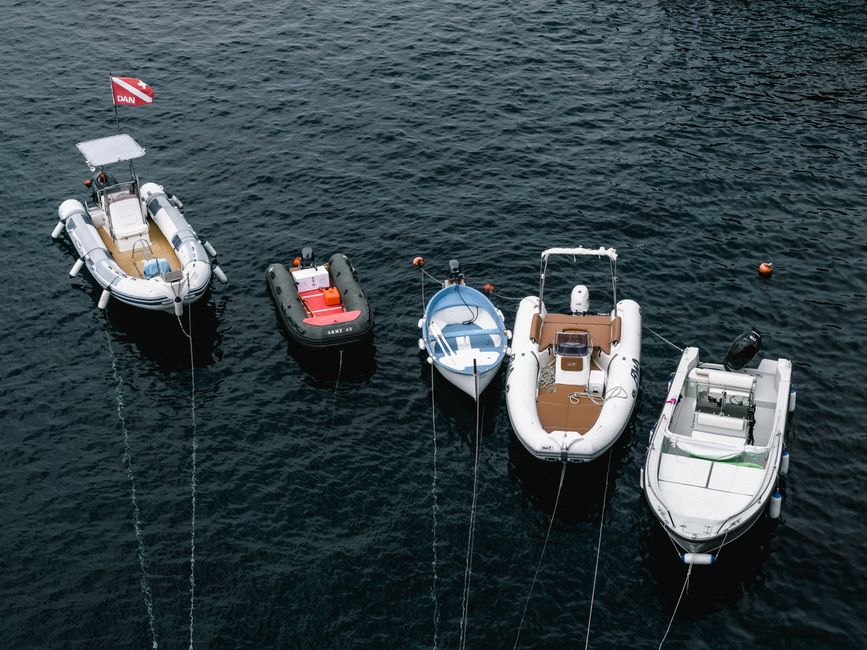
The anchor bites, the engine goes quiet, and the cove is all yours. Within a few minutes a firm inflatable deck is tied off the stern, a ladder hangs into the clear water, and the boat has doubled its living space: somewhere to sunbathe without stepping over anyone, a launch pad for swimmers, a landing for the paddle board and the tender. For a lot of owners, an inflatable extension to the yacht swim platform is the yacht toy that gets used every single trip.
In short: at anchor, an inflatable platform extends the boat’s swim platform into a floating deck for swimming, lounging and boarding. Choose one that packs small enough to stow aboard, ties on with solid D-rings, protects the hull, and is rated by its maker for your crew. Engines and generator off whenever anyone is on or near it.
This is one of our Explore by Use guides; if you’re new to inflatable platforms, start here.

What a day at anchor asks of a platform
A platform for a boat lives a different life from one in front of a lake house. It has to go from a locker to the water and back again, sometimes several times a weekend, and it spends the day tied to something expensive.
- It has to stow. Rolled size and weight matter more than on shore. As a guide, one maker lists its 10 x 6 ft yacht dock at 53 lb, rolling to 40 x 16 x 14 in, and RAVE lists its 18 x 5 ft deck at 56 lb. Measure your locker or lazarette before you choose.
- It has to fit where you launch it. You unroll and inflate it on the swim platform or deck. Island Hopper points out that a 6 ft wide platform can be rolled out off the stern of boats where a 10 ft one would be impossible to deploy.
- It has to tie on. Look for several stainless D-rings so you can run two lines to the stern cleats and keep it from swinging.
- It shouldn’t mark the hull. Rubber corner bumpers or soft edges help; fenders between platform and hull help more.
- People have to get back aboard. From deep water, a firm platform plus a ladder is far easier than a boarding ladder alone.
- It inflates on deck. Most come with a hand pump; a 12V electric pump makes the routine quicker. Inflate to the maker’s pressure, no higher: makers state anywhere from about 5 psi to 15 psi depending on the design.
Which platform type does what at anchor
Boaters usually combine two or three of these. Each links to the full type guide.
| What you want to do | Platform type | Why it works off a boat |
|---|---|---|
| Extend the swim platform, sunbathe, sit with feet in the water | Boat swim platform / extension | Firm drop-stitch deck sized to sit beside the stern |
| Tie up the tender, paddle boards or a jet ski | Inflatable dock or launch platform | A stable step between the water, the toys and the boat |
| Let kids play and walk on water | Foam floating mat | Light, rolls up, ties off with a tether |
| Swim in a protected area | Sea pool / netted enclosure | A netted swimming area that floats beside the boat |
| Lounge in comfort with a drink | Floating lounge | Seats and backrests instead of open deck |
Sizes for a yacht swim platform extension
There’s no single right size; it depends on the stern, the crew and the locker. These are the common size classes, with makers’ own figures as examples. Capacity always comes from the maker, never from the deck area.
| Size class | What makers state (example) | Suits | Watch for |
|---|---|---|---|
| Compact, about 8 x 5 ft | 4 to 6 persons (Solstice) | Smaller boats, a couple or a small family | Less room to lie down |
| Wide, about 10 x 6 ft, 6 in thick | 1,500 lb (Island Hopper) | Most cruisers and pontoons; fits across many sterns | Rolled size against your locker |
| Long, about 18 x 5 ft, 4 in thick | 8 adults or 14 kids, 1,500 lb (RAVE) | A bigger crew; lying side by side | Needs room to swing clear of the hull |
| Large, about 10 x 10 ft, 6 in thick | 10 adults or 14 children, 1,800 lb (RAVE) | Larger yachts with deck space to inflate | Weight to lift back aboard |
For the full type guide, with ladders, attachment and maker-rated group sizes, see boat swim platforms. For a short list of platform picks, see BoatSlide’s best inflatable docks.
How they’re built, and what that means on a boat
Almost every boat platform extension is drop-stitch: two layers of fabric joined by thousands of threads, so the deck stays flat when pumped up hard. Our guide on what drop stitch is explains it in detail. Two things matter more on a boat than on a lake. First, the outer skin: Island Hopper, for example, describes a reinforced 1000-denier outer fabric it says handles UV, oil stains and abrasion, with heat-welded seams. Second, the hardware: stainless D-rings and corner bumpers take the strain and the knocks of being tied to a hull all day.
Prices move with the season, but the 10 to 18 ft drop-stitch decks whose makers we checked in October 2026 listed for roughly $600 to $800. Warranties differ widely: among the makers we checked, from a limited lifetime warranty for personal use to five years, so read what’s covered.
An inflatable yacht platform, step by step
The routine most owners settle into goes like this. Anchor in calm water and shut the engines and generator down. Unroll the platform on the swim platform or deck and inflate it to the pressure the maker states. Slide it in, then tie it from its D-rings to the stern cleats with two lines, with a fender or the platform’s bumpers against the hull. Hang a ladder from the platform or the boat. When you leave, everyone back aboard first, then untie, deflate and roll it up before the engines start. Never tow it with anyone on it; one dock maker’s manual says never to tow its dock with people or pets aboard.
The engine rule isn’t fussiness. The U.S. Coast Guard warns never to sit, teak surf or hang on the back deck or swim platform while the engines are running, because carbon monoxide from the exhaust collects there, and never to enter areas under swim platforms where exhaust outlets are located unless the area has been properly ventilated. The CDC adds that carbon monoxide near the swim deck can kill in seconds, and advises staying at least 20 ft from boats running a generator or engine. A platform tied off the stern is right in that zone, and so is one tied off a neighbor’s boat in a raft-up.
Ladders and getting back on
A drop-stitch deck sits several inches out of the water, which is easy for some swimmers and a real climb for others. Rope ladders with molded steps that hang from a cleat or a D-ring are common, as are rope boarding steps made for inflatables. Check the weight rating on the ladder’s own label (some don’t state one), hang it from a solid point, and look it over before each trip. Platforms with handles along the edge help tired swimmers pull themselves up.
Tender access and the rest of the yacht toys
On larger boats the platform becomes the hub for everything else: paddle boards tied alongside, a kayak, a slide off the upper deck, a jet ski or the tender coming and going. A firm deck at water level makes boarding the tender steadier than stepping down from a high transom. If launching craft is the main job, our launch platforms guide covers what to check for each kind of craft, and our floating dock for jet ski guide compares inflatable and drive-on options. Yacht owners also often add a netted sea pool for a protected swimming area beside the boat.
A weekend at anchor, in practice
Friday evening, the platform goes aboard rolled and strapped, with the pump, two dock lines, two fenders and the ladder in the same bag. Saturday you anchor in a sheltered cove, kill the engines and generator, and inflate on the swim platform while the kids find their life jackets. The deck goes in on the leeward side, tied at two points with fenders against the hull; the paddle boards are clipped to its D-rings. At lunch the wind backs and the cove gets choppy, so everyone comes aboard, the platform is pulled in close and checked. Late afternoon the sky builds to the west; you deflate and stow before the thunder, not after. Sunday morning, a rinse with fresh water and mild soap, a dry in the shade, and it’s rolled loosely for the run home.
Safety at anchor
- Engines and generator off while anyone is on the platform, on the swim platform or in the water nearby (U.S. Coast Guard and CDC carbon monoxide guidance).
- Life jackets aboard for everyone. To meet Coast Guard requirements a recreational vessel must carry a USCG-approved wearable life jacket for each person on board, and the Coast Guard notes that most boating drownings happen on nice days.
- Keep clear of props and hard edges. One dock maker’s manual notes that tethering a platform to boats or other hard objects increases the potential for injury, and asks owners to keep it away from engines and propellers.
- No swimming near marina docks. Tennessee’s State Fire Marshal advises never swimming within 100 yards of a freshwater marina or boatyard, because of the risk of electric shock drowning.
- Watch the weather. The National Weather Service’s rule is “When thunder roars, go indoors”; pack the platform away and get everyone aboard early.
- Stay within the maker’s rating and the maker’s minimum water depth.
Our inflatable platform safety checklist goes further, and if you’ll anchor the platform on its own away from the boat, read how to anchor an inflatable platform.
Boat platform checklist
- Rolled size and weight fit your locker and your crew’s arms.
- Maker’s people and weight rating covers your crew.
- Pump, pressure gauge, two lines, two fenders and a ladder packed together.
- Anchored in calm, sheltered water; engines and generator off.
- Inflated to the maker’s pressure, not above it.
- Tied at two points, fenders against the hull, clear of the props.
- A life jacket for every person aboard; kids in theirs.
- Everyone aboard and the platform stowed before engines start.
Charter operators, yacht clubs and marinas using platforms with guests every day should look at our commercial platforms section, especially the page for marinas and yacht clubs: a recreational product’s advertised capacity does not make it suitable for commercial use.
Boating and yacht platform questions
What is an inflatable yacht platform?
A drop-stitch inflatable deck that ties to the stern at anchor and extends the boat’s swim platform: a place to swim from, sunbathe, board the tender and climb back aboard. It deflates and rolls up for storage on board.
How do you attach an inflatable platform to a boat?
With the boat anchored and the engines off, run two lines from the platform’s D-rings to the stern cleats so it can’t swing, and put fenders or the platform’s bumpers against the hull. Follow the maker’s instructions for which attachment points to use.
Can I tow an inflatable platform while the boat is moving?
Bring it aboard before you get underway. These platforms are described for use at anchor or tied up, one dock maker’s manual says never to tow it with people or pets aboard, and the Coast Guard warns against anyone being on the swim platform area while engines run.
How many people fit on a yacht swim platform extension?
Only what the maker states. RAVE rates its 18 x 5 ft deck for 8 adults or 14 kids (1,500 lb); Island Hopper rates its 10 x 6 ft yacht dock for 1,500 lb. Never estimate capacity from the deck size.
What other yacht toys work with a platform?
Paddle boards, kayaks, foam mats, floating lounges, netted sea pools and slides all pair well with a platform, which becomes the base everyone swims back to.
Where do I store an inflatable platform on a boat?
Deflated and rolled loosely in a dry locker, out of the sun. Rinse off salt and dirt with mild soap and fresh water first and let it dry, as dock makers’ care instructions ask; avoid solvents and petroleum products.
Is a 10 x 6 or an 18 x 5 platform better for a boat?
A wide 10 x 6 ft deck sits neatly across many sterns and is easy to step onto from the swim platform; a long 18 x 5 ft deck gives a bigger crew room to lie side by side. Compare the rolled size, the maker’s rating and the number of D-rings, and measure your locker.
Keep exploring
Spending the day at the lake house instead? See family lake days; rafting up with friends, try our floating party ideas; paddling from the boat, read water sports and fitness; and browse every use guide in the uses category.