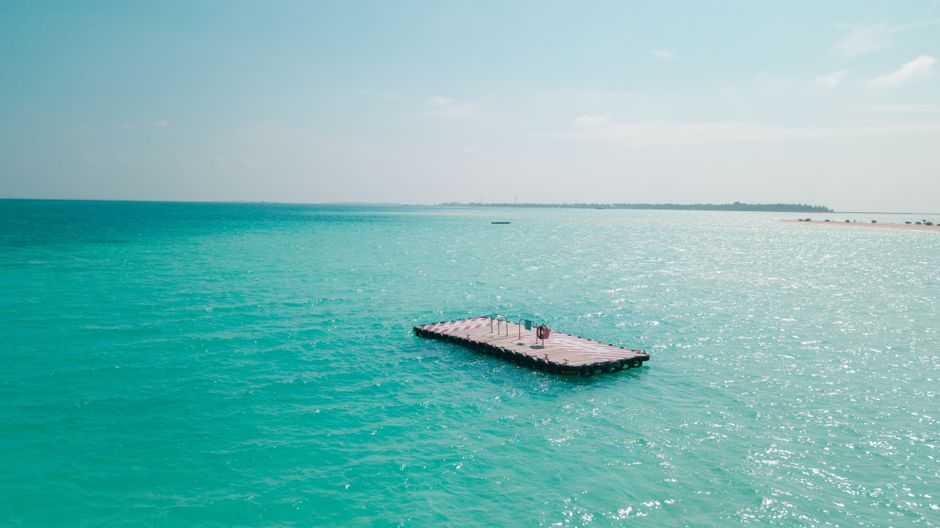
It’s mid-morning at a beach club. Guests swim out to a floating deck, a family waits their turn on the paddle boards, and a staff member in a bright shirt keeps an eye on everyone from the edge. That deck works hard: hundreds of people a week, all season, in sun and salt. A commercial inflatable platform or floating dock system has to handle that, and so does the business running it. This page is for resorts, marinas, rental operators and work crews: what’s out there, how commercial systems differ from consumer docks, what they cost, and what to ask a supplier before you buy.
In short: commercial platforms are built, tested and supported for repeated business use, and work platforms are engineered and documented for crews and equipment. A consumer dock’s capacity rating doesn’t make it suitable for either. Start with your use (guests, boats, rentals or work), then ask suppliers for load ratings, anchoring plans, warranty terms for commercial use and installation support.
Commercial platforms by business
Resorts, hotels and beach clubs
Floating swim decks, lounges, sea pools and floating water parks turn a waterfront into a guest amenity. Suppliers in this space pitch a lot of support: Wibit says it does a site assessment and a custom anchoring plan for open-water parks, offers installation, and recommends trained staff supervise at all times. EZ Dock markets floating patios, swim platforms and watersports rental docks to hotels and resorts. Read the resorts and hospitality guide.
Marinas and yacht clubs
Marinas use floating dock systems for slips, guest docks, walkways and drive-on ports for jet skis and small boats. These are usually rigid modular systems from makers like EZ Dock, Candock and Jet Dock, sold through dealers and designed for the site. Inflatable platforms play a smaller role here, for example as a seasonal swim deck for members. See the marinas and yacht clubs guide.
Rental businesses, tour operators and watersports centers
Rental and watersports businesses need platforms that launch kayaks and paddle boards quickly, survive constant use and pack down when the season ends; launch platforms explains the options. Some consumer brands have commercial programs (Island Hopper, for example, has a commercial operator discount page), but check that the warranty and the maker’s instructions cover business use before you rent anything out. Read the rental and tour operator guide.
Heavy-duty and work access
Staging, inspection and maintenance over water need engineered work platforms, not recreational docks. EZ Dock, for example, sells modular polyethylene work-platform sections in 40, 60, 80 and 100 in widths, with low-profile options for working close to the water. Worker safety rules apply too: OSHA’s construction standard 1926.106 requires Coast Guard approved life jackets or buoyant work vests where there’s a danger of drowning, ring buoys with at least 90 ft of line, and at least one lifesaving skiff immediately available. See the heavy-duty and work access guide, and for what the product type is, work platforms.
Commercial vs consumer platforms
| Consumer inflatable dock | Commercial recreation platform | Engineered work platform | |
|---|---|---|---|
| Built for | Personal and family fun | Repeated guest use | Crews, tools, equipment |
| Capacity rating | People relaxing, as the maker states | Per the maker’s commercial specs | Documented loads for the stated use |
| Warranty | Often personal use only | Written for commercial use | Per supplier contract |
| Anchoring | D-rings, owner sets it up | Site plan, often installed by supplier | Designed for the site and loads |
| Where it’s sold | Retailers and maker websites | Specialist suppliers | Dealers, engineers, contractors |
The commercial recreation type has its own page: commercial recreation platforms. For the whole family of types, see floating platform types, and for the trade-offs between air-filled and plastic systems, inflatable vs rigid floating docks.
What commercial systems cost, and how to think about it
Commercial pricing is mostly by quote, because the layout, anchoring and installation are designed for each site. Two public reference points give a sense of scale. Aquaglide’s aquapark catalog listed individual floating park components from about $3,400 to more than $25,000 each in October 2026, before anchoring and installation. Wave Armor’s list prices for rigid drive-on jet ski ports ran from about $1,700 to $2,700 per port. EZ Dock doesn’t publish prices and sends buyers to a local distributor for a quote.
The purchase price is only the start. When you compare quotes, add the things that recur each season: installation and removal, anchoring hardware, storage space, repairs and spare parts, staff time for supervision, and insurance. Then weigh that against what the platform does for you: guest nights, rentals per day, or crew hours saved. We don’t publish return-on-investment numbers because they depend entirely on your site and pricing, but asking each supplier to walk you through a season’s running costs is the quickest way to compare them fairly.
What to ask a modular floating dock system supplier
Whether you’re buying a modular floating dock system for a marina or a floating park for a resort, these questions sort serious suppliers from the rest:
- What is it rated for, in writing? Ask for the maximum load and number of users for your layout, and how that was determined.
- Is it made and warranted for commercial use? Get the warranty terms and how long it lasts under daily use.
- What testing or certification does it have? For example, Wibit says its products are TÜV-certified, and Aquaglide says its aquapark designs are third-party tested.
- Who designs the anchoring? Ask for an anchoring plan for your water depth, bottom, wind and water-level changes. Our anchoring guide explains the basics so you can follow the conversation.
- Who installs it, and how long does it take? Wibit, for example, says full open-water parks take one to two days to install.
- What about staffing and rules? Ask what supervision, signage and user rules the supplier recommends.
- Parts, repairs and off-season storage: how quickly can you get replacement parts, and how should it be stored?
- Permits: which local, state or federal approvals your site may need. In navigable U.S. waters the Army Corps of Engineers regulates structures such as docks. Your supplier may know the usual process, but the responsibility stays with the owner.
A practical scenario: a lakeside resort’s first platform season
Picture a small lakeside resort that wants a swim area guests can reach from the beach. In autumn, the owner talks to two or three suppliers of commercial floating platforms, shares water depths, bottom type and how much the lake level changes, and asks each for a layout, a written user and load rating, a commercial warranty and an anchoring plan. Over winter, the owner checks with the state and local authorities about what approvals a seasonal installation needs and talks to the resort’s insurer.
In spring the supplier, or a dock and mooring specialist, sets the anchors and installs the platform; for a full open-water park Wibit puts this at one to two days. Staff are trained on supervision, opening hours are set around daylight and weather, child-size life jackets go on a rack by the beach, and a daily routine starts: check the forecast, walk the platform for damage, check lines and pressure, then open. At the end of the season it comes out, is cleaned, dried and stored as the supplier directs, and the owner reviews repairs and guest use before the next order. The resorts and hospitality page goes through this in more detail.
Daily operating checklist
- Weather first: check the National Weather Service marine forecast and have a clear rule for closing the platform in wind, waves or lightning.
- Walk it: look for cuts, worn seams, loose connectors and damaged handles; close anything damaged until it’s repaired.
- Lines and anchors: check every line, shackle and anchor point, and that the platform hasn’t drifted.
- Pressure: on inflatables, check against the supplier’s stated pressure, especially as the day warms up.
- Staff and rules: trained staff on duty as your supplier recommends, user rules posted, maximum users per the written rating.
- Life jackets: the U.S. Coast Guard says the best approved life jacket is the one people will wear, and that adult sizes may not work for children. Keep child sizes on hand.
- Workers over water: crews fall under OSHA rules, including life jackets or buoyant work vests, ring buoys and a rescue skiff.
- Log it: a short daily record of checks, repairs and incidents helps with warranty claims and insurance.
Our safety checklist covers the basics for any platform, and the commercial and heavy-duty section has more. New to the site? Begin at Start here.
Commercial platform questions
What is a commercial inflatable platform?
A floating platform made, tested and warranted for repeated business use, such as swim decks, floating parks or sea pools at resorts and camps. It differs from a consumer dock in its materials, documentation, warranty and the installation and anchoring support behind it.
What is a modular floating dock system?
A dock built from connectable sections or cubes, often made of plastic such as polyethylene, that can be arranged into walkways, slips, platforms and drive-on ports and expanded later. EZ Dock, Candock and Jet Dock all sell modular systems for residential and commercial sites; our modular platforms page explains layouts and connectors.
How much does a commercial floating platform cost?
Most suppliers price by quote. As a reference, one maker’s aquapark catalog listed single components from about $3,400 to over $25,000 in October 2026, before anchoring and installation, and a full layout is several components plus site work.
Can I rent out a consumer inflatable dock?
Check the maker’s warranty and instructions first. Some consumer warranties cover personal use only, and rental use may also raise insurance and local licensing questions. If it’s a core part of your business, a commercially rated product is the safer route.
Is a heavy-duty inflatable dock suitable for work?
Not because of its capacity rating alone. Recreational ratings are for people relaxing on the deck. Work access needs a platform engineered and documented for crews and equipment, plus the safety measures OSHA requires for work over water.
Who installs a commercial floating platform?
Usually the supplier or a dealer, sometimes with a dock and mooring specialist for the anchors. Wibit says it has a dedicated team that handles installation, and Aquaglide recommends a dock and mooring specialist for anchoring its lakefront products. Ask who carries responsibility if the anchoring fails.
Planning a platform for your business?
Tell us about your site, your guests or your project, and we’ll point you to the right type of system and the questions to ask. Contact us with your business inquiry.
Keep exploring: see how marinas and rental and tour operators use floating systems, compare every kind in floating platform types, or read how to choose an inflatable platform for the basics of size, material and rating.