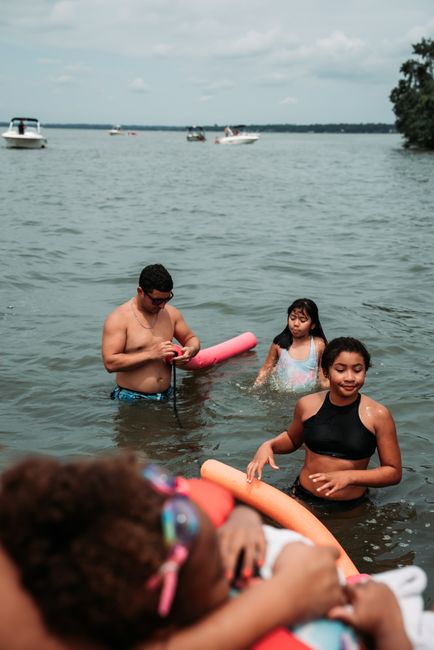
The best platform days feel effortless: the deck is out, the kids are jumping off the edge feet first, someone is lying in the sun with one hand trailing in the water, and the grown-ups are chatting on the boat. That easy feeling usually comes from ten minutes of checks nobody noticed. Good inflatable platform safety is not complicated: watch the weather, wear life jackets, anchor it properly, keep to the maker’s capacity, have an adult watching the kids, and look the platform over before you use it. Here is the whole thing as a checklist you can actually use, whatever kind of platform you have (our platform types guide shows them all).
In short: go out only in calm weather and come in at the first thunder; wear a U.S. Coast Guard approved life jacket that fits; anchor at the maker’s anchor points, away from running engines; keep to the number of people and pressure the maker states; and have one adult whose only job is watching the water.
The inflatable platform safety checklist
Before you head out
- Check the forecast. If thunderstorms are expected, don’t go.
- A properly fitting, Coast Guard approved life jacket for every person, sized by weight for each child.
- Read the manual: minimum water depth, maximum people and weight, inflation pressure, anchor points.
- Pump, pressure gauge if you have one, repair kit and anchor lines packed.
Setting up
- Inspect the platform for wear, damage or missing parts. Don’t use it if anything is damaged.
- Inflate to the maker’s pressure, never beyond it.
- Carry it to the water; don’t drag it.
- Check the spot: deep enough, clear of rocks, logs and sandbars, sheltered from wind, away from hard objects.
- Anchor or tether at the maker’s anchor points. Engines and generators off nearby.
While you’re on it
- One adult watching the water at all times, without a phone or a drink in hand.
- Feet first off the edge; no head-first dives, flips or somersaults.
- Nobody swims under the platform, and everyone knows where the anchor lines are.
- Stay within the maker’s number of people.
- At the first thunder, or if wind and waves build, everyone off and to shore.
Packing up
- Rinse with mild soap and fresh water, dry fully, roll loosely and store out of the sun.
- Don’t leave it out where it can be used unsupervised.
The sections below explain each step and where it comes from.
Weather: calm water only, and come in at the first thunder
Platform makers are clear on this. RAVE’s manual for its 10 x 10 ft inflatable dock says never to use it in high winds, waves, strong currents or rough water, during storms or when there is lightning, and if a storm comes up, to get to shore rather than stay on the platform. It also says not to use it after sunset, before dawn or in poor light. RAVE suggests choosing the spot most protected from wind.
Lightning is the one people underestimate. NOAA’s advice is to get out and away from ponds, lakes and other water immediately when a storm threatens, and to stay in a safe shelter until at least 30 minutes after the last thunder. The National Weather Service adds that most lightning injuries and deaths on boats happen on small boats with no cabin, so a ride back on an open boat is not shelter; heading in early is.
Cold water matters too, especially early and late in the season. The National Weather Service says cold shock can be as severe in water of 50–60°F as in water at 35°F, and that gasping from sudden immersion can be triggered by water as warm as 77°F. Wearing a life jacket greatly improves the chance of survival.
Life jackets that are approved and fit
The numbers make the case. In its 2024 recreational boating statistics, the U.S. Coast Guard reports that where the cause of death was known, 76% of victims drowned, and where life jacket use was known, 87% of them were not wearing one.
A platform is not a boat, but the rules on the boat that brings you there still apply, and the platform makers ask for life jackets too. RAVE’s dock manual says to always wear a Coast Guard approved Type III / Level 70N (or other approved) life jacket when using the dock. For the boat, the Coast Guard requires a wearable, approved life jacket of the right size for each person aboard, and federal law requires children under 13 to wear one while the vessel is underway, unless they are below deck or in an enclosed cabin. Some states set a different age: Minnesota, for example, requires children under 10 to wear one while a boat is underway. Check your state’s rule.
Fit is everything. The Coast Guard’s fit test: check the label for your size and weight, fasten it, hold your arms straight up, and have a friend pull up gently on the shoulders. It shouldn’t ride up over your chin or face. Adult life jackets don’t work for children, so buy kids’ jackets by the weight range on the label. Inflatable life jackets are comfortable for adults on the boat, but the Coast Guard says they are not for children under 16 or non-swimmers, and not for sports where you expect to end up in the water (its examples are whitewater paddling and waterskiing). Jumping off a platform all afternoon is that kind of day. For platform play, a foam jacket is the simpler choice.
Capacity: only what the maker states
Every platform has a maker-rated limit, and it is the only number to use. A few examples: RAVE rates its 10 x 10 ft inflatable dock for a maximum of 14 users and 1,800 lb, and says its 5 psi working pressure is the recommended pressure for up to 10 adults or 14 children, with a clear warning not to inflate beyond 5 psi. Aquaglide rates one of its large lounge decks for 8 adults or 1,600 lb. Don’t work out your own number from the size of the deck, and spread people out rather than crowding one edge.
Those ratings are for recreation. A consumer platform’s advertised capacity does not make it a work platform for tools, equipment or staging; engineered work platforms are a different product with their own documentation, and businesses that put guests on platforms should start from our commercial platforms page. Our guide to choosing an inflatable platform explains how to read the specs, and what drop stitch is explains why pressure matters so much.
Kids: one adult watching, feet-first jumps
The CDC’s drowning prevention advice is to choose a responsible adult to supervise closely and constantly whenever children are in or near water, without distractions like phones or alcohol, because drowning happens quickly and quietly. Swimming lessons help, but the CDC notes that children who have had them still need close, constant supervision. Taking turns as the “water watcher” is an easy way to make sure someone always is.
Platform makers add their own rules. RAVE says children should use its dock only under constant adult supervision; that jumps should be feet first and never head first; that flips, somersaults and other acrobatics are not allowed because landing on the head or neck can cause serious injury; and that the surface gets wet and slippery. Its manual also warns never to swim or play under the dock: it is a large object with nowhere to come up for air.
Anchoring, boats and engines
An unanchored platform drifts, and a platform tied too close to a boat bumps the hull and sits near the propeller and exhaust. Anchor at the maker’s anchor points; our guide on how to anchor an inflatable platform covers anchor weight, rope and local rules. RAVE warns that tethering to boats, docks or other hard objects raises the risk of injury and asks users to keep a safe distance from engines and propellers. It also says never to tow the platform with people or pets on it.
Carbon monoxide is the hidden one. The CDC warns that CO building up beneath the stern deck and on or near the swim deck can kill someone in seconds, that generators on boats such as houseboats can vent toward the rear, and that you should anchor at least 20 feet from any boat running a generator or engine. Engines off while people are swimming and playing off the back of the boat.
Docks with electricity: electric shock drowning
If your platform is near a dock or marina with electrical power, know about electric shock drowning. Faulty wiring can put current into the water, and freshwater is the main concern. Tennessee’s State Fire Marshal’s Office advises never swimming within 100 yards of a freshwater marina or boatyard. If you feel tingling or shocks in the water, it says not to swim toward the dock but to stay upright, back out of the area and head for shore at least 100 yards from the dock. If someone else is affected, fight the instinct to jump in (many rescuers have died) and turn off the shore power first. Dock owners should have outlets on GFCI protection and use an electrician familiar with American Boat and Yacht Council standards.
Inspection, repair and storage
Look the platform over every time: seams, valve, handles, D-rings and anchor points. RAVE says not to use its dock if there are any signs of damage, wear or deterioration, and to repair or replace parts first. For small holes, its manual describes the usual fix: find the leak with soapy water, cut a patch with rounded corners 1–2 in wider than the hole, clean both surfaces with rubbing alcohol, glue, press out the bubbles, and wait 24 hours before inflating. Large holes, tears and seam failures go back to the maker.
For storage, RAVE says to clean with mild soap and fresh water (no petroleum-based cleaners, solvents or power washers), dry it completely, roll it loosely and keep it in a cool, dry, shaded place. Muskrats and other rodents can chew PVC; keeping the platform at full pressure when it is on the water, or taking it out at night, helps. And secure it against unsupervised use, so nobody, especially a child, goes out on it alone.
What to keep with the platform
A small kit that stays with the platform makes most of the checklist automatic:
- Life jackets for everyone, Coast Guard approved, sized by the weight range on each label, with children’s jackets for children.
- The maker’s repair kit and the glue it recommends, plus the valve tool if your platform uses one.
- The pump and a gauge, with the maker’s psi written on a tag or the pump itself.
- Anchor lines and anchors sized to the maker’s instructions.
- A charged phone in a waterproof pouch for weather radar and emergencies, kept with the adult on watch rather than in their hand.
Extra checks by platform type
The checklist above fits every platform, but each type has one or two things worth adding.
- Boat swim platforms: the stern is where engines, propellers and exhaust are. Engines and generators off, and the platform tied far enough back that it can’t drift under the swim ladder. See boat swim platforms.
- Foam floating mats: they can’t go flat, but they flex and tip people off, so depth matters most. Aqua Lily Pad, for one, says its mats should never be used in water less than 6 ft deep. More on floating mats.
- Sea pools and netted enclosures: a net keeps swimmers in an area, but it doesn’t replace a watcher or a life jacket. Follow the maker’s attachment instructions. See sea pools.
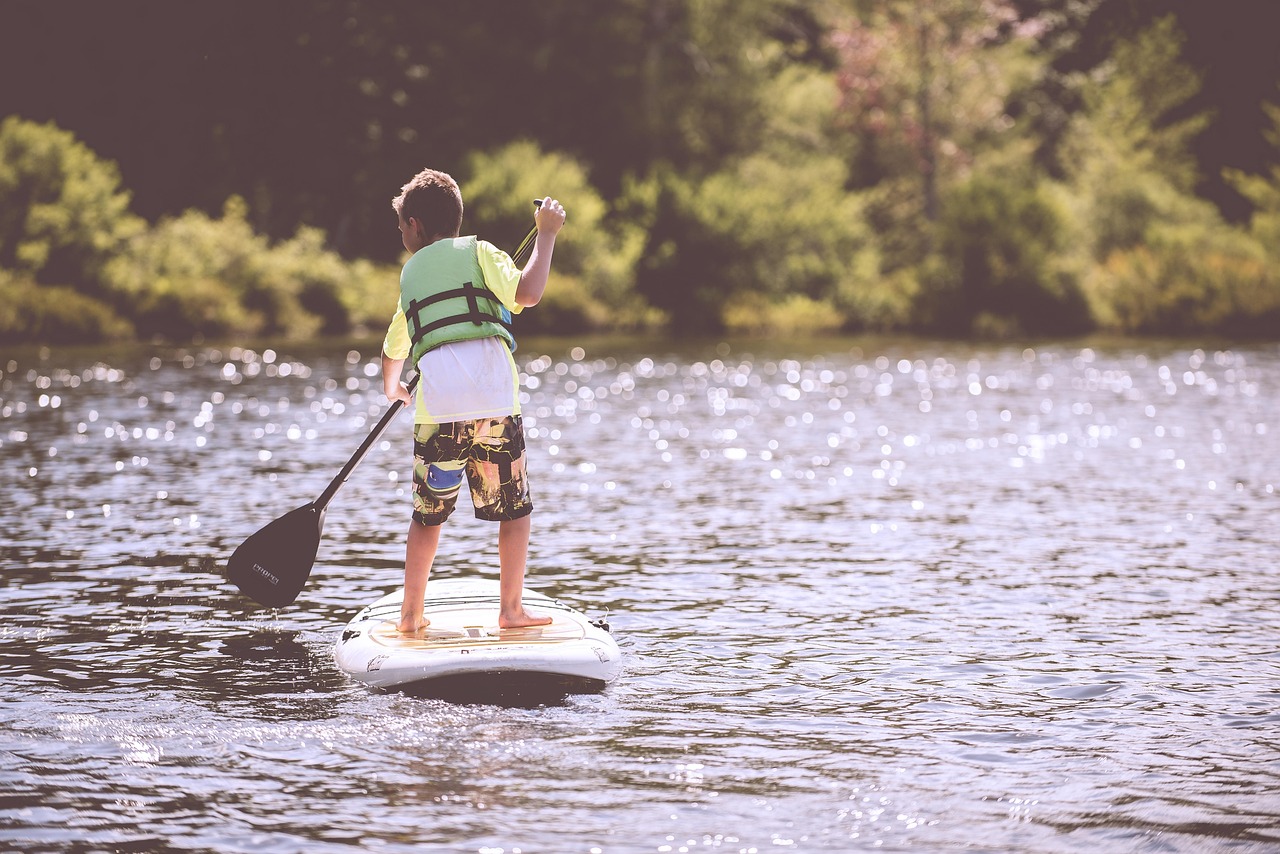
- Launch platforms: getting in and out of a kayak or paddle board is an easy moment to fall in, so wear the life jacket while launching, not just on the water. See launch platforms.
- Docks left out all season: recheck anchors and lines after storms and water-level changes; our ponds and lakes guide covers the longer-term setup.
For an afternoon built around the kids, our family lake days page puts these checks into a real day out. More guides on setup and care are in Setup, care and safety.
Platform safety questions
Do you need a life jacket on an inflatable platform?
Makers ask for one. RAVE’s dock manual says to always wear a Coast Guard approved Type III / Level 70N life jacket when using it. On the boat that takes you there, children under 13 must wear one while underway under federal law (some states set a different age).
How many people can safely be on an inflatable platform?
Only as many as the maker states for that model, for example 14 users and 1,800 lb for RAVE’s 10 x 10 ft dock, or 8 adults for one of Aquaglide’s large lounge decks. Don’t estimate from the size.
When should we get off the platform?
At the first thunder, or when wind, waves or current build. NOAA says to get out of and away from the water when a storm threatens and to wait 30 minutes after the last thunder before going back.
Is it safe to dive off an inflatable platform?
RAVE tells users never to dive off its dock head first and to jump feet first, and it bans flips and somersaults. Check the depth and what’s under the water before anyone jumps.
Can we use the platform near the boat with the engine running?
No. The CDC warns that carbon monoxide near the swim deck can kill in seconds and advises staying at least 20 feet from any boat running an engine or generator. Turn engines off while people are on or around the platform.
What if the platform starts losing air?
Get everyone off and back to the boat or shore, then bring the platform in. Find the leak with soapy water once it’s on land, and repair it following the maker’s instructions; large holes and seam failures go back to the maker. Our drop-stitch guide has a quick inspection routine.
Do foam floating mats need the same precautions?
Mostly, yes: weather, life jackets, supervision, tethering and the maker’s depth and capacity. Mats can’t deflate, but they flex more and can tip people off more easily. Our inflatable platform vs floating mat guide compares the two.
Keep exploring
Set your platform up properly with how to anchor an inflatable platform, pick the right size and rating with how to choose an inflatable platform, compare inflatable docks for everyday use, or begin at Start here.