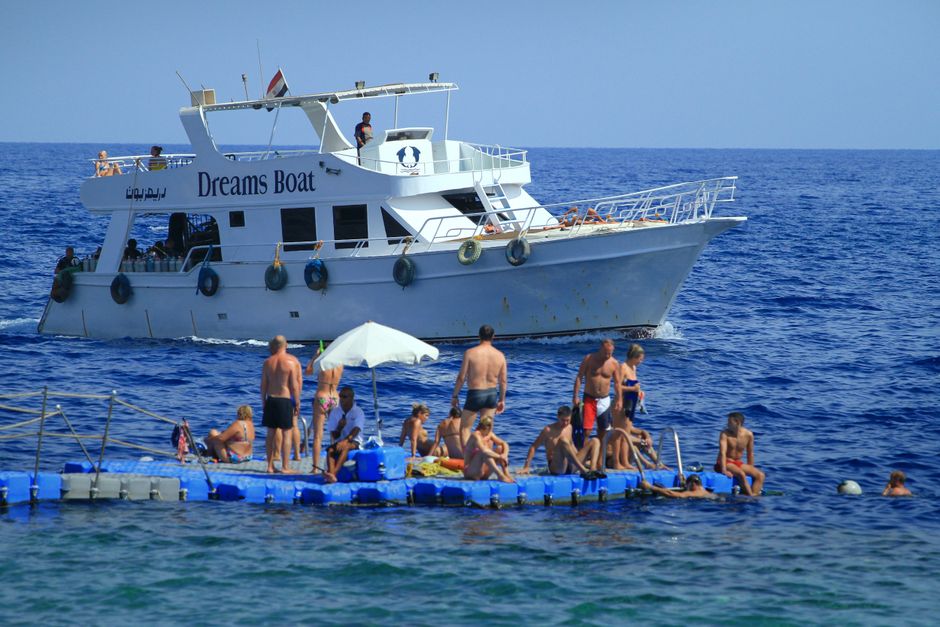
The anchor bites, the engine goes quiet, and within a minute someone asks, “Can we get in?” This is the moment an inflatable swim platform for a boat earns its place. Clip it off the stern and the boat suddenly has a floating back porch: room for the kids to cannonball, for two friends to lie in the sun with their feet in the water, and for everyone to climb back out without fighting a skinny ladder. This page answers the two questions boaters really ask: how many of us fit, and what can we do on it at anchor?
In short: inflatable swim platforms for boats run from about 7 x 7 ft to 20 ft long. Makers rate them by weight and sometimes by people; RAVE, for example, rates its 10 x 10 ft deck for up to 10 adults or 14 children and its 18 ft mat for 8 adults or 14 kids. Use only the maker’s figure, tie the platform to the boat with the engine off, and plan how everyone climbs back aboard.
How many people fit on an inflatable swim platform?
Only the maker can answer that, and not every maker does. The honest way to read a spec sheet: use the people count if there is one, never go above the weight limit, and if only a weight is given, don’t turn it into a head count yourself. Here is what makers state for the common size classes, and what each shape is good for at anchor.
| Size class | Thickness | What makers state (examples) | Best at anchor for |
|---|---|---|---|
| Small square, about 7 x 7 ft (49 sq ft) | 8 in | 1,050 lb (BOTE 7 ft); no head count given | Two or three people sitting with their feet in the water; small boats with little storage |
| Rectangle, 10 x 6 ft (60 sq ft) | 6 in | 1,500 lb (Island Hopper, which says “a full family” rather than a number) | A swim step beside the stern, getting in and out, a family taking turns |
| Square, 10 x 10 ft (100 sq ft) | 6 to 8 in | 1,800 lb or 10 adults / 14 children (RAVE); 2,100 lb (BOTE 10 ft) | A group hangout off a pontoon or cruiser; everyone facing each other |
| Long mat, 15 to 20 x 5 ft | 4 in | 1,100 lb (RAVE 15 ft); 1,500 lb or 8 adults / 14 kids (RAVE 18 ft); 1,500 lb (RAVE 20 ft) | A runway for kids to run and jump off; lying in a row in the sun |
Notice how the figures differ even for similar sizes. That’s why the only safe number is the one printed by the maker of the platform you’re standing on. Adding two platforms together doesn’t add their ratings either; our guide to choosing an inflatable platform explains how to read capacity claims.
What you can do on a swim platform at anchor
- Swim and climb out easily. A platform sitting on the water is much easier to climb onto than a boat’s transom. Many have handles around the edge; RAVE puts ten neoprene-covered handles on its 10 x 10 ft deck for climbing on from deep water.
- Sunbathe with your feet in the water. A firm drop-stitch deck stays flat, so you can lay out towels and stay there for the afternoon. Foam tops and foam corner pads are softer and less slippery to sit on.
- Let the kids jump. Kids love running the length of a long mat and leaping off. Check the depth first: RAVE asks for at least 4 ft of water under its decks and mats, and jumping needs more than that.
- Launch toys. A platform makes a handy base for paddle boards, snorkel gear and floats. Island Hopper describes its 10 x 6 ft deck as a boarding step and staging area for water sports. Paddlers will find more on our launch platforms page.
- Just hang out. D-rings on the deck let you strap down a cooler or dry bag so it stays put when someone jumps.
How an inflatable swim platform is built
Almost every boat swim platform is made of drop-stitch: two layers of coated fabric joined by thousands of fine threads, so that when you pump it up hard it becomes a flat, firm board instead of a balloon. Thickness runs from about 4 in on long mats to 6 to 8 in on square decks; thicker decks feel steadier underfoot. Makers state their own pressures, from 5 psi on RAVE’s decks to 6 to 10 psi on BOTE’s and 8 to 15 psi on Island Hopper’s, so always inflate to the figure in your manual. Our explainer what is drop stitch covers how it works.
The outer skin is PVC, sometimes with an extra reinforcing layer: Island Hopper describes a 1000-denier rip-resistant fabric and heat-welded seams. On top you’ll usually find a non-slip foam or textured pad, plus D-rings, handles and anchor points. Rubber corner bumpers, where fitted, protect both the platform and the hull when the two touch.
Sizes and shapes, and which boats they suit
- Narrow rectangles (about 6 ft wide) are the easiest to launch off a small boat’s stern and to stow. Island Hopper says its 10 x 6 ft deck rolls to 40 x 16 x 14 in and weighs 53 lb.
- Squares (7 to 10 ft) make a sociable hangout but take more deck space to unroll and more effort to pump. RAVE’s 10 x 10 ft deck weighs about 69 lb and BOTE’s 10 ft deck about 83 lb.
- Long mats (15 to 20 ft) are thinner and lighter for their length and give kids a runway. They swing more in wind, so tie them well.
- U-shaped and L-shaped decks are mostly built for a jet ski to nose into; see our floating dock for jet ski guide if that’s your plan.
Setting up and inflating at anchor
RAVE’s owner’s manual says to inflate on flat ground or at the end of the boat with the motor off. Unroll the platform, attach the pump to the valve and pump to the maker’s pressure; a gauge helps. With the included hand pumps, Island Hopper says about 8 minutes for its 10 x 6 ft deck and RAVE says 5 to 10 minutes for its 18 ft mat. An electric pump saves effort on big squares. Don’t overdo it: heat raises the pressure inside, and RAVE’s warranty doesn’t cover failures from over- or under-inflation, so check the pressure again if the platform has sat in hot sun.
Getting back aboard: the swim platform ladder
A swim platform ladder for a boat matters as much as the platform, because sooner or later everyone has to climb back into the boat. There are two ladders to think about. The first gets swimmers onto the inflatable: some platforms include a soft rope ladder, and others sell one separately. The second gets people from the water or the inflatable back onto the boat: telescoping stainless steel ladders mount on the boat’s own swim deck and fold away. Wide treads and tall handrails are easier for kids and older swimmers. Measure your swim deck and mounting space before choosing, since fit varies by boat, and check the ladder maker’s stated load.
Attaching it to the boat, safely
- Engines and generator off. The U.S. Coast Guard says never to sit, teak surf or hang on the back deck or swim platform while engines are running, to keep everyone away from engine and generator exhaust outlets, and warns that carbon monoxide can stay around a boat at dangerous levels even after an engine stops. The CDC adds: swim and play away from exhaust vents, and stay at least 20 ft from boats running an engine or generator.
- Two lines from the D-rings to the stern cleats keep the platform from swinging into the hull or toward the propeller. Use only the attachment points the maker provides. RAVE’s manual warns that tethering to a boat increases the potential for injury and says to keep a distance from engines and propellers.
- Life jackets. The Coast Guard requires a USCG-approved wearable life jacket for each person aboard, notes that adult sizes may not work for children, and that rules for kids vary by state.
- Stay within the maker’s rating for people and weight, and pack the platform away before wind and chop build.
Staying put away from the boat, at a sandbar or off a beach, is a job for anchors rather than cleats; our guide on how to anchor an inflatable platform covers it, and the inflatable platform safety checklist pulls every rule together.
Care, storage and how long it lasts
At the end of the day, deflate it, rinse off salt and sand with fresh water, dry it and roll it up. FUNBOY’s care advice for its drop-stitch dock is the same: deflate, clean, dry, and store somewhere cool and out of the sun. Island Hopper says its 10 x 6 ft deck folds on a marked center line and packs in about 10 minutes. What shortens a platform’s life is easy to read from the warranty exclusions RAVE lists: sun fading, punctures and snags, over- or under-inflation, improper storage and chemicals such as chlorine.
Warranties are the best clue to how long a maker expects its deck to last, and they vary a lot: about 90 days on some budget decks sold online, 2 years at BOTE, 5 years at Island Hopper (if you register within 30 days) and a limited lifetime warranty for personal use at RAVE. Read what each covers before you compare.
What a boat swim platform costs
On the makers’ own sites in October 2026, branded drop-stitch swim platforms were listed from about $500 for long mats to about $1,550 for a 10 ft square, and unbranded 10 x 6 ft drop-stitch decks were listed online for under $200 with much shorter warranties. Thickness, size, materials and warranty explain most of the gap. Budget extra for a faster pump and a proper boarding ladder.
Who it suits, and who should pick something else
A swim platform suits boaters who anchor for the afternoon and want more room to swim, sunbathe and climb out. It’s less suited to a few other plans:
- Jellyfish or current worries? A netted sea pool gives swimmers an enclosed patch of water.
- Mostly lounging? Floating lounges have backrests, cup holders and coolers.
- Kids who want to walk on water? A foam floating mat is lighter, wobblier and needs no pump; our inflatable platform vs floating mat comparison explains the trade-off.
- A dock that stays out all summer at the lake house? See inflatable docks, or modular platforms if you want to build a shape and grow it.
For a short list of picks, see BoatSlide’s best inflatable docks.
Boat swim platform questions
What size inflatable swim platform do I need for my boat?
Start with your group and your storage space. A 10 x 6 ft platform rolls small enough for most boats, while a 10 x 10 ft deck or 18 ft mat holds more people but takes more room to store and more effort to pump. Then check the maker’s people and weight rating against your group.
Is an inflatable swim platform the same as a boat’s built-in swim platform?
No. A built-in swim platform is the fixed step on the boat’s stern. An inflatable swim platform floats on the water beside or behind the boat and adds a separate deck for swimming and lounging.
Can kids jump off an inflatable swim platform?
That’s one of the main reasons families get one, but check the depth first. RAVE asks for at least 4 ft of water under its platforms, and jumping needs more. Keep kids in fitted life jackets and keep an adult watching.
How long does it take to inflate?
Makers quote about 5 to 10 minutes with the included hand pump for a mid-size deck or long mat (RAVE, Island Hopper). Bigger and higher-pressure decks take longer, and an electric pump saves effort.
Do inflatable swim platforms come with a ladder?
Some include a soft rope ladder for climbing onto the platform; others sell one separately. To get back into the boat itself, use the boat’s boarding ladder or add a telescoping stainless one that fits your swim deck.
Can I leave a swim platform tied to the boat overnight?
RAVE’s manual says to deflate and store its deck when it isn’t in use. Wind can swing a platform into the hull overnight, and sun and heat change its pressure, so bring it in at the end of the day.
Should I tie the platform to the boat or anchor it?
Tied to the stern cleats with the engine off is the usual way at anchor. If you want swimmers well away from the boat and its exhaust, anchor the platform separately using the maker’s anchor points; RAVE’s manual says anchors or tethers keep wind from swinging the deck.
How much does an inflatable swim platform cost?
In October 2026, makers listed branded decks from about $500 to about $1,550, and unbranded decks sold online for under $200. Compare thickness, the maker’s rating and the warranty, not just the size.
Keep exploring: see every type on floating platform types, plan a day at anchor with boating and yachts or a family outing with family lake days, browse all of swim and boat platforms, or if you’re new here, start here.