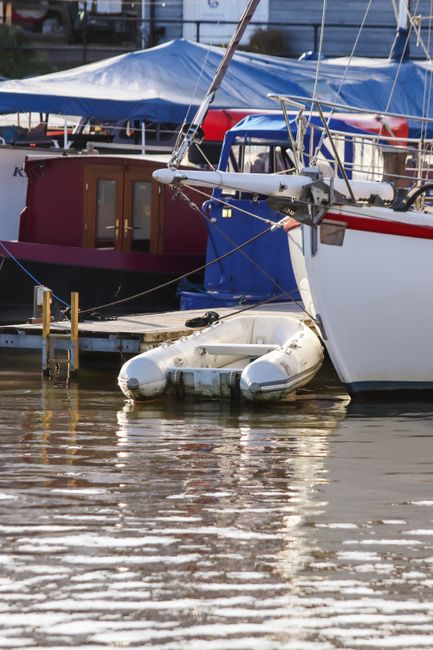
The first time you step onto a good inflatable platform, it’s a small surprise. Twenty minutes ago it was a soft roll of vinyl in a bag; now it’s a flat, firm deck floating off the back of the boat, and you can stand, kneel and sit cross-legged with a cold drink without it sagging like a pool float. The reason is a clever fabric called drop-stitch. So what is drop stitch, exactly, and why does it matter when you’re choosing a platform? Here’s the plain version.
In short: drop-stitch is two layers of airtight coated fabric joined by thousands of fine internal threads. When you pump it up, the threads pull tight at a fixed length, so the panel stays flat and stiff instead of ballooning out. Higher pressure means a stiffer panel, which is why makers give a target psi: the recreational platform makers we checked state anywhere from 3.5 to 15 psi, depending on the model.

What is drop stitch? The simple picture
Imagine two bedsheets laid one on top of the other, a few inches apart, and stitched together all over by thousands of short vertical threads, like a carpet with a second backing on top. Now coat both sheets so they’re airtight, seal the edges, and blow air in. A normal balloon would puff up into a round shape. This one can’t: every thread stops the top and bottom from moving any further apart than its own length. The air pushes outward everywhere, the threads hold the shape, and you get a flat, rigid slab.
That’s drop-stitch. The threads (sometimes called drop yarns) are commonly polyester or nylon; SUP Scout notes polyester is popular because it’s strong and barely stretches. The outer fabric is coated with PVC (or sometimes TPU) to hold the air. Earth River SUP describes the threads in many boards as 5 or 6 in long, the same as the 6 in thickness of many floating docks.
Why it makes a drop stitch platform rigid
An ordinary inflatable, like a pool float or a ring, is just a sealed bag. Its shape comes from the bag itself, so it rounds out and gets squashy when you press on it. Pump it harder and it simply bulges more, until a seam gives way. Drop-stitch works the other way round: the harder you pump, the tighter every thread pulls, and the stiffer the panel gets. SUP Scout puts it simply: the higher the pressure, the more rigid the inflatable.
For a floating platform that means three things you’ll notice on the water:
- A flat deck. You can stand and sit on it like a floor, set down a cooler, and walk to the edge.
- Firm edges. Climbing out of deep water is easier because the edge doesn’t fold under your weight.
- Packs small. Let the air out and it rolls up, because without pressure the threads are slack and the fabric folds.
It’s the same construction used in inflatable paddle boards, and it has a longer history than most people expect: according to Wikipedia’s account, Goodyear developed it in the 1950s under the name “Airmat” for inflatable airplanes. Today it is in paddle boards, inflatable dinghies, gym mats, and many of the floating platforms on this site.
On a platform, drop-stitch is what lets inflatable docks work as a step on and off a boat, what gives boat swim platforms a firm edge to climb onto, and what lets modular platforms be joined into a bigger deck. You’ll find it in many launch platforms for kayaks and paddle boards too. Our platform types guide shows them all.
How drop-stitch is made, and the layer types
The core is woven on specialist machines that weave the top and bottom fabric in parallel while running threads between them; Wikipedia notes these machines can use hundreds of needles, sometimes more than 400. The woven core is then coated, cut to shape, and the side walls (rails) are glued or welded on to seal it.
You’ll see a few construction names on product pages, mostly borrowed from paddle boards:
| Construction | What it means | What it changes |
|---|---|---|
| Single layer | One ply of fabric on top and bottom with a PVC coating | Lighter and cheaper; Earth River SUP says boards feel bouncier and are more prone to punctures |
| Double layer (laminated) | An extra sheet of PVC-coated fabric bonded over the core | Stiffer and more durable, a few pounds heavier |
| Fusion (or similar) | Two plies of fabric bonded together at the factory, PVC outside | Described as a balance of stiffness, weight and cost |
| Knitted vs woven threads | Single vertical threads vs interlaced, cross-woven threads | SUP Scout says woven is stiffer and lasts longer |
Platform makers describe their materials in their own terms. Aquaglide lists one of its lounge decks as 15 cm single-layer drop-stitch in 31 oz fabric with welded, three-layer seams. Island Hopper describes heat-welded PVC with a reinforced 1000-denier fabric layer. RAVE calls its material UV-resistant high-pressure PVC drop-stitch. There’s no single industry grade to compare, so treat these as clues and lean on the maker’s capacity rating and warranty.
PSI: what makers say
Pressure is where drop-stitch platforms differ most, and the right number is always the one the maker gives for your model. Here are the figures makers state, grouped by type and size class:
| Type and size class | Thickness | Maker’s stated pressure | Figure stated by |
|---|---|---|---|
| Lounge-shaped deck, about 15 ft | 15 cm (about 6 in) | 3.5–5 psi | Aquaglide |
| Square dock, 10 x 10 ft | 6 in | 5 psi | RAVE |
| Floating island dock with backrest | not stated | 6–8 psi, do not exceed 8 | FUNBOY |
| Square docks, 7 x 7 ft / 10 x 10 ft | 8 in | 6–8 psi / 8–10 psi | BOTE |
| Boat-size dock, 10 x 6 ft | 6 in | 8–15 psi | Island Hopper |
| Inflatable paddle boards, for comparison | varies | usually 12 up to 28 psi | SUP Scout |
Two things follow. First, don’t copy a paddle-board pressure onto a platform, or one brand’s pressure onto another: a big deck has far more surface for the air to push on, and each maker designs its seams for its own figure. Second, pressure changes with temperature. FUNBOY warns that direct sun and heat can raise the pressure inside and recommends checking it and letting some air out if needed. A pump with a gauge, or an electric pump that stops at a set psi, makes this easy.
Drop-stitch vs other floating platforms
- Foam floating mats are solid closed-cell foam about 1.4 in thick. They can’t go flat and need no pump, but they flex under you. Compare them in inflatable platform vs floating mat.
- Tube-style floating islands are classic inflatables: round air chambers, soft seats, cup holders. Comfortable, but not a firm deck. See floating lounges.
- Rigid and modular docks (plastic cubes, wood on floats) stay in the water all season and never need pumping, but they’re heavy and permanent. Our inflatable vs rigid floating docks comparison covers when each wins.
Caring for a drop-stitch platform
- Inflate to the maker’s psi, not “as hard as it goes”. Under-inflated decks feel soft; over-inflated ones stress the seams.
- Watch the heat. Check pressure on hot afternoons and keep it shaded when it’s out of the water.
- Rinse, dry, store cool. FUNBOY’s care steps are a good model: deflate fully, clean and dry it, fold it into its bag and store it somewhere cool and dry, out of direct sun.
- Keep a repair kit aboard. Many platforms ship with patches; a PVC patch kit with vinyl cement and a valve wrench covers small punctures and a loose valve.
Drop-stitch makes a platform firm, but it doesn’t make it a boat or a life-saving device. FUNBOY states its drop-stitch island is not a life-saving device and asks for adult supervision at all times; follow your maker’s capacity, depth and anchoring instructions and wear a U.S. Coast Guard approved life jacket. Our safety checklist and anchoring guide cover the rest.
Checking a drop-stitch platform: a quick inspection
Because a drop-stitch deck depends on air pressure and sealed seams, a two-minute look before each outing is worth the habit:
- Pump to the maker’s psi and read the gauge. If it won’t reach the number, or drops noticeably overnight, look for a leak before you go out.
- Run a hand along the seams and rails. Look for lifting edges, scuffs worn through the coating or glue lines that have opened.
- Check the valve. The cap should seal and the valve should sit tight; a loose valve can cause a slow leak, and a valve wrench (often in the repair kit) tightens it.
- Look at the deck surface. A flat, even deck is what you want. Anything uneven, a bubble or a soft spot is a reason to stop using it and ask the maker.
- Check the D-rings and handles. These take the load of anchor lines and people climbing out.
Soapy water sprayed on a seam or valve shows a slow leak as small bubbles, a common way to find a pinhole before patching it. Follow the repair instructions in your maker’s manual, and leave seam failures to the maker, since they are usually a warranty matter.
When drop-stitch is the right choice, and when it isn’t
Drop-stitch shines when you need a firm deck that also packs away: a platform that travels on a boat, goes home in a car, or comes out of the water every evening. It’s less suited to a platform you want to leave in the water all season with no attention, or to a busy commercial deck where a puncture would close it for the day. For year-round, set-and-forget use, a rigid dock is often simpler; our inflatable vs rigid floating docks guide and floating docks for ponds and lakes go into that choice. If kids playing is the main plan, a foam mat that can’t go flat is worth a look too.
For a short list of drop-stitch docks, see BoatSlide’s best inflatable docks. Ready to pick one? Read how to choose an inflatable platform, or browse all our guides.
Drop-stitch questions
Is drop-stitch the same as the material in inflatable paddle boards?
Yes, it’s the same idea. Paddle boards usually run at higher pressure than platforms; SUP Scout says usually 12 up to 28 psi, while the platform makers we checked state 3.5–15 psi.
Can a drop-stitch platform pop?
It can puncture, like any inflatable, though the PVC skin is tough. A puncture lets air out rather than bursting; patch it with the maker’s kit. Over-inflating past the maker’s psi stresses the seams, so stay within the stated range.
What psi should I inflate my platform to?
Exactly what your maker states for that model. It varies widely: RAVE says 5 psi for its 10 x 10 ft dock, BOTE 6–10 psi depending on size, Island Hopper 8–15 psi for its 10 x 6 ft dock.
Why are so many inflatable docks 6 inches thick?
The thickness is set by the length of the internal threads. Earth River SUP describes drop-stitch threads of 5 or 6 in in common use; some makers go thicker, such as BOTE with 8 in docks.
Does a thicker platform hold more weight?
Thicker panels flex less, but capacity depends on the whole design. Only use the capacity the maker states for that exact model; don’t estimate it from size or thickness.
Is a drop-stitch platform better than a foam mat?
Different jobs. Drop-stitch gives a firm deck and packs small; foam needs no pump and can’t go flat but flexes underfoot. Our inflatable platform vs floating mat guide compares them.
Can I leave a drop-stitch platform inflated?
Follow your maker’s instructions. Air pressure rises with heat, so check it on hot days and let some out if it’s above the maker’s range; for long storage, FUNBOY’s advice is to deflate, clean, dry and store it cool and out of the sun.
Keep exploring
See drop-stitch at work on inflatable docks and floating lounges, learn to set yours up safely in how to anchor an inflatable platform, or start from the beginning at Start here.