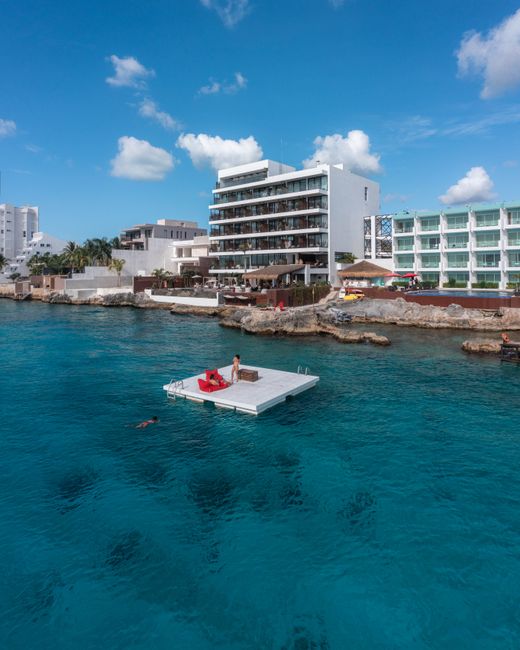
Ten in the morning at a beach club: the platform is anchored, the staff have checked the pressure, and the first family swims out. By five o’clock it has carried dozens of guests, sunscreen, wet feet, a dropped sunglasses case and at least one cannonball contest. Tomorrow it does it again. A commercial inflatable platform is built for that rhythm: repeated paying guests, season after season, with a maker who stands behind it when it is used as a business.
In short: the right commercial floating platform is the one that survives daily guest use and can be fixed fast when it gets hurt. Look first at the material, the seams, how repairs are done and what the warranty says about commercial use, then let the maker’s stated user capacity set your guest limit. A product sold for backyard use is not automatically covered, or rated, for paying guests.

What makes a commercial inflatable platform different
From the beach, a residential inflatable dock and a commercial one can look alike: a firm, flat deck on the water. The differences are in what you don’t see. Commercial makers describe heavier materials and welded seams, publish the safety standards they build to, and write warranties for business use. Aquaglide, for example, says its aquapark products use 31 oz Duratex material with hot-air welded three-layer seams and meet EN 15649 / ISO 25649, the standards for floating leisure articles. Wibit describes UV-resistant PVC built for demanding commercial environments, a three-year warranty, lifetime support with spare parts, and help with permit documents and site planning.
This page is about recreation platforms used commercially: swim decks, lounging platforms and play areas for guests. If your crew needs to stand on the water to clean hulls, inspect pilings or stage equipment, that is a different product with different paperwork: see floating work platforms. All the other types sit on our floating platform types hub.
How a commercial floating platform is built
Most commercial decks are drop-stitch: two layers of coated fabric joined by thousands of threads, so the panel stays flat and stiff when inflated instead of ballooning into a tube. Our drop-stitch explainer covers the basics. What changes for commercial use is the weight of the coating, how the seams are made and how much margin there is between working pressure and the most the panel can take.
Aquaglide gives a useful example of that margin. It says its High Pressure drop-stitch material withstands an internal pressure of up to 20 psi without damage but is used at a working pressure of 5 psi, because commercial platforms face daily pressure swings as the sun heats the air inside. It also says its seams are hot-air welded rather than glued, and that its play structures and connectors use a separate fabric with a 1000-denier polyester core developed for commercial wear. You don’t need to memorize any of that; you need to ask every supplier the same three things: what is the fabric, how are the seams joined, and what is the working pressure compared with the tested maximum?
Sizes, shapes and growing the layout
Commercial recreation platforms come in two broad forms. Single decks are rectangles or squares used as swim-out destinations and sun decks. Modular systems are made of pieces (straight walkways, corner and hub pieces, slides, climbing features) that connect into a course. Aquaglide, for instance, describes an octagonal hub piece that can link other features on all eight sides, so an operator can start small and add pieces as demand grows. If you expect to expand, ask how pieces connect, whether connectors are replaceable and whether next year’s features will fit this year’s layout. Our modular platforms page goes deeper into layouts.
The daily-use checklist
Take this table to every supplier conversation. Each line is a question the maker should answer in writing, not a number we can give you.
| Check | Why it matters on day 90 | Ask the supplier for |
|---|---|---|
| Material and weight of the fabric | Feet, sand, sun and boat contact wear the surface every day | The fabric spec and whether it is the same material used on their commercial line |
| Seams | Seam failure ends a season; patches don’t fix a seam the way they fix a pinhole | How seams are made (welded, glued) and whether seam failure is covered |
| Deck surface | Wet, crowded decks are where slips happen | The non-slip surface type and whether it can be replaced |
| Rated users and load | Your guest limit should come from the maker, not a guess | The maximum users and weight, in the manual |
| Anchoring and water depth | A platform that drifts or touches bottom is a hazard | The anchoring plan, the anchor weight they specify and minimum depth |
| Pressure and monitoring | Sun heats the air inside; over-inflation is a common warranty exclusion | Working pressure and how staff should check it during the day |
| Repairs and parts | A same-week repair saves the season | Repair kit contents, spare parts, field-repair instructions and turnaround time |
| Warranty for business use | Residential warranties can shrink or vanish under commercial use | The written term for your type of use |
| Standards and documents | Insurers and authorities may ask | Standards the product meets, the owner’s manual and the mooring diagram |
Set-up, inflation and anchoring
Inflate to the maker’s working pressure with a gauge, never by feel, and check it again once the sun is on the deck. Some commercial makers build this into the product: Aquaglide offers solar-powered gauges that show air pressure in real time. A morning reading and an afternoon reading in a log is the low-tech version, and it is often what a warranty claim will ask about.
Anchoring is where commercial and residential set-ups differ most. Aquaglide says correct mooring is critical, that improper mooring can cause excessive wear and be dangerous, and that it ships a mooring diagram with every aquapark feature. Its commercial lines use elastic sections to soften shock loads and can be adjusted in one-foot steps for different water depths. Whatever you buy, follow the maker’s anchor points, anchor weights and minimum depth. Our anchoring guide explains the basics of rope, scope and anchor types for smaller platforms.
Repairability decides your season
Every inflatable that sees heavy use will eventually get a cut, a scrape from a hull or a slow leak. What separates a good commercial purchase from a bad one is how quickly you can get it back on the water. Ask three things before you buy: Does the platform ship with a repair kit, and which glue and patch material does the maker want you to use? Are valves and the deck surface replaceable on site? And does the maker or its dealer repair seams, or only replace whole units?
Warranties shape this too. Aquaglide’s warranty excludes repairable cuts, punctures and tears from external forces, UV damage without proper treatment, damage from over-inflation (including heat build-up in the sun) and damage from exceeding the maximum weight or user capacity. It also says that in most cases an unauthorized repair voids the warranty, so you should file a claim and wait for an answer before fixing anything that might be a defect. In plain words: daily wear and accidents are your job, possible defects are the maker’s, and staff need to know which is which.
Warranty: read the commercial-use line first
Two examples show why. Aquaglide gives its lakefront products three years when used for residential purposes, but one year when used for light commercial purposes; its commercial aquapark products get three years, and it defines those as products intended, designed and sold for commercial use, including independent operators, camps and municipalities. RAVE Sports gives its reinforced-PVC docks and mats a limited lifetime warranty for personal use (which its policy says runs up to seven years), but in a commercial environment a limited three-year warranty assessed case by case. Same kind of deck, very different cover once guests pay to use it.
So ask the question directly and get the answer in writing: “We will use this at a resort/rental/camp. What is the warranty term for that use?” If the maker has a commercial line, it usually costs more and comes with the documents and support you’ll want anyway.
Care, storage and how long it lasts
The warranty exclusions double as a care manual. Aquaglide lists damage while in storage (including freezing), dragging the product, sand or debris inside, marine growth, chemicals or poor water quality, and improper cleaning among the things it does not cover. RAVE excludes over- and under-inflation, sun fading, improper storage and chlorine damage. So the routine is: carry, don’t drag; keep valves free of sand; clean as the manual says; treat for UV if the maker recommends it; and store clean, dry and protected from frost.
Nobody can honestly promise a lifespan in years. Aquaglide suggests judging an aquapark investment over three to five years rather than on the purchase price, and its own commercial warranty is three years (pro-rated in the third year). Treat the written commercial warranty as the clearest signal of what a maker expects, and ask other operators on similar water what they got from theirs.
Cost per season, without made-up numbers
Prices cover a wide range. One maker’s residential and light-commercial lakefront line ran from a few hundred dollars for a single lounge or deck to about $12,000 for its largest multi-piece mini park when we checked in October 2026; full commercial aquaparks are quoted per site. The sticker price is still the smallest part of the decision. A simple way to compare two platforms is to add up what each will really cost over the seasons you expect to use it, then divide by the days it will be open to guests:
- Purchase and delivery, plus anchors, lines and a pump suited to the working pressure.
- Staff time: inflating, anchoring, checking pressure, supervising, deflating or securing before storms.
- Repairs and parts per season, and what is not covered by the warranty.
- Storage and cleaning in the off season.
- Insurance and any permits your location requires.
- Life of the product as the maker and other operators describe it, and the warranty term for your use.
On the other side: what the platform brings in, directly (rentals, day passes) or indirectly (better reviews, a reason to book). Your own numbers matter far more than any average we could quote. Rental businesses will find a fill-in worksheet on our rental and tour operators page.
Guests per hour: let the maker set the ceiling
How many guests can use the platform at once is the maker’s number, printed in the manual, not something to work out from square feet. Your hourly flow then depends on your rules: session length, supervision, life jackets and how many staff you have on the water. The U.S. Coast Guard’s advice applies on a sunny resort day as much as on a boat: most boating-related drownings happen on nice days, and the best life jacket is the one you will actually wear. Check your state and local rules for guest swimming areas too, and run through our inflatable platform safety checklist with your team before opening day.
Who it suits, and who should choose something else
A commercial inflatable platform suits resorts, beach clubs, camps, municipal swim areas and rental businesses that put many different guests on the water every day and want something that packs away out of season. Our resorts and hotels page covers the guest-experience side. It is the wrong choice if you need a permanent walkway or boat landing that carries carts and foot traffic all year: that is the job of rigid floating docks, compared in inflatable vs rigid floating docks. And a private villa with a few guests a week may be fine with a residential deck, as long as the warranty and insurer agree.
Compare with other platform types
For kids walking on water close to shore, a foam floating mat is simpler to run. For a quiet adults-only corner, look at floating lounges. For a protected swim area away from boats and jellyfish, see sea pools. For a guest boat landing that stays out all season, rigid modular docks usually make more sense than inflatables. And for maintenance crews rather than guests, go to work platforms and our business page on heavy-duty and work access.
Commercial platform questions
Can I use a residential inflatable dock for paying guests?
Check the warranty and manual first. Some makers shorten the warranty for commercial use (Aquaglide: one year for light commercial use of lakefront products instead of three) or assess commercial claims case by case (RAVE). Ask the maker in writing, and talk to your insurer.
What standards do commercial floating platforms meet?
Makers state their own. Aquaglide says its products meet EN 15649 / ISO 25649, the standards for floating leisure articles used on and in the water, are third-party certified, and encourages buyers to ask any supplier for proof of compliance. Ask for the documents for the exact product.
How many guests can be on it at once?
Only the number the maker states in the manual. Don’t estimate it from size, and remember the warranty may exclude damage from exceeding the rated weight or user capacity.
What usually ends a commercial platform’s season early?
Damage that isn’t covered and can’t be repaired quickly: seams, valves, sun and over-inflation, and abrasion from boats or the bottom. That’s why repairability and anchoring belong on your checklist before price.
How long is a commercial warranty?
It varies by maker and use. Aquaglide and Wibit both state three years for their commercial lines. Read the exclusions as carefully as the term.
What pressure should a commercial deck be inflated to?
The working pressure in its manual, checked with a gauge. As one example, Aquaglide runs its High Pressure drop-stitch at 5 psi. Over-inflation, including heat build-up in the sun, is a common warranty exclusion, so check again in the afternoon.
Should we patch a leak ourselves?
Small cuts and punctures from outside are usually yours to repair with the maker’s kit. If it might be a defect (a seam, a valve), contact the maker first: Aquaglide, for example, says unauthorized repairs void the warranty in most cases.
Can we start small and expand later?
With modular systems, yes, if you stay within one maker’s connection system. Ask how pieces connect and which future features fit your first layout before you buy.
Keep exploring
Running a business on the water? The commercial hub has pages for resorts, marinas and rental operators, and the commercial and heavy-duty section collects the rest. If you’re still comparing options, how to choose an inflatable platform walks through the decision, and Start here covers the basics.