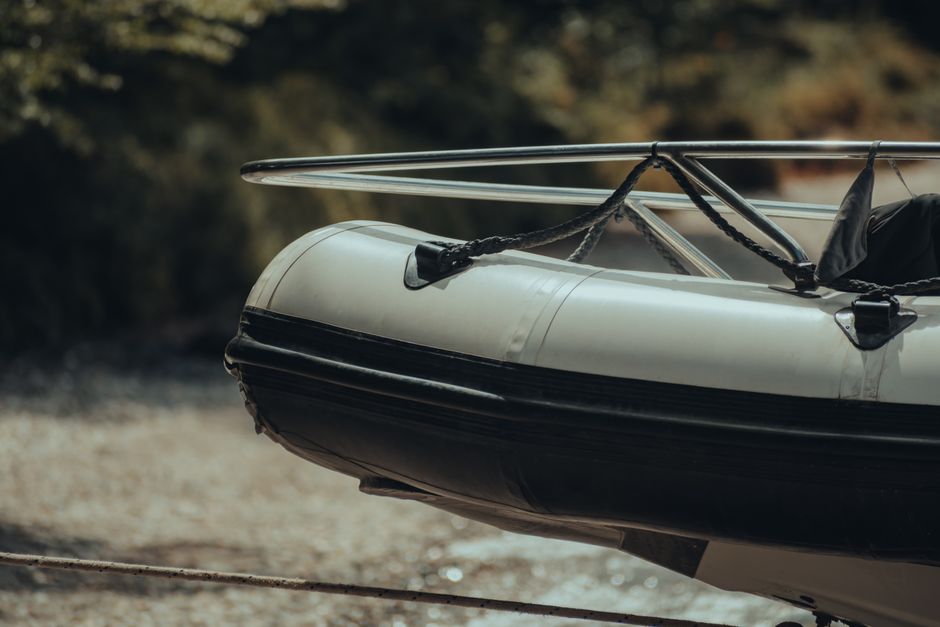
You idle up to the lake house, cut the engine, and instead of jumping into knee-deep mud or hopping awkwardly onto a fixed pier, you step onto a firm, flat deck that rides at the same height as the water. Lines go on the D-rings, the cooler comes off, the kids climb out, and the boat sits there, fenders against a soft edge, until sunset. That’s what an inflatable dock is for: somewhere to tie up, step on and off, and hang out, that you can roll up and take home. This page is about docking: how an inflatable floating dock holds a boat or jet ski, how it feels underfoot, how it’s built, how it connects to shore, how to look after it, and whether it can stay out all season.
In short: an inflatable dock is a 6 to 8 in thick drop-stitch platform pumped hard (makers state anywhere from about 3.5 to 15 psi for their own models) so you can stand and step on it. Boat-style docks around 10 x 6 ft tie alongside a boat; U, L and T-shaped docks are made for jet skis; 10 x 10 ft decks suit a lake shore. Use the tie-down points and limits the maker gives, and treat most of them as seasonal, not permanent, docks.
Can you tie up to an inflatable dock?
Yes, within limits, and that’s what the D-rings are for. A good inflatable floating dock has stainless D-rings on several sides so you can run lines to a boat’s cleats or to anchors. RAVE’s 10 x 10 ft dock, for example, has 8 D-rings plus 2 dedicated anchor points underneath; Island Hopper’s 10 x 6 ft boat dock has stainless side D-rings and rubber bumpers on all four corners, which the maker says absorb impact from a boat hull, dock posts and the shoreline.
Makers are cautious about what you tie to. RAVE’s owner’s manual warns that tethering its dock to boats, docks or other hard objects increases the potential for injury, tells you to keep it away from engines and propellers, and says not to connect it directly to docks, piers or other hard objects. So read your own manual before you tie a boat alongside. And an inflatable dock is not a mooring for leaving a boat unattended in wind and waves: it floats on the surface and moves with the water, so treat it as a place to tie up while you’re there. For a jet ski that lives on the water, rigid drive-on ports exist; our guide to the floating dock for a jet ski compares both.
Matching the dock to your boat or jet ski
Makers design different shapes for different jobs. This table shows the shapes and size classes sold for each kind of craft, from maker pages and retail listings we looked at in October 2026. It describes what each shape is pitched for; it is not a load or mooring rating. Always check the maker’s own limits for your boat and conditions.
| What you’re docking | Shapes makers sell | Size classes seen | Thickness | Attachments to look for |
|---|---|---|---|---|
| Jet ski / PWC | U, L, T and E shapes that wrap the hull | U shapes around 8 x 8 ft with a slot about 4 ft wide; E shapes up to about 15 x 8 ft with two slots; narrow L step-offs about 2 ft wide | 6 in | Bumper edges, D-rings top and bottom, mooring ropes |
| Ski boat, pontoon, small cruiser | Rectangular boat dock alongside or off the stern | About 10 x 6 ft | 6 in | Corner bumpers, side D-rings, grab handles |
| Yacht or sailboat swim deck | Long docks and swim-step extensions | 10 x 6 ft and longer | 6 in | Ladder, handles on every side, a way to join two docks |
| Lake shore or private pier | Square decks and anchored lounge decks | About 7 x 7 to 10 x 10 ft; lounge decks about 15 x 15 ft | 6–8 in | Anchor points, handles for climbing out of deep water |
How an inflatable dock is built
The core is a single drop-stitch chamber: top and bottom skins of coated fabric joined by thousands of threads, so the dock stays flat when pumped hard. Most docks are 6 in thick; some, like BOTE’s, are 8 in. Makers build the skin differently: Island Hopper describes heat-welded PVC with a reinforced 1000-denier outer fabric and no glued edges or corners, Aquaglide a 15 cm single-layer drop-stitch with welded seams, and RAVE a high-grade drop-stitch PVC. On top sits a non-slip foam pad, usually EVA, either across the whole deck or in zones. Around it you’ll find handles (RAVE puts ten neoprene-covered ones on its 10 x 10 ft dock), stainless D-rings, anchor points and, on boat docks, corner bumpers.
Shape follows the job. Squares give the most room per foot of edge and suit a lake house. Rectangles about 6 ft wide fit off the back of a boat; Island Hopper points out that a 6 ft beam is what lets its dock be launched off smaller boats where a 10 ft platform couldn’t. U, L, T and E shapes leave a slot or a long edge for a jet ski. Weight goes up with size: makers list about 35 lb for a 7 x 7 ft deck and 53 to 83 lb for 10 x 6 to 10 x 10 ft docks, so the bigger ones are a two-person carry.
How stable is it underfoot?
Stepping from a boat onto a dock is where people slip, so the feel underfoot matters more than any spec. Drop-stitch construction joins the top and bottom skins so a properly pumped dock stays flat instead of bulging like a pool float (our page on what drop-stitch is explains why). Three things make it firmer: the right pressure (RAVE states 5 psi for its 10 x 10 ft dock, BOTE 6 to 10 psi depending on size, Island Hopper 8 to 15 psi), a non-slip foam top such as EVA, and a wider deck. It still rides the water: it rises with a wake and dips if everyone stands on one edge, and RAVE’s manual reminds owners that a floating product is not a stable surface and can shift quickly. A heavy rigid dock moves less, which our inflatable vs rigid floating docks comparison covers.
Setting up and inflating
Most docks come with a double-action hand pump, a carry strap or bag and a repair kit. Unroll the dock on a flat surface clear of sharp objects, or on a flat part of the boat with the motor off, as RAVE’s manual describes. Island Hopper says its 10 x 6 ft dock inflates in about 8 minutes with the included hand pump; bigger, higher-pressure docks take longer, and an electric pump that stops at a set pressure takes the effort out. Pump to the pressure printed for your model and no higher: RAVE says not to inflate its dock beyond 5 psi to avoid damage. If you inflate on land, carry it to the water with two or more people.
Connecting to shore or a fixed dock
At a lake house, the usual approach is to anchor the dock off the shore or beside a pier, rather than lashing it tight to a hard structure, because makers like RAVE warn against connecting directly to docks and piers. Use the anchor points so the wind can’t swing it. Some makers set minimums: RAVE asks for at least 4 ft of water under its docks; Aquaglide’s anchored lounge deck needs at least 4.8 ft of water, 3.3 ft from shore, and a total anchor weight of 4,400 lb, and the maker recommends a dock and mooring specialist. Our anchoring guide walks through anchor types, rope and scope, and floating docks for ponds and lakes covers smaller water. Placing any structure in public water can need a permit; in navigable U.S. waters the Army Corps of Engineers regulates structures, so check with your state and local authority before you set up a permanent spot.
Can it stay out all season?
Some are built to be anchored in place, but most are built to come in. Aquaglide’s lounge deck is designed for an anchored installation with heavy weights. RAVE, on the other hand, tells owners to deflate and store its dock when it’s not in use, and one jet ski dock seller describes its inflatable docks as made for temporary docking. If you keep a dock out for days at a time, keep it at the maker’s pressure (air expands as it warms in the sun), rinse off grime, check D-rings and seams, and bring it in before storms. RAVE also notes that keeping full pressure while it’s on the water discourages muskrats from chewing the vinyl. The National Weather Service says to get out of and away from lakes and other water immediately when lightning threatens.
Care, storage and lifespan
RAVE’s owner’s manual gives a routine that works for any inflatable dock. Carry it to land, or deflate it on a flat part of the boat, without dragging it. Wash it with mild soap and fresh water; never use petroleum-based cleaners, solvents or a power washer, which the maker says will damage it beyond repair. Let each side dry in the sun for 15 minutes or more, towel off what’s left, then fold and roll it loosely. Store it completely dry in a cool, dry, shaded place, off bare concrete and in a container rodents can’t chew through. For small holes, the included kit’s patches go on with glue and need a day to cure; for large tears or seam failures, contact the maker.
How long will it last? No maker gives a number of years, and sun, storage and how it’s handled make the biggest difference. Warranties show what makers stand behind: Island Hopper gives five years with registration, RAVE a limited lifetime warranty for personal use, Aquaglide three years against manufacturing defects on its lounge deck, and BOTE two years. Read the terms: several cover personal use only.
What an inflatable dock costs
From makers’ own price lists in October 2026, drop-stitch docks from 10 x 6 ft to 10 x 10 ft were listed at roughly $750 to $1,000, and a large anchored lounge deck at about $2,000. Jet ski docks from lesser-known brands at a major retailer ran from under $200 for a narrow L-shaped step-off to around $670 for a large two-slot E shape. Budget too for an electric pump if you don’t want to hand-pump to high pressure, anchors and line, and a ladder if you’ll climb up from deep water. Whatever the price, compare the maker’s stated rating, warranty and minimum water depth before anything else; how to choose an inflatable platform walks through that.
Who an inflatable dock suits, and who should pick something else
An inflatable dock suits you if you want a firm place to step on and off a boat or jet ski for the day, you have no fixed dock or want a second one further out, you’ll take it home or store it at the end of the season, or you travel with the boat and need something that rolls into a bag. It’s also a good fit for renters and second-home owners who can’t build anything permanent.
Pick something else if the boat or ski needs to live on the water all summer (a rigid drive-on port or a fixed dock is made for that), if you want a dock that stays in place for years with minimal setup (look at rigid modular platforms), if the main point is a protected swim spot behind a yacht (see boat and yacht swim platforms), or if kids just want something soft to run and bounce on (a floating mat is cheaper and simpler). And if you need to carry crews, tools or equipment, no recreational dock is the answer; that’s what engineered work platforms are for.
Compare with other platform types
An inflatable dock sits in the middle of the family. A boat swim platform is the same idea shaped and fitted to travel with a boat, with the focus on how many people fit and what they do at anchor. Launch platforms trade deck space for easier entry and exit from kayaks, paddle boards and jet skis. Modular platforms connect into bigger or odd-shaped layouts; note that not every inflatable dock links up (RAVE says its 10 x 10 ft dock doesn’t connect to its other products, while its Aqua Mat Deluxe models have connection features). For the soft alternative, read inflatable platform vs floating mat, and for the permanent one, inflatable vs rigid floating docks. All nine types are side by side on floating platform types.
Before you choose an inflatable dock
- Count the D-rings and where they are. You want points on the boat side, the anchor side and underneath.
- Check the edge. Bumpers or soft rails protect gelcoat when the boat rocks against it.
- Use the maker’s limit. Go by the stated weight and people count, never a guess from the size. If none is stated, ask.
- Check the minimum depth in the manual against the water where it will sit.
- Read what it may be tied to. Some makers say not to connect directly to docks, piers or other hard objects.
- Plan the pump. Hand pumps come with most; an electric pump makes 10 to 15 psi much easier.
- Wear life jackets. The U.S. Coast Guard urges everyone to wear a USCG-approved life jacket, and federal law requires children under 13 to wear one on a vessel underway (state rules can differ). Our safety checklist covers the rest.
For a short list of picks, see BoatSlide’s best inflatable docks.
Inflatable dock questions
Can I leave my boat tied to an inflatable dock overnight?
Makers sell these docks for tying up while you’re aboard or nearby, not as unattended moorings, and some advise against tethering to boats at all. Wind, wakes and storms can push a boat against a floating dock all night. Use your proper mooring or slip overnight.
Is it easy to step from a boat onto an inflatable dock?
Easier than from a ladder, because the deck sits low and flat on the water. Pump it to the maker’s pressure, keep the foam top clean, and step onto the middle rather than the edge.
How thick should an inflatable dock be?
Six inches is the common thickness for boat, lake and jet ski docks, and some docks, such as BOTE’s, are 8 in. Thicker docks generally flex less, but pressure and width matter too.
How long does it take to set up?
Island Hopper says about 8 minutes to inflate its 10 x 6 ft dock with the included hand pump, plus a few minutes to anchor or tie off. Bigger, higher-pressure docks take longer, and an electric pump speeds things up.
How much does an inflatable dock cost?
In October 2026, makers listed 10 x 6 to 10 x 10 ft drop-stitch docks at roughly $750 to $1,000 and a large anchored lounge deck at about $2,000. Jet ski docks from lesser-known brands started under $200.
How long does an inflatable dock last?
Makers don’t give a lifespan in years. Warranties run from two years to a limited lifetime for personal use. Cleaning with mild soap, drying fully, and storing it shaded, cool and away from rodents make the biggest difference.
Can I connect two inflatable docks together?
Only if the maker designed them to connect. Some models have link points; others, such as RAVE’s 10 x 10 ft dock, don’t connect to other products. If you want to grow a layout over time, look at modular platforms.
Can an inflatable dock be used as a work platform?
No. A recreational dock’s stated capacity is for people relaxing and swimming. Construction, inspection or maintenance access needs an engineered platform with documented ratings; see work platforms.
Keep exploring: browse all inflatable docks articles, see the jet ski side in floating dock for jet ski, hold your dock in place with how to anchor an inflatable platform, or go back to Start here for the big picture.