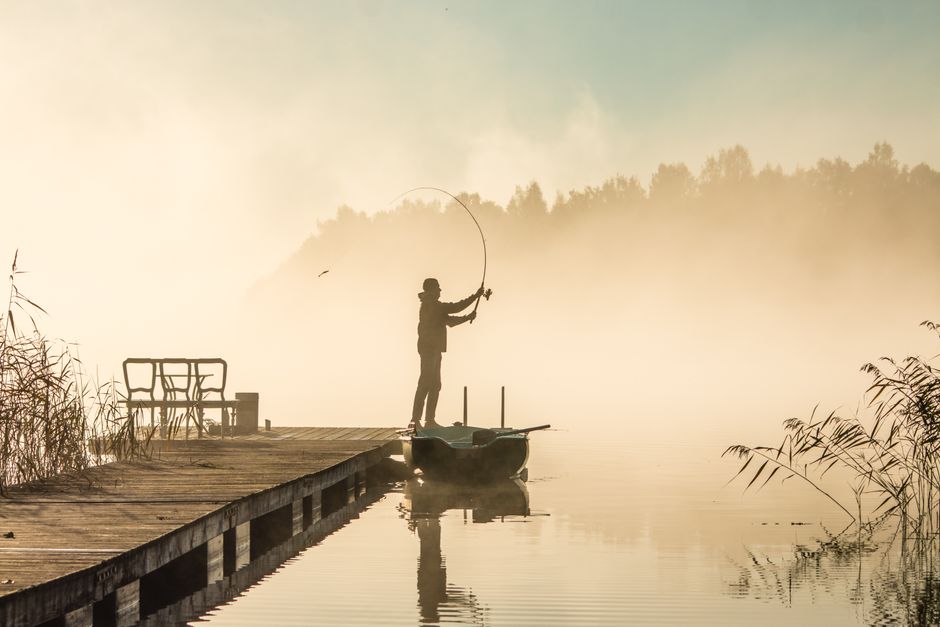
Mist is still lifting off the cove when you paddle the platform out to the weed line you’ve been casting at from shore all summer. Drop the anchor, set the tackle box down where it won’t slide, and for the first time you’re fishing the water instead of the bank: standing, casting both ways, coffee within reach. A floating fishing platform gives you that spot on the water without a boat, or adds a steady deck next to the boat you already have.
In short: a good fishing platform for a lake is firm enough to stand and cast from, holds you plus your gear within the maker’s stated capacity, and anchors securely. A drop-stitch inflatable dock is the steadiest standing deck; a smaller fishing-specific platform with oars lets you move between spots; a foam mat is fine for kids dangling a line but too flexible to stand and cast on. Keep hooks and knives packed away from inflated fabric.
This page is one of our Explore by Use guides. New to inflatable platforms? Start here.
What a fishing morning asks of a platform
Fishing is slow, quiet and full of sharp things, and that changes what matters compared with a swim or party platform.
- Standing stability. You’ll stand, turn and cast for hours. A thick, high-pressure drop-stitch deck stays flat; a foam mat bends under your feet.
- Room for gear. Rods, a tackle box, a cooler, a net, a bucket. D-rings to strap things down keep them from sliding off when you shift your weight.
- Getting there. Will you paddle out, bring it on a small boat, or leave it anchored off your shoreline? That decides between a portable platform and a bigger dock.
- Holding position. Drift ruins a good spot. Anchor points on the platform and a proper anchor are essential, not extras.
- Living with hooks. Every inflatable can be punctured. A tough outer layer helps, and a tidy deck helps more.
Which floating platform suits your fishing style?
| How you fish | Platform type | Why | What to check |
|---|---|---|---|
| Off your own shoreline, same spots every week | Drop-stitch dock, anchored for the season or the day | The steadiest standing deck; room for two anglers and gear | Maker’s capacity and minimum water depth; anchor points |
| Moving between coves on a pond or small lake | Compact fishing platform with oars | Light enough to carry, paddle and re-anchor | Who states the capacity (maker or only a seller); D-rings; oar or motor mounts |
| From the boat, at anchor | Swim-style dock tied to the stern | Extra standing room and a low spot to land fish | Bumpers or soft edges; tie-off points (see boating and yachts) |
| Kids with a line and a bobber | Foam mat or a small dock close to shore | Low and easy to climb back onto | Life jackets on; hooks handled by an adult; the maker’s minimum depth |
Three ways to use a fishing platform for the lake
1. The anchored casting deck
A large inflatable dock anchored over a drop-off or along a weed edge becomes your own little fishing pier. Makers of 10 x 6 ft and 10 x 10 ft drop-stitch docks rate them for 1,500 to 1,800 lb (Island Hopper and RAVE, for example). For fishing, the outer skin matters: Island Hopper describes a reinforced 1000-denier outer fabric that it says handles UV exposure, oil stains and abrasion, with heat-welded seams. RAVE asks for at least 4 ft of water under its 10 x 10 ft dock. For a deck that stays out all season, read floating docks for ponds and lakes, and if you’re weighing an inflatable against a wooden or plastic dock, see inflatable vs rigid floating docks.
2. The roaming platform
Smaller fishing-specific platforms trade deck space for portability. Some are sold with oars, a pump, stainless D-rings and mounting points for a small outboard. Many come from lesser-known brands whose capacity figures appear only in a seller’s listing, so ask for the maker’s documentation before you trust a number. If you add a motor, check your state’s rules on registration and equipment first; the U.S. Coast Guard keeps a directory of state boating laws.
3. The boat-side deck
Tied off the stern of an anchored boat, a dock adds a low, wide spot to cast from, land a fish or let the kids fish while the adults use the boat. Use two lines so it can’t swing, keep it clear of the propeller and exhaust, and pull it in before you start the engine. The boat swim platforms guide covers sizes and attachment.
Holding your spot: anchoring for anglers
A platform catches wind like a sail, so anchoring is half of fishing from one. A few principles from boating courses carry over. BoatUS recommends a scope (line length to depth) of about 7:1, or 5:1 for a small boat with a light anchor in good weather, and notes that lightweight anchors hold best in hard sand or mud, not very soft mud or grass. Mushroom anchors are sold for soft, muddy or weedy bottoms on small craft in protected waters. For a big dock left out, makers set their own numbers: one suggests 150 to 200 lb of anchor weight for its 10 x 10 ft dock, depending on the lake and bottom. Two anchors, one at each end, also stop a platform from swinging while you cast. Our full guide to anchoring an inflatable platform walks through anchor types, rope and scope.
Hooks, knives and inflatables
- Keep lures and loose hooks in a closed tackle box, not on the deck.
- Bring a small cutting board for bait and fillets. Never cut directly on the platform.
- Rinse off fish slime and bait after each trip with mild soap and water; dock makers advise against solvents and petroleum products on the fabric.
- Carry the maker’s repair kit, and check pressure in the morning: a deck that’s gone soft overnight needs a look before you stand on it.
- Left out overnight? One dock maker warns that muskrats and other rodents can damage a dock, and suggests keeping it at full pressure or taking it out at night.
Why drop-stitch docks shrug off standing weight but still fear a hook point is explained in what is drop stitch.
Sizes and cost for a fishing deck
| Size class | What makers state (example) | Suits |
|---|---|---|
| Small dock, about 6 x 5 to 8 x 5 ft | 3 to 5 or 4 to 6 persons (Solstice) | One angler and gear; a kid’s first fishing spot |
| Wide dock, about 10 x 6 ft, 6 in thick | 1,500 lb (Island Hopper) | Two anglers; tied to a boat |
| Large dock, about 10 x 10 ft, 6 in thick | 1,800 lb, 10 adults or 14 children (RAVE) | A season-long casting deck off the shoreline |
The drop-stitch docks whose makers we checked in October 2026 listed from about $350 for smaller sizes to about $800 for a 10 x 10 ft deck. Remember that these are recreational products: their stated capacity is for recreational use, not for work. For a short list of dock picks, see BoatSlide’s best inflatable docks.
A dawn session, start to finish
The night before, you check the forecast and the wind direction, and pack the rods in tubes, the tackle in a closed box, a cutting board, the repair kit, a pump and two anchors with line. At first light you inflate the platform on the shore to the maker’s pressure, put on your life jacket, and paddle out to the edge of the weed bed. One anchor goes upwind, the second off the other end, so the platform holds square to the spot. You fish standing in the middle, keeping your weight off the very edge on hard casts. When the breeze picks up mid-morning, you pull the downwind anchor first, then the upwind one, and paddle back with the wind behind you. Back on shore: rinse, dry in the shade, and check the deck for nicks before you roll it.
Licenses, rules and weather
- Fishing license. Licenses are issued by the states, and the U.S. Fish and Wildlife Service notes every state has slightly different rules. Most sell them online, by phone or at stores.
- Leaving a platform out. A dock anchored for the season may need permission. Minnesota, for example, requires a county sheriff’s permit for swimming rafts that don’t extend from shore to stay in the water from sunset to sunrise. Ask your lake association or state agency before you set one.
- Life jackets. Wear one, especially alone at dawn. The National Weather Service warns cold water can cause involuntary gasping, and that a life jacket significantly increases the chances of survival.
- Lightning. Holding up a long rod on open water in a storm is a bad idea. The NWS notes that most lightning injuries and deaths on boats happen on small boats with no cabin, says to get away from lakes when thunder roars, and to wait 30 minutes after the last thunder.
More in our inflatable platform safety checklist.
Fishing platform checklist
- You, your gear and any second angler within the maker’s stated capacity.
- Inflated to the maker’s pressure; checked again before you stand on it.
- Two anchors and enough line for the depth; the maker’s anchor points used.
- Hooks and knives in closed boxes; a cutting board for bait.
- Repair kit and pump aboard.
- Life jacket worn; phone in a dry bag; someone on shore knows where you are.
- Fishing license for your state; permission if the platform stays out.
- Forecast checked; off the water before storms.
Floating fishing platform questions
Can you stand and fish on an inflatable platform?
On a firm drop-stitch platform, yes; that’s what makes them feel like a deck. Stay within the maker’s stated capacity, keep your weight away from the very edge when casting hard, and anchor it so it doesn’t spin.
Will a fishhook pop an inflatable dock?
A hook or knife can puncture any inflatable. Docks with a heavier, reinforced outer fabric add some protection, but the real fix is keeping hooks in the box and carrying the repair kit.
Is a fishing platform better than a kayak?
They do different jobs. A kayak covers distance; a platform gives you room to stand, spread out gear and fish with a friend in one spot. Many anglers use a kayak to explore and a platform as a base; our launch platforms page covers getting in and out of a kayak from one.
How do I keep a fishing platform in one place?
Use the anchor points the maker provides. A small mushroom anchor holds a light platform in calm, shallow water with a soft bottom; bigger docks and windy spots need heavier anchoring, set as the maker recommends. Two anchors, one at each end, also stop it swinging.
Do I need a fishing license on a private pond?
Rules differ from state to state, so check with your state’s fish and wildlife agency before you fish, even on private water.
Can I put a trolling motor on an inflatable fishing platform?
Only if the maker provides motor mounts and says so. Adding a motor can also change how your state treats the platform for registration and equipment, so check the state rules in the Coast Guard’s directory first.
How deep should the water be under a fishing platform?
At least the maker’s minimum; for example, RAVE asks for 4 ft under its drop-stitch docks and Aqua Lily Pad 6 ft under its foam mats. Deeper water also helps keep the platform off rocks and stumps.
Keep exploring
Bringing the family along? See family lake days; paddling out at dawn, read water sports and fitness; planning a bigger day on the water, try fun and recreation; still choosing your deck, use how to choose an inflatable platform; and every use guide is in the uses category.