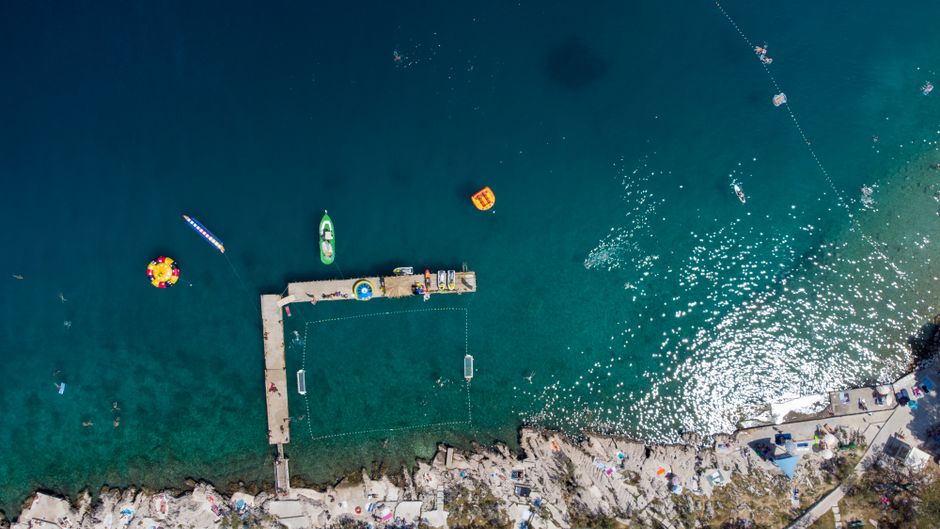
Seven-thirty on a July morning at the beach kiosk. The pump is humming, the first group has booked a platform for ten, the boat tour leaves at nine with a swim stop on the way, and by six tonight everything has to be rinsed, dried, checked and ready to go again. If you run an inflatable platform rental business, a tour boat or a watersports center, you don’t buy a platform for a perfect day. You buy it for the hundredth day. This page is built around the three things that decide whether it pays: will it last, how fast can the team turn it around, and will it earn back what it cost?
In short: for rentals and tours, choose platforms the maker supports for commercial use, keep fast pumps and repair kits on hand, and work out return on investment with your own prices, days open and costs. Consumer warranties often change or end under commercial use, so get the terms in writing.

Durability: what survives a rental season
Rental gear gets dragged on sand, sat on with wet sunscreen, over-inflated in the sun and packed away damp. Three things decide how long it lasts.
- Construction. Inflatable drop-stitch platforms are firm and pack small (our drop-stitch explainer shows why); foam mats can’t deflate but can tear and are bulky to store, as our platform vs mat comparison explains. Commercial aquapark makers describe heavier fabrics and welded seams; Aquaglide, for example, describes 31 oz fabric and hot-air welded three-layer seams on its commercial line. Ask each maker which fabric and seams a model uses.
- Warranty under commercial use. This is where consumer products surprise operators. RAVE Sports’ warranty policy says heavy commercial use falls under a separate warranty assessed case by case; its reinforced-PVC products, which carry a limited lifetime warranty for personal use (up to seven years, by its policy), get a limited three-year warranty in a commercial setting, assessed case by case, and its Splash Zones drop from three years to six months. Aquaglide gives its lakefront products three years for residential use but one year for light commercial use, and three years for its commercial aquapark line. Other makers differ, so ask before you buy a fleet.
- Repairability. A small puncture should cost an hour, not a season. Choose PVC products that can be patched, keep the right glue and patches on site, and ask the maker about spare valves and parts. Check the warranty’s repair rules too: Aquaglide, for example, says an unauthorized repair voids its warranty in most cases, so suspected defects go to the maker first.
Turnover: from the van to the water and back
Every minute of pumping is a minute nobody is paying for. Makers state their own inflation times and pressures, so time your crew with your own platforms and pumps. A common pattern is a fast, high-volume inflator for the first fill and a hand or high-pressure pump to finish: one work-float dealer, for example, suggests a battery inflator to about 1 psi, then the hand pump to the working pressure. And check pressure again later in the day: Aquaglide notes that platforms face daily pressure swings as the sun heats the air inside, and over-inflation, including heat build-up, is a common warranty exclusion.
| Turnover step | What speeds it up | What to check |
|---|---|---|
| Inflate | An electric pump that stops at a set pressure, finished with a gauge check | The maker’s pressure, valve type and pump fitting |
| Launch and anchor | Pre-rigged anchor lines and a marked spot | The maker’s anchor points and minimum depth |
| Hand over to guests | A two-minute safety briefing, life jackets ready | The maker’s rated capacity, posted on the platform |
| Recover and rinse | Fresh-water hose station, deflate function on the pump | Sand in valves, scuffs, seam wear |
| Dry and store | Shade racks; dry before rolling | Mildew, folds in the same place, repair log |
Will an inflatable platform rental business pay? Use your own numbers
We won’t guess what you can charge or how many days you’ll rent; that depends entirely on your location and season. What we can give you is the worksheet. Fill in the right-hand column with your figures.
| Line | Where the number comes from | Your figure |
|---|---|---|
| Platform price plus shipping | Supplier quote | |
| Pumps, anchors, lines, repair kits, life jackets | Supplier quotes | |
| Expected seasons of use | Commercial warranty in writing, plus the maker’s advice | |
| Days open per season | Your calendar and weather history | |
| Paid rentals or tour stops per day | Your booking records | |
| Price per rental or added to a tour | Your price list | |
| Staff time per turnover | Time your crew on a real day | |
| Insurance, storage, repairs per season | Insurer, landlord, repair log |
Revenue per season = days open × paid rentals per day × price. Cost per season = (equipment ÷ expected seasons) + staff time + insurance + storage + repairs. If revenue per season clears cost per season with a margin you are comfortable with, the platform pays its way. For a tour operator, the platform may not be rented on its own at all: it is part of what makes the swim stop worth booking, so look at bookings and reviews too.
Watersports center equipment checklist
- Platforms the maker supports for commercial use, with the capacity and minimum depth on file.
- At least two electric pumps (one as a spare) plus a manual pump.
- Repair kits matched to the material: PVC glue and patches, valve wrench, spare valves.
- Anchors and lines sized as the maker states, plus spare clips.
- US Coast Guard-approved life jackets in a range of sizes. The Coast Guard’s advice: the best life jacket is the one you will wear.
- A written weather rule (wind, storms) for when platforms come in, and a damage and inspection log.
- Waivers and rental terms reviewed by your insurer and a local lawyer.
Where you set up matters too. In US navigable waters, a platform that stays moored can count as a structure for the Army Corps of Engineers, and marked swim or rental areas may need buoy approvals from your state or the Coast Guard. Check with the local authority before your first season.
Which platform types work for rentals and tours
| Business | Platform type that usually fits | Why | Watch for |
|---|---|---|---|
| Beach rental kiosk | Inflatable drop-stitch decks and foam mats | Quick to launch from the beach; easy for groups | Commercial warranty terms, sand in valves |
| Boat tour with a swim stop | A deck that packs onto the boat | Inflated at anchor or carried inflated, then packed away | Deck space on board, tie-off points, the maker’s capacity |
| Watersports center | Launch platforms for kayaks and SUPs | Easier entry and exit for beginners | Craft and rider weights the maker states |
| Day-pass attraction | Commercial recreation platforms or a modular aquapark | A headline experience people pay for | Staffing, mooring plan, standards certificates |
A season with a tour boat swim stop: a practical scenario
A small operator runs two half-day snorkel trips and wants a better swim stop. Here is one way the first season could go. It’s an illustration; the real limits come from the maker’s manual, the boat’s capacity and local rules.
- Before buying: the owner asks two makers for warranty terms for tour use in writing, the stated capacity and minimum depth, the attachment points and the working pressure, and checks with the insurer.
- On the boat: the deck rides deflated in a bag. At the swim stop the crew inflates it with the 12V pump, finishes with a gauge, ties it off downwind of the boat at the maker’s D-rings and briefs guests in two minutes: capacity, life jackets, no diving off the edge.
- During the stop: one crew member watches the platform and swimmers the whole time; the platform comes in if the wind or swell picks up.
- Back at the dock: rinse, check seams and valves, log any damage, dry in the shade before packing.
- End of season: the operator fills in the worksheet above with real numbers and compares bookings and reviews with last year’s.
Our anchoring guide covers tie-off and anchor basics, and the safety checklist is a good base for your guest briefing. Running fitness classes or SUP tours from a platform? See water sports and fitness.
Daily turnover checklist
- Pressure checked with a gauge against the manual, morning and afternoon.
- Deck, seams, valves, handles and D-rings inspected before the first rental.
- Anchor lines and clips checked; platform at the maker’s minimum depth.
- Maker’s capacity posted on the platform and given in every briefing.
- Life jackets in the right sizes, handed out and fitted.
- Weather rule applied; platforms in before wind or storms build.
- Carried, not dragged; rinsed, dried in shade, logged and stored.
Rental and tour operator questions
Can I rent out a consumer inflatable platform?
Ask the maker first. Consumer warranties are often for personal use, and commercial use may get a shorter or case-by-case warranty. Your insurer may also have conditions on the equipment you rent out.
How long does an inflatable platform last in rental use?
There is no honest single answer: it depends on the product, the sun, sand, salt and how well it’s rinsed, dried and repaired. The commercial warranty the maker gives you in writing is the best guide to what they expect.
What pump should a rental business use?
An electric pump that reaches the maker’s pressure, shuts off automatically at the set pressure and can deflate too. Keep a spare and a manual pump for the day one fails.
How many guests can use a rental platform?
Only as many as the manufacturer states for that model. Put the number on the platform and in your briefing, and lower it in rough conditions.
Is a platform worth it for a boat tour?
Often the value shows up in bookings rather than a rental fee: a better swim stop can make the tour easier to sell. Use the worksheet above with your own figures to decide.
Does the warranty cover damage from guests?
Usually not. Warranties cover manufacturing defects; RAVE and Aquaglide both exclude cuts and punctures from use, over-inflation and improper storage. Budget for repairs and keep a log.
Foam mat or inflatable deck for a rental fleet?
Mats are simple and need no pump, but they’re bulky and can tear; inflatable decks are firmer, pack small and need pumping and pressure checks. Many operators use both for different groups.
Equipping a rental fleet or tour?
Tell us about your business: where you operate, what you rent or run, your season and your group sizes. We’ll reply with the questions to put to suppliers and the kind of equipment to look at. Send a business inquiry.
Keep exploring
Working with a hotel or a marina? See resorts and hotels and marinas, or go back to the commercial overview. Need a platform for maintenance rather than guests? Read heavy-duty and work access. The commercial and heavy-duty category collects the rest, and Start here covers the basics.