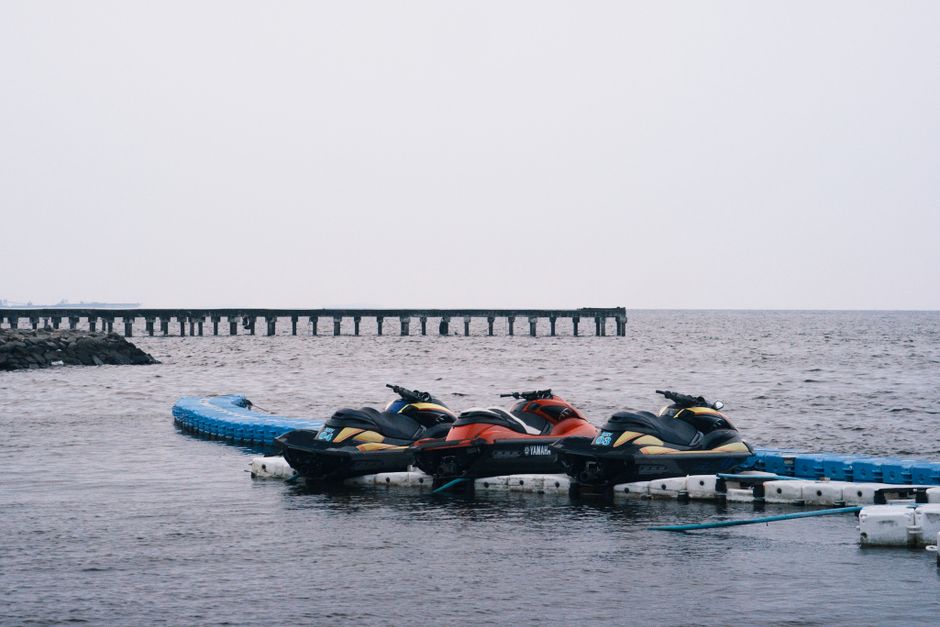
The best part of a jet ski day is the bit nobody films: idling back to the cabin at golden hour, sliding up to something solid, and stepping off dry instead of wading in and dragging the ski off the sand. A floating dock for jet ski owners gives your PWC a place to rest that rises and falls with the lake, and gives you a clean step on and off. There are two very different kinds: soft inflatable docks that roll up into a bag, and rigid drive-on ports you power onto and that stay out all season. This guide compares them: how each works, the shapes and sizes, what makers state about weight, what they cost, and how to look after them.
In short: an inflatable jet ski dock (U, L, T or E-shaped drop-stitch, listed from under $200 to around $670 in October 2026) is a portable place to tie up and step off for the day. A drive-on PWC port (rotomolded plastic with rollers or wheels, about $1,700 to $2,700 per port at list) lets you drive the ski partly out of the water and leave it there all season. Pick inflatable for travel and day use, drive-on for a home dock.
Two kinds of floating dock for jet ski owners
Inflatable jet ski docks are 6 in thick drop-stitch PVC, the same construction as inflatable paddle boards, pumped hard with a hand pump. They come in shapes that wrap around the ski: a U with a slot you nose into, an L you tie alongside, a T, or a big E with two slots. They have an EVA foam top for grip, D-rings for mooring lines, and soft edges that work as a fender. Most roll up into a bag that fits in a trunk. Our drop-stitch explainer shows why a pumped-up deck this thin can still feel firm.
Drive-on PWC ports are rigid floating cradles made of rotationally molded polyethylene. You idle up, give a little throttle, and the hull rides up a set of rollers or wheels until a bow stop catches it. The ski sits mostly out of the water, and you back off to launch. They attach to an existing floating or fixed dock (or float on their own, anchored) and are designed to stay in the water for the season. Wave Armor, for example, describes its smallest port as foam-filled polyethylene with 12 adjustable wheels and a rubber bow stop; EZ Dock says the adjustable roller system on its EZ Port 2i adapts to different hull shapes.
Inflatable vs drive-on: how they compare
| Inflatable jet ski dock | Drive-on PWC port | |
|---|---|---|
| What it is | Drop-stitch PVC, 6 in thick, EVA top | Rotomolded polyethylene, often foam-filled, with rollers or wheels |
| Where the ski sits | In the water, tied in a slot or alongside | Mostly out of the water on the port |
| Setup | Pump up, tie off, deflate and pack after | Installed and connected to a dock or anchored; stays out |
| Portable? | Yes, rolls into a bag; a U-shaped one we saw weighs 39 lb | No; one maker lists 180 lb for its smallest port and 350 lb for a larger one |
| Weight rating | The listings we checked state none in pounds | Stated by makers, for example 700 lb for Wave Armor’s smallest port and 1,700 lb flotation capacity for EZ Dock’s EZ Port 2i |
| Typical price, Oct 2026 | Under $200 to around $670 | About $1,700 to $2,700 per port at list, before installation |
| Best for | Day trips, rentals, lake houses without a dock, boat-side docking | A home or marina dock where the ski lives all summer |
The same air-vs-plastic trade-off applies to docks in general; inflatable vs rigid floating docks goes deeper on stability, cost and how long each lasts.
Inflatable jet ski dock shapes explained
The shape decides how you dock, so it’s worth picking before anything else.
- U shape: a deck with a slot you nose the ski into, so there’s dock on three sides. U docks we saw were around 8 x 8 ft, and one maker gives its slot as 4 ft wide and 4 ft deep. The U also acts as a buffer around the hull.
- L shape: a long, narrow arm (about 2 ft wide on the one we looked at) with a short foot. You tie the ski alongside. It’s more of a big fender and step-off than a place to hang out, and it comes in left- and right-hand versions.
- T shape: a stem with a crossbar, which gives you more edge to tie up along and step off from.
- E shape: two slots with a deck between them, for two skis side by side; the one we saw was 15 x 8 ft.
All of them tie off with lines to D-rings; look for rings on top and underneath so you can run lines to both the ski and an anchor.
Sizing the dock to your ski
Start with two numbers from your owner’s manual: the ski’s width (beam) and its dry weight. Sea-Doo, for example, lists its Spark at 46 in wide and 443 to 473 lb dry depending on version, and larger three-seat models are wider and heavier. For a U or E dock, compare the beam with the slot width: a 46 in hull in a 48 in slot leaves only about an inch each side, so check the seller’s slot size carefully. For a drive-on port, compare dry weight plus fuel and gear with the maker’s stated capacity, and check which hulls the maker designed it for. Wave Armor, for instance, says its smallest port is made for smaller, lightweight PWCs such as the Sea-Doo Spark and Yamaha EX series and stand-up models, while EZ Dock says its EZ Port 2i is designed for today’s larger three-seaters.
Floating jet ski dock price
Here are the ranges we found in October 2026. Inflatable jet ski docks at a major retailer ran from under $200 for a narrow L-shaped step-off, through about $340 to $550 for U shapes, to around $670 for a large two-slot E. Rigid drive-on ports cost a lot more: Wave Armor’s list prices ran from $1,725 to $2,699 per single port, with an inline double port at $5,199. EZ Dock doesn’t publish prices; it sends buyers to a local distributor for a quote.
The sticker price isn’t the whole bill for a rigid port. Wave Armor notes that connection kits and accessories for its smallest port are bought separately, and one dealer we checked lists installation, anchoring equipment and shipping as extras. If you don’t already have a floating dock to attach it to, budget for that or for anchoring the port on its own. Inflatable docks usually include a hand pump, ropes and a repair kit; anchors and an electric pump are extra.
How docking works, step by step
At an inflatable dock: approach slowly into the wind or current, ease alongside or nose into the slot, shut the engine off, then step onto the middle of the deck rather than the edge. Run a bow line and a stern line to the D-rings so the ski can’t swing, and keep the dock itself anchored so it doesn’t drift with the ski attached. Never leave the engine running while people are on the dock or swimming nearby.
At a drive-on port: line up straight, idle in, and give just enough throttle for the hull to ride up the rollers or wheels until the bow stop. Shut down, clip the bow, and step off onto the dock. To launch, push off or back down gently. Follow the maker’s instructions for your port; EZ Dock, for one, describes a built-in bow designed to keep the ski from overshooting.
Care and the off-season
Inflatable docks last longest when they come in after use. Makers of drop-stitch docks give similar care instructions; RAVE’s manual, for example, says to wash with mild soap and fresh water, avoid solvents and power washers, dry it completely, and store it rolled loosely in a cool, shaded place, off concrete and away from rodents. Keep it at the stated pressure while it’s out, since sun-warmed air raises the pressure. Inflatable jet ski dock warranties we saw ran from half a year to one year.
Rigid ports are made to stay out longer. EZ Dock says its EZ Port 2i is built to withstand harsh sun, freezing temperatures and salt water. Where ice shifts in winter, some polyethylene dock makers advise taking sections out; ask your dealer what they recommend for your lake.
What to check before you choose
- Your ski’s weight and hull. Find the dry weight in your owner’s manual and compare it with the port’s stated capacity. Some ports are made for smaller skis, others for bigger three-seaters. If an inflatable dock states no limit, ask the seller.
- The slot size. For U and E shapes, measure your ski’s beam and compare it with the slot.
- Day use or all season. One inflatable jet ski dock seller describes its docks as great for temporary docking. If the ski will live on the water, a drive-on port is the product built for that.
- What it connects to. Ports usually bolt or clip to an existing dock with connection kits (Wave Armor sells kits for other brands). Inflatables tie off with lines to D-rings and need their own anchors; our anchoring guide explains how.
- Warranty. We saw half a year to one year on inflatable jet ski dock listings. Rigid port warranties vary by maker and dealer; ask.
- Local rules. A port that stays out is a structure. In navigable U.S. waters the Army Corps of Engineers regulates structures, and states and lake authorities have their own rules. Ask before you install.
One safety note for every jet ski day: PWC rules are set by each state. In Virginia, for example, the operator and every rider must wear a USCG-approved life jacket (inflatable life jackets are not allowed), the operator must attach the engine cut-off lanyard to themselves, their clothing or their life jacket, and PWCs may not be operated between sunset and sunrise. Check your own state’s rules, keep the engine off when people are swimming around the dock, and run through our inflatable platform safety checklist if the dock doubles as a swim spot.
For more on how inflatable docks hold a boat and feel underfoot, see our inflatable docks page. For kayaks and SUPs as well as skis, launch platforms compares ramps, rollers and low decks, and if you’d like to build a dock layout that a port clips onto, modular platforms explains connectors and shapes. Planning a dock for your own shoreline? Read floating docks for ponds and lakes. Running jet ski rentals? Our rental and tour operator page covers commercial use. For a short list of picks, see BoatSlide’s best inflatable docks.
Jet ski dock questions
Can you drive a jet ski onto an inflatable dock?
Some sellers say you can drive onto their inflatable docks, but none of the listings we checked gives a weight rating in pounds. Most inflatable jet ski docks are designed so the ski floats in the slot, tied off. To drive the ski up and out of the water, a rigid drive-on port with rollers is the product made for it.
How much does a floating jet ski dock cost?
In October 2026 we saw inflatable jet ski docks from under $200 to around $670 at a major retailer, and rigid drive-on ports from about $1,700 to $2,700 per port at one maker’s list prices, before connection kits, installation, anchoring and shipping.
What size floating dock do I need for a jet ski?
For a U or E dock, the slot must be wider than your ski’s beam, with some room to spare; for a port, its stated capacity must cover your ski’s dry weight plus fuel and gear, and the maker should list your hull type. Check both numbers in your owner’s manual before you choose.
Can one dock hold two jet skis?
Yes. E-shaped inflatable docks have two slots with a deck between them. On the rigid side, makers sell double ports and you can connect two single ports to a dock.
Do drive-on jet ski ports work in salt water?
EZ Dock says its EZ Port 2i is built to withstand salt water as well as sun and freezing temperatures. Check each maker’s statement; some hardware differs between fresh and salt water.
Can I leave my jet ski on an inflatable dock overnight?
Inflatable jet ski docks are sold mostly for day and temporary use. Overnight wind and wakes can work a ski against the dock, so a trailer, a lift or a drive-on port is safer for long stays.
Is a PWC lift the same as a floating port?
No. A floating port floats and rises and falls with the water. A lift is usually a frame standing on the lake bed that raises the ski with a crank or motor. Lifts suit fixed docks in shallow water; ports suit floating docks and changing water levels.
Keep exploring: browse every article in inflatable docks, see all nine kinds side by side on floating platform types, find ideas for paddling and riding on water sports and fitness, or go back to Start here.