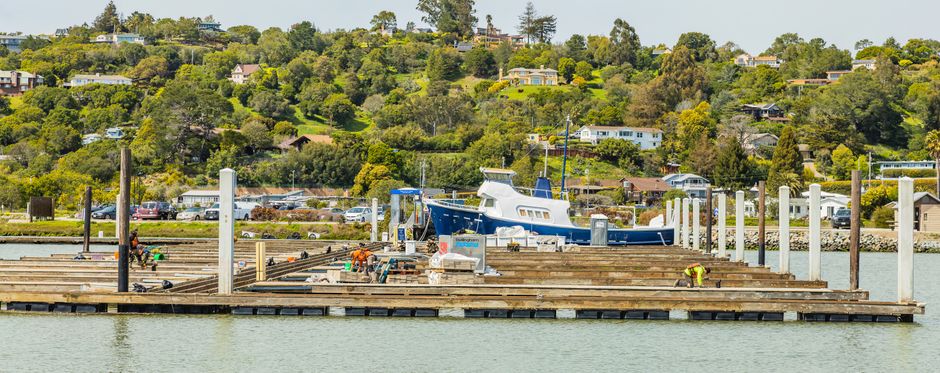
A sailboat sits in its slip with a waterline that needs polishing, and the only way to reach it is from the water. Someone suggests the family’s swim dock. It floats, it’s big, the box says it holds a lot of weight. But a floating work platform is a different thing: a deck built for people, tools and materials doing a job, with a load the maker has documented and paperwork that says so. Kids lounging and a crew sanding a hull are not the same load, and they are not the same product.
In short: buy a work platform on its documented payload, not its size or a marketing line. Ask the supplier for the written load rating (people and equipment), how it was determined, the standards or engineering behind it, the anchoring and stability instructions, and who supports you when something goes wrong. A recreational platform’s advertised capacity does not make it suitable for work.
What a floating work platform is, and what it isn’t
A work platform is sold for a task: hull cleaning and painting, inspection, diving support, dock and piling maintenance, or, at the heavy end, marine construction. What makes it a work platform isn’t the color or the word “heavy-duty” in the title; it’s that the maker designed it for that task and documents what it can carry, how to stabilize and anchor it, and how to use it. Recreational docks, mats and swim platforms are rated by their makers for people having fun. Those ratings tell you nothing about tools, buckets, compressors or a crew leaning over one edge. You’ll find every recreational type on our floating platform types hub.
Four families of floating work platform
| Family | Typical jobs (as makers and sellers list them) | How it’s built | What to expect on paper |
|---|---|---|---|
| Compact inflatable work float | Hull cleaning, polishing, painting, waxing, inspections, diving support | Drop-stitch PVC deck, often with a perimeter tube and water ballast bags underneath | A maximum load and number of persons, working pressure, size and packed size |
| Rigid modular plastic platform | Equipment staging, pumping stations, material barges, access walkways | Air-filled polyethylene cubes or sections pinned or bolted together | Buoyancy per module or per square foot, and a warranty |
| Sectional modular barge | Crane platforms, pile driving, dredging, floating bridges, dive and drill barges | Barge sections connected into a deck configured for the project | Engineering for the specific project and configuration |
| Custom-built work float | Whatever the client specifies | Varies | Everything below, because there is no catalog page to check |
The first family is what most marinas, boatyards and detailers mean by an inflatable work platform: a stable deck that packs into a bag. Rigid modular systems overlap with dock building: Candock, for example, lists versatile work platforms and equipment staging among the uses of its cubes, and EZ Dock says companies use its docks for floating pumping stations, equipment and material barges and floating work platforms. Sectional barges are a different scale entirely; Flexifloat, for instance, offers engineering help from concept to completion on each project. Our page on modular platforms explains how connecting systems work.
How an inflatable work float is built
An inflatable work float uses the same drop-stitch idea as a swim dock: two layers of coated fabric held together by thousands of threads, so the deck stays flat and stiff when pumped up (our drop-stitch explainer shows how). What changes is the detail around it. Published examples show the pattern:
- Separate air chambers. AERÉ’s dealer lists a high-pressure drop-stitch floor plus a secondary perimeter tube, so one punctured chamber is not the whole platform.
- Ballast bags. Both the Talamex Air-Dock Work and the larger AERÉ sizes are listed with water ballast bags under the deck, described as adding stability and stopping the rocking when people work near the edge. AERÉ’s dealer notes the smallest size does not use them.
- Hardware for tying off. The Talamex retailer lists stainless D-rings at the four corners for linking platforms together and another underneath for an anchor line; AERÉ’s dealer lists stainless D-rings and perimeter rub rails.
- Welded, heavy fabric. Listings describe welded heavy-duty PVC (AERÉ) and 0.7 mm drop-stitch PVC (Talamex). The Talamex retailer also says the 20 cm deck height keeps waves from washing over it.
Sizes and shapes
Inflatable work floats are rectangles sized for a few people working side by side. The published sizes we found run from about 4 x 5 ft to 6 x 10 ft (AERÉ’s three sizes) and 4 x 2 m (Talamex). AERÉ’s dealer says its largest size was made to hold a 4 x 8 ft sheet of plywood, which is a handy way to picture it. Pick the size for the job and the crew, then read that size’s own rating: a bigger deck in the same line does not automatically carry proportionally more. When one float is not enough, some makers design units to be tied together at the corners; ask whether the combined layout has its own rating.
Documented payload: what the number should tell you
A useful load rating answers more than “how much.” Look at how the Talamex Air-Dock Work is listed: a maximum load of 700 kg and a maximum of 5 persons, alongside the size, the material and the ballast system that keeps it steady. That’s the shape of a real rating. Compare a phrase like “easily holds 8+ crew members (~1,600 lbs),” which appears on one dealer’s listing for the largest AERÉ size: it’s helpful, but it’s a description, not a document. Ask the maker for the written rating behind it.
Questions a good supplier can answer about the payload:
- Is the rating for people, equipment or both, and is there a maximum number of persons?
- Does it assume the load is spread out? What about heavy items in one spot or everyone at one edge?
- At what inflation pressure, with ballast bags filled or not, in what water conditions?
- How was it determined (testing, calculation, a standard), and can we have that in writing?
We don’t calculate safe loads from dimensions, and you shouldn’t either. If the supplier can’t put a number and its conditions on paper, treat that as the answer.
The spec checklist for suppliers
Copy this into your request for a quote. Every line should come back with a document or a clear written answer.
| Ask for | Why |
|---|---|
| Written load rating: persons, equipment, conditions | The core of a work platform; it defines what you can put on it |
| How the rating was established, and any standards or certifications | Separates engineering from marketing; insurers and clients may ask |
| Materials and construction (fabric, seams, floor, chambers) | Tells you how it copes with tools, abrasion and a punctured chamber |
| Stability system (ballast bags, outriggers, connection to other units) | Work happens at the edge; stability there is what matters |
| Anchoring and mooring instructions, attachment points and their ratings | A platform tied to a hull or piling moves with wakes and current |
| Working pressure and the pump to reach it | Under-inflated decks flex; over-inflation can damage seams |
| Owner’s manual and operating limits (wind, waves, current) | You need to know when not to use it |
| Inspection and repair instructions, spare parts, repair service | Downtime costs money on a job |
| Warranty terms for commercial use | Many consumer warranties exclude or shorten business use |
| Supplier support: training, contact, lead time | Someone should answer the phone when a crew is waiting |
Set-up, inflation and anchoring
Inflate to the maker’s working pressure with a gauge. Work floats often run higher than you might expect: AERÉ’s dealer gives 5 to 9 psi per chamber, and suggests a battery inflator to reach about 1 psi before topping up with the supplied hand pump. Fill the ballast bags once the platform is in the water, if it has them.
Then decide how it stays put. Alongside a moored boat or a piling, the platform is usually tied off at its D-rings, and it will move with every wake that passes; fenders between the float and the hull protect both. In open water it needs an anchor sized and set as the maker says. Our anchoring guide explains rope, scope and anchor types in plain terms, but for a work float the maker’s instructions come first.
People on the deck: the safety rules that apply
When employees work over or near water, OSHA’s construction standard 29 CFR 1926.106 is a good reference point: where there’s a danger of drowning, workers are provided U.S. Coast Guard-approved life jackets or buoyant work vests, inspected before and after each use; ring buoys with at least 90 feet of line are readily available, no more than 200 feet apart; and at least one lifesaving skiff is immediately available. Which OSHA rules apply to your job depends on the work, so check with your safety advisor. A platform’s paperwork doesn’t replace any of this; it’s one part of a safe setup. For the general on-the-water basics, see our safety checklist.
Care, storage and lifespan
Work is harder on a deck than play: paint, solvents, grit, dropped tools and hull contact. Rinse it after every job, keep sand and debris away from valves, let it dry before rolling it up, and store it out of the sun and frost. Many inflatable warranties exclude chemical damage, dragging, improper storage and over-inflation (Aquaglide’s lists all of these), so a quick daily routine protects your cover as well as the platform. Patch small punctures with the kit the maker supplies, and call the maker before touching a seam or valve.
We found no maker that publishes a lifespan in years for its work floats, and we won’t invent one. The written warranty for commercial use, and what other crews on similar water report, are the honest guides.
What it costs
Compact inflatable work floats were listed by the dealers and retailers we checked in October 2026 from several hundred dollars (or euros) for the smallest size to roughly $2,500 for a 6 x 10 ft float. Rigid modular systems are usually quoted by area plus transport and installation, and sectional barges are quoted per project; Flexifloat says its barges are available both to buy and to rent. Get written quotes with the documents above attached.
Who it suits, and who should pick something else
An inflatable work float suits boatyards, detailers, yacht crews, dive teams and marinas that need a few people at the waterline and want to carry the platform to the job. A rigid modular platform suits work that stays in one place for a season, such as a pump station or a staging area. Construction with heavy machinery belongs on engineered barges. And if what you really want is a place for guests to swim, you need a commercial recreation platform, not a work float.
Why a recreational dock isn’t a work platform
Recreational makers rate their docks for recreation, and their warranties say so. RAVE Sports, for example, gives its Aqua Dock a limited lifetime warranty for personal use, and Aquaglide’s lakefront warranty drops from three years for residential use to one year for light commercial use. Neither says anything about crews, tools or point loads, and you shouldn’t read a work rating into a party rating. If you already own a swim dock, it can still be a lovely inflatable dock for the weekend; for the job, get a product sold and documented for work.
Compare with other platform types
Rigid and inflatable floats each have their place; our inflatable vs rigid floating docks guide sets them side by side. For a low, stable spot to launch kayaks or paddleboards rather than to work, see launch platforms. For guest areas, see commercial recreation platforms, and for bigger connected layouts, modular platforms.
Floating work platform questions
What is an inflatable work platform used for?
Makers and dealers list hull cleaning, polishing, painting, inspections, repairs, anchor gear checks and diving support: jobs done from the water alongside a boat or structure.
How much weight can a floating work platform hold?
Only what its maker documents. For example, the Talamex Air-Dock Work is listed at a maximum of 700 kg and 5 persons. Ask for the conditions behind any rating, and never estimate one from size.
Why do work platforms have ballast bags?
The bags under the deck fill with water and, as the sellers describe it, steady the platform and reduce rocking while people work near its edges.
Can I use my swim dock as a work platform?
Its maker rated it for recreation, and its warranty may exclude business use. A recreational capacity doesn’t tell you how it handles tools, point loads or a crew at one edge, so use a platform documented for work.
What paperwork should come with a work platform?
At least a written load rating with its conditions, the owner’s manual with operating limits, anchoring and inflation instructions, repair guidance and the warranty for commercial use. For engineered systems, ask for the engineering or standards behind the rating.
What pressure does an inflatable work float use?
Whatever its manual says. As an example, AERÉ’s dealer lists 5 to 9 psi per chamber. Use a gauge, and don’t exceed the stated figure.
Inflatable or rigid modular for work?
Inflatable if you move it from job to job and store it in a locker or van; rigid modular if it stays in one place for a season and carries equipment. Either way, buy on the written rating.
Can I rent a work platform instead of buying?
For large projects, often yes: Flexifloat, for example, offers its sectional barges for rent or purchase. For small inflatable floats, ask local marine suppliers and contractors.
Keep exploring
If you’re a business deciding what job you need a platform for and how to brief a supplier, read heavy-duty and work access, the companion to this page, and our page for marinas. The commercial and heavy-duty section collects the rest, and Start here covers the basics.