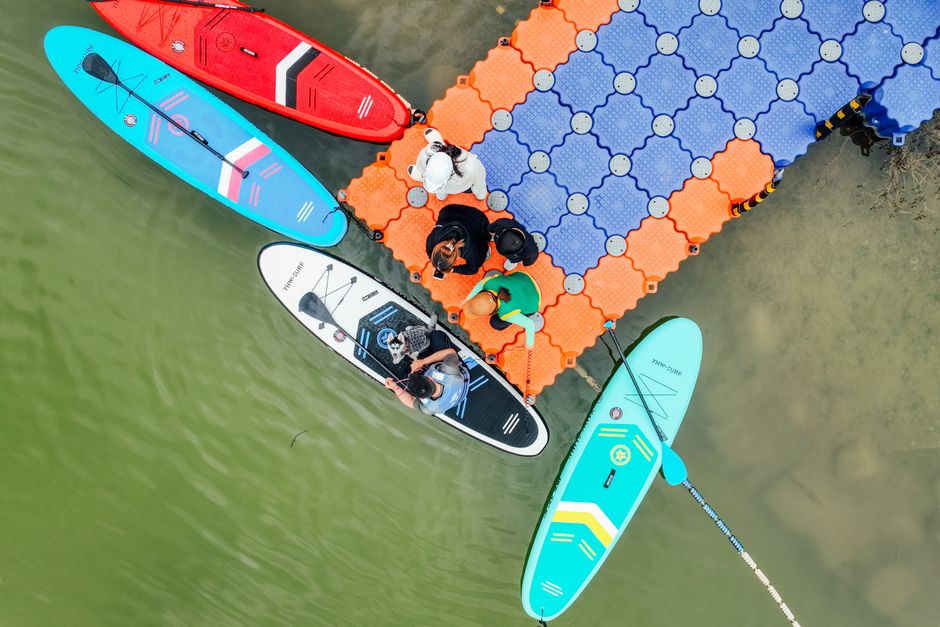
The first summer it’s a square you can swim out to. The next year you add a walkway so nobody has to swim, and the year after that a side arm where the kayaks and the jet ski tie up. That’s the promise of a modular floating dock: you buy pieces, not a finished shape, and you rearrange or grow the layout when your family, your boat or your shoreline changes.
In short: a modular floating platform is built from identical floating units (plastic cubes, larger plastic dock sections, or inflatable platforms) that lock or tie together into almost any shape. Start with the piece count your first layout needs and add more later. Each maker’s connectors only work with its own pieces, so choose the system first, then the shape.

What makes a floating platform “modular”
A modular floating dock is one where the pieces are designed to join and come apart again. You’ll find three main kinds:
- Cube systems. Small hollow blocks of high-density polyethylene (HDPE), about the size of a moving box, screwed together like building bricks. Candock’s G2 cube, for example, is 19 x 19 in and 14 in high and weighs 12 lb; the maker rates each cube at 150 lb (60 lb per sq ft) and says there’s only air inside.
- Section systems. Bigger molded plastic sections joined by flexible couplers. EZ Dock’s 60 in section is 5 ft wide, 10 ft long and 15 in high, and the maker gives it 3,000 lb of capacity. Sections are joined with dog-bone-shaped recycled rubber couplers (4,000 lb shear strength, says EZ Dock), which let each section move a little in waves.
- Inflatable platforms that link. Drop-stitch inflatable docks with D-rings around the edge. Island Hopper explains how to line platforms up side by side and run marine-grade straps or rope through the D-rings so they move together, and BOTE suggests lashing a few of its docks together for more space. Aquaglide goes further with its Interlock connectors on lounges like the C Lounge, which links to other Aquaglide lounges on up to two sides. Not every inflatable is meant to link: RAVE says its 10 x 10 ft Aqua Dock doesn’t connect to its other products.
What they share: you plan in pieces, the shape is yours to choose, and you can take pieces away again. What sets them apart is everything else, from feel underfoot to price per square foot. If you’re still deciding between soft and hard, our inflatable vs rigid floating docks comparison covers it.
How the pieces are built
Plastic sections and cubes are molded polyethylene: Candock uses high-density polyethylene with an anti-skid surface, and EZ Dock uses linear low-density polyethylene, which it says won’t damage the finish on a boat or jet ski. Sun is the enemy of plastic, so look for a stated UV stabilizer. EZ Dock says its raw materials carry a UV-16 rating, meaning additives that protect the material from serious UV damage for about 8 years of Florida sunlight under ASTM testing. EZ Dock sections draw only about 1.5 to 2 in of water, which leaves a deck 13 to 13.5 in above the surface, and they have coupler pockets about every 20 in around the edge, so new sections can join almost anywhere. The couplers are designed to break before the plastic does in severe waves, so a storm repair means a new coupler rather than a new section.
Inflatable modules are drop-stitch: two fabric skins held flat by thousands of threads and pumped hard. They sit only a few inches above the water and flex a little underfoot. Our explainer what is drop stitch covers how they get so rigid, and why pressure matters.
Example layouts and how many pieces they take
Here are four common shapes, counted in deck pieces for two kinds of system: a 19 in cube system (Candock G2 size) and 5 x 10 ft sections (EZ Dock 60 in size). The sizes are rounded and the counts are for the floating pieces only. Connectors, edge pieces, a ramp to shore and anchoring are extra, and your supplier’s plan is the one to build from.
| Layout | Rough size | 19 in cubes | 5 x 10 ft sections | Good for |
|---|---|---|---|---|
| Square swim platform | About 10 x 10 ft | 36 (6 x 6) | 2 side by side | A swim-out spot, sunbathing, a first piece to grow from |
| Straight walkway | About 5 x 30 ft | 57 (3 x 19) | 3 end to end | Reaching deeper water from the shore |
| L-shape | 5 x 20 ft walkway + 10 x 10 ft head to one side | 75 (39 + 36) | 4 (2 + 2) | A boat on one side, swimmers on the other |
| T-shape | 5 x 20 ft walkway + 5 x 20 ft crosspiece | 78 (39 + 39) | 4 (2 + 2) | Two boat slips, or a long sunning bar at the end |
For a sense of scale, Candock’s own ready-made kits run from a 189 sq ft straight dock to an L-shape of 250 sq ft, T-shapes of 340 and 470 sq ft and a U-shape of 475 sq ft. Two things the table can’t tell you. First, how much weight a finished layout can hold: that depends on the pieces, the connectors and the water, so ask the maker or dealer for the figure for your layout and use only that. Second, whether you’re allowed to put it there (see permits below).
Start small, then grow
The best modular layouts begin with one useful piece and a plan for the next. A few habits make growing easy:
- Pick one system and stay with it. Connectors are made for one brand’s pieces. Aquaglide puts it plainly: combinations of its products must be approved by the maker in advance, and it warns that mixing in other brands may increase the risk of entrapment or injury.
- Draw the final shape on day one. Even if you only buy the square, sketch where the walkway and the boat side will go, so the first piece sits in the right spot and the anchors don’t have to move later.
- Grow along the anchors. Each new arm changes how wind and waves push the platform. EZ Dock lists pipes, deadweight anchors, piling brackets and stiff arms as anchoring options, with hardware for fresh and salt water; ask your dealer which one fits each stage. Our guide to anchoring an inflatable platform covers the portable side.
- Plan the add-ons. Section systems offer launch and port pieces that couple straight on: EZ Dock’s kayak launch and jet ski port connect to its sections with the same couplers. See launch platforms for what to check, and our floating dock for jet ski guide if a PWC is part of the plan.
Plastic modules or inflatable modules?
| Plastic cubes and sections | Linked inflatable platforms | |
|---|---|---|
| Feel underfoot | Hard and steady. EZ Dock gives 13 to 13.5 in of freeboard (deck height above the water) | Firm but with some give; a few inches above the water |
| How pieces join | Pins, screws or rubber couplers made by the same maker | Straps or rope through D-rings, or a maker’s own connectors (Aquaglide Interlock) |
| Stays in | All season, anchored | A day or a weekend, then deflated and packed |
| Grows by | Adding pieces in any direction | Adding whole platforms side by side |
| Best for | Lake houses, ponds, boat and jet ski docking | Boats, rentals, trips, lakes where you can’t leave a dock in |
A linked group of inflatable docks is still a recreational platform. Its makers rate each piece for people having fun on the water, not for work loads. If you need a platform for staging, inspection or maintenance, see work platforms: those are engineered systems with documented loads.
Installing a modular dock
Plastic systems are a one-day job rather than a one-hour one. EZ Dock says most of its docks can be installed in a day by you and a helper, using only an in-water coupler tool and a coupler nut tool, and that its dealers can deliver and install them for you. Candock cubes are held together by the maker’s mounting screws, and Candock says to check now and then that the nuts on cleats, ladders, benches and connecting pins are still tight. You’ll also need a way from the shore to the dock: EZ Dock offers hardware to build a wooden gangway, polyethylene gangways up to 18 ft and aluminum gangways. Large inflatables need serious anchoring too; Aquaglide asks for 4,400 lb of total anchor weight for its C Lounge and recommends a dock and mooring specialist. Our floating docks for ponds and lakes guide walks through kits, anchoring and shore access.
Winter, care and how long it lasts
Plastic modules need little care. EZ Dock says a good rain is normally all it takes to keep its docks clean, with no boards to split or stain. Winter is the big question in cold places: Candock doesn’t recommend leaving its cubes in over winter, notes they aren’t guaranteed against ice breakage, and says the damage usually comes from ice moving during the spring thaw rather than from the ice itself. Ask your dealer whether to pull the dock out or leave it in for your lake.
Inflatable modules come out of the water after each trip: deflate, rinse, dry and store them cool and out of the sun. Warranties hint at expected life. Candock says its plastic system is guaranteed for twenty years; Aquaglide gives the C Lounge a 3-year limited warranty against manufacturing defects; inflatable dock warranties range from about 2 years (BOTE) to 5 years (Island Hopper, with registration). Read what each one covers.
What a modular floating dock costs
Plastic systems are priced per piece or per square foot, before delivery and installation. Candock gives an indicative starting price of about 44 Canadian dollars per square foot before transport and installation, and EZ Dock prices through its dealers. Linked inflatables are priced per platform: branded drop-stitch docks were listed on the makers’ own sites from about $750 to about $1,550 each in October 2026 (Island Hopper, BOTE). Add anchoring, a gangway or ramp, and any permit fees when you compare.
Permits and local rules
A dock left in all season is a structure, and structures in navigable waters can need a U.S. Army Corps of Engineers permit under federal rules; states, counties and lake associations often add their own. Minnesota, for example, requires a county sheriff’s permit for swimming rafts and similar structures that stay in the water overnight and aren’t attached to shore. Check with your state, county or lake association before you order.
Who it suits, and what to compare it with
Modular docks suit lake-house owners, ponds and anyone with an awkward shoreline who wants a shape that can change. If you want something you can take on the boat and pack away the same day, a single inflatable dock or a boat swim platform is simpler. If the plan is mostly sitting back with friends, linked floating lounges do that better. Marinas and clubs looking at larger systems should read marinas. For a short list of picks, see BoatSlide’s best inflatable docks.
Modular floating dock questions
Can I add to a modular floating dock later?
Yes, that’s the point of it. EZ Dock says its sections can be reconfigured or expanded at any time, and Candock says you can change the layout as often as you like. Buy more pieces from the same system, and check your anchoring when the shape changes.
Can I connect docks from different brands?
Don’t count on it. Connectors are made for one maker’s pieces, and Aquaglide warns against combining its products with other brands. Inflatable docks tied together with straps through D-rings are the loosest kind of link, and Island Hopper advises using all the D-rings and checking the connections during use.
How many people can a modular platform hold?
Only the maker can say. Each piece has a maker rating, but how a whole layout behaves depends on the connectors, anchoring and water, so ask the supplier for a figure for your layout and never add up piece ratings yourself.
Do I need a permit for a floating dock?
You may, especially for a dock left in all season. Federal, state and local rules can all apply, so ask your local permitting office or lake association before you build.
Is a modular dock better than one big inflatable?
It’s better if your needs will change or your shoreline is an awkward shape. One big inflatable is quicker to set up and easier to take on a boat. If you want it in the water all season, a plastic section or cube system is the usual choice.
Can I leave a modular dock in the water over winter?
It depends on the system and your lake. Candock doesn’t recommend it and doesn’t guarantee its cubes against ice; the risk is ice moving in the spring thaw. Ask your dealer, and take inflatables out at the end of every outing.
How much does a modular floating dock cost?
Plastic systems are quoted per square foot or per layout through dealers; Candock gives an indicative start of about 44 Canadian dollars per square foot before transport and installation. Branded inflatable docks were listed from about $750 to $1,550 each in October 2026.
Can I add a kayak launch or jet ski port to a modular dock?
With section systems, usually yes: EZ Dock’s launch and port pieces couple onto its sections. Check the launch maker’s stated craft size and weight first.
Keep exploring: see every type on floating platform types, read our guide to choosing an inflatable platform, plan a family day on family lake days, browse all of inflatable docks, or if you’re new here, start here.