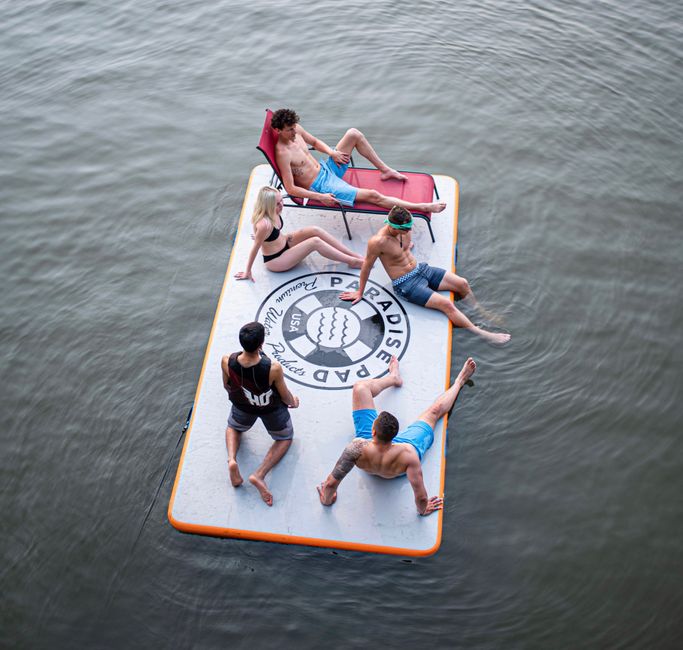
It’s a hot Saturday at the lake. The kids want something to jump off, your sister wants somewhere to lie in the sun with her feet in the water, and you want to be home before dark without an hour of packing. Two things usually come up in that conversation: a floating mat (the big foam “lily pad” that rolls out on the water) and an inflatable platform (a firm, pumped-up drop-stitch deck). They look similar in photos. On the water they feel completely different, and that difference decides which one your family will actually use. Here is inflatable platform vs floating mat, compared plainly.
In short: a floating mat is a flexible foam sheet, commonly about 1.4 in thick, that you unroll in a minute; it bends and bobs under you, which is half the fun. An inflatable platform is drop-stitch PVC pumped to the pressure its maker sets (the makers we checked list about 5 to 10 psi) and is usually 4 to 8 in thick, so it stays flat and firm like a deck, and it takes a pump and a few minutes to set up. Mats suit playing and lounging; platforms suit standing, sitting, climbing out and tying up to a boat.
Both are part of a bigger family of floating platforms. If you’re still getting your bearings, our guide to platform types shows docks, swim platforms, mats, lounges and more side by side.

What a floating mat is
A floating mat, also sold as a water pad or lily pad, is closed-cell foam in layers, commonly about 6 ft wide and 9 to 20 ft long. To give a sense of the numbers makers publish: Aqua Lily Pad describes its mats as 1.375 in thick cross-linked polyethylene foam in two layers, lists its 18 ft size at 25 lb and rates it for 9–10 adults. Rubber Dockie describes its 18 x 6 ft mat as 1 3/8 in, two-ply closed-cell foam weighing 30 lb, rated for about 9 adults or 1,500 lb spread evenly.
There is nothing to inflate. You unroll it, clip on the tether and push it out. Because it’s thin foam, it floats right at the surface and flexes as people move: walk across it and it sinks a little under each step, run and jump and it ripples. Kids love that. It’s also the reason a mat is a play surface rather than a place to set a folding chair. Our floating mats page covers sizes, group sizes and foam types in more depth.
What an inflatable platform is
An inflatable platform (or inflatable dock) is made of drop-stitch fabric: two layers of coated fabric tied together by thousands of internal threads. When you pump it up, the threads pull tight and hold the top and bottom flat, so the panel becomes stiff instead of puffing into a balloon. We explain the construction in what drop-stitch is.
The result is a deck you can stand, sit and kneel on. Here is what makers publish for a few common size classes. RAVE lists an 18 x 5 ft drop-stitch mat at 4 in thick and 5 psi, 56 lb, rated for 1,500 lb or about 8 adults, and a 10 x 10 ft dock at 6 in thick and 5 psi, 69 lb, rated for 1,800 lb. BOTE lists its docks at 8 in thick, inflated to 6–10 psi depending on size. The pattern is the useful part: bigger and thicker decks are rated for more weight and feel stiffer, and they also weigh more to carry.
Inflatable platforms come in several shapes: long narrow “drop-stitch mats,” squarer docks, boat swim platforms that tie to a stern, and modular platforms that connect into bigger layouts. The inflatable docks page goes into lengths, thickness and attachments.
Inflatable platform vs floating mat, side by side
| Foam floating mat | Inflatable platform | |
|---|---|---|
| Made of | Layered closed-cell foam | Drop-stitch PVC, filled with air |
| Thickness | About 1.4 in (1 3/8 in) | 4 to 8 in |
| Feel underfoot | Flexes and ripples | Flat and firm, like a deck |
| Setup | Unroll, tether, done | Pump to the maker’s psi (RAVE quotes 5–10 minutes with a hand pump for its 18 ft drop-stitch mat) |
| Weight, 18 ft size class (maker figures) | About 25–30 lb | About 56 lb |
| Packed | A thick roll with straps | Folds and rolls smaller, like a sleeping bag |
| If it gets a hole | Keeps floating | Loses air until patched; carry the repair kit |
| Best at | Play, lounging, kids, quick setup | Sitting, standing, climbing out, tying to a boat |
How each one feels on the water
Think trampoline versus patio. On a foam mat, people lie down, roll, wrestle and tumble off. With a few adults standing on it the mat dips where they stand, and the edges ride up and down with the waves. That’s fine for swimming and play, and it’s the reason mats are so popular behind boats at a sandbar.
An inflatable platform feels solid. You can climb out of deep water onto its edge without it folding under you, set a cooler on it, and sit cross-legged for an hour. Thicker platforms flex less when several people stand near one edge. That firmness is why platforms double as swim steps and dock extensions, which mats can’t really do.
Setup, packing and carrying
This is where mats win. A foam mat needs no pump and no pressure gauge; it’s ready the moment it’s unrolled. The catch is bulk: an 18 ft mat rolls into a thick cylinder about 6 ft long, which is easy on a pontoon or in a truck bed but awkward in a small car trunk.
An inflatable platform folds and rolls smaller once deflated. RAVE compares its packed 18 ft drop-stitch mat to a sleeping bag, and Island Hopper says its 10 x 6 ft dock rolls to 40 x 16 x 14 in. But it’s heavier (RAVE lists 56 lb and 69 lb for its 18 ft mat and 10 x 10 ft dock) and it needs inflating. Many come with a hand pump; an electric pump saves a lot of effort, especially on bigger decks at higher pressures. Check the pressure with a gauge rather than by feel, and stop at the maker’s number.
Plan where it goes after the lake, too. Both types should be rinsed, dried and stored out of the sun. A mat needs a long, flat-ish spot for its roll; a deflated platform fits a closet shelf or a boat locker but is a two-person carry once it’s inflated. If you’ll leave a platform inflated on the water for days, read our anchoring guide first.
Where each one works: lake, boat, dock
- Floating mat for a lake day: great off a dock or a beach, tethered to something fixed. Mind the depth: Aqua Lily Pad says its mats should never be used in water less than 6 ft deep.
- Behind a boat at anchor: both work. A mat is lighter to throw over and pull back in; a platform gives a firmer step back aboard and often has D-rings and handles all round for tying off.
- As an extra dock or swim step: a platform. Its firm, flat deck is what makes climbing out easy. See our boat swim platforms page.
- Out all season in front of a house: neither type is automatically built for that; follow the maker’s anchoring instructions and bring it in before storms. Our ponds and lakes guide covers what changes when a float stays out.
RAVE asks for at least 4 ft of water under its drop-stitch mats and docks. Whichever you choose, deep enough to float is not the same as deep enough to jump into: check the depth where people will land.
Capacity: read the maker’s number, then be sensible
Makers rate both types by the weight they can float when it’s spread out. Aqua Lily Pad states its ratings in adults and pounds (500 lb, 1–4 adults, for its 9 ft mat); Rubber Dockie says about 1,500 lb “spread equally” for its 18 ft mat; RAVE gives 1,500 lb for its 18 ft drop-stitch mat and 1,800 lb for its 10 x 10 ft dock. Use the maker’s number as the limit, never a target, and remember a crowd standing on one corner is a very different load from the same people spread out. These are recreational products: their ratings are for swimming and lounging, not for work, events or commercial use. If you need a platform for a business, see our commercial platforms page.
Durability and care
A foam mat can’t go flat, which is a real comfort with kids, dogs and fishing hooks around. It can tear, and sun slowly wears the surface; makers like Rubber Dockie and Aqua Lily Pad add tear-stop or UV layers for that reason. An inflatable platform has a tough PVC skin, but a hole means air loss until you patch it, so keep the repair kit that comes with it in the boat.
Air expands as it warms. FUNBOY, which makes drop-stitch floats, warns that long exposure to direct sun or heat can raise the pressure inside and recommends checking it and letting some air out if needed. Rinse either type after salt water, let it dry before rolling it up, and store it out of the sun.
Which one suits you?
- Choose a floating mat if it’s mostly kids playing, you want zero setup, you don’t want to worry about punctures, and you have room to carry a long roll.
- Choose an inflatable platform if adults will sit and stand on it, you want an easy climb out of deep water, you’ll tie it to a boat or dock, or you need it to pack small.
- Want a bit of both? A long, thinner drop-stitch “mat” sits in the middle: mat shape, platform firmness. Makers sell these in the same 18 ft lengths as foam mats.
- Mostly want to relax? Look at floating lounges instead: backrests and seats matter more than deck space when the plan is a book and a cold drink.
Three real-life lake days, and what fits each
A cabin weekend with young kids. The plan is hours of splashing off the end of a dock. A foam mat tethered to the dock is the easy answer: nothing to pump, nothing to pop, and kids can run, fall and climb back on. Put an adult on watch and life jackets on the kids; our family lake days page has more ideas for that kind of afternoon.
A pontoon or bowrider at anchor with adults. People want to sit with their feet in the water, step off to swim and climb back up without hauling themselves over a high side. That’s the job of a firm inflatable platform tied to the boat, ideally one with handles along the edge. See boat swim platforms for how they attach and what makers rate them for.
A small car and a public beach. You can’t fit a long foam roll in the trunk and there’s no dock to tie to. A drop-stitch platform that packs like a sleeping bag, plus a pump and a small anchor, is the practical choice; check the beach’s rules about floats before you go.
Before either one goes in the water
- Check the depth where people will land, not just where the float sits.
- Tether or anchor it to the points the maker provides, and keep it away from boat traffic and swim lines.
- Stay under the maker’s rating, and spread people out.
- Weak swimmers and kids in U.S. Coast Guard approved life jackets.
- Bring it in when wind picks up or thunder is around.
Our inflatable platform safety checklist goes through each step with official sources.
For a short list of foam picks, see BoatSlide’s best floating water mats. If you’ve settled on a platform, how to choose an inflatable platform walks through size, thickness and the maker’s rating step by step.
Floating mat questions
Is a floating mat the same as an inflatable dock?
No. A floating mat is solid foam about 1.4 in thick that flexes on the water. An inflatable dock is drop-stitch PVC pumped with air to a set pressure, usually 4 to 8 in thick, and stays flat and firm.
What size floating mat do I need for a lake?
Go by the maker’s rating for your group. Aqua Lily Pad, for example, rates its 9 ft mat for 1–4 adults, its 12 ft for 5–6 and its 18 ft for 9–10. Then check you can carry and store the roll.
Can a floating mat pop?
No, foam mats have no air to lose, so a cut won’t sink them, though foam can tear. Drop-stitch platforms can puncture, which is why they come with repair patches.
How deep should the water be?
Follow the maker. Aqua Lily Pad says never use its mats in water under 6 ft; RAVE asks for at least 4 ft under its drop-stitch mats and docks. Deeper still if people will jump in.
Which is better behind a boat?
For play, a mat is light and quick. For a firm step back aboard and a place to sit, a platform with D-rings and handles is better. Either way, anchor the boat, turn the engine off and keep everyone well away from the propeller, and have everyone in a U.S. Coast Guard approved life jacket who needs one.
Can I leave a floating mat or platform out all summer?
Only if the maker says it’s built for that and you anchor it the way they describe. Sun wears both foam and PVC over time, and storms move floats. Most families bring them in between weekends.
Can I join a mat and a platform together?
Some people tether them side by side, but only connect them the way each maker allows, using their own D-rings or connectors. If you want one bigger surface that grows over time, modular platforms are designed to connect.
Keep exploring
See how drop-stitch decks hold their shape in what drop-stitch is, compare air-filled and hard docks in inflatable vs rigid floating docks, browse everything in floating mats and lounges, or go back to Start here for the full map of the site.