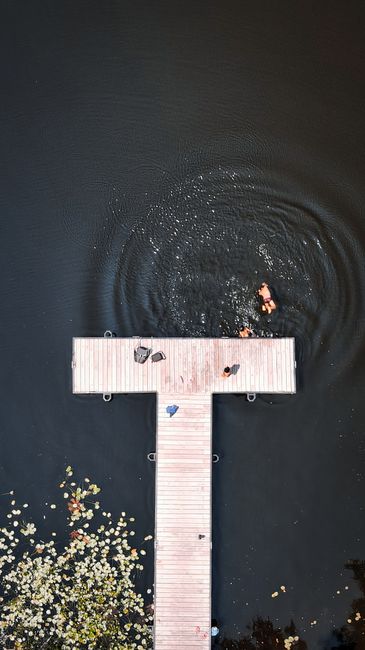
Ask five people what they want a floating platform for and you get five different days. A family wants a safe place in front of the cabin where the kids can jump in all afternoon. A boater wants a back porch off the stern at anchor. Friends want a party spot in the middle of the cove. A paddler wants an easy way into a kayak, and someone else just wants a quiet early morning with a fishing rod. The right floating platform for a lake depends far more on that day than on any spec sheet, so this section starts from what you plan to do.
In short: pick the use first, then the platform type. Families usually do best with a foam mat or a drop-stitch inflatable dock, boaters with a stern-friendly dock or swim platform, groups with a large dock or a floating island, paddlers with a launch platform, and anglers with a stable, flat deck. Always go by the capacity the maker states, never by size alone.

Five ways people use an inflatable platform on a lake
Each use has its own page with the platform types that suit it, what to check before you choose, and the questions that matter for that kind of day. Here is the quick tour.
Family lake days: swimming, sunbathing, the backyard waterfront
The classic summer afternoon: a raft off the dock, kids running across a foam mat, grown-ups lying in the sun with their feet in the water. The questions here are how many of you there are, how young the youngest swimmer is, and whether the platform stays out all season or goes back in the garage each evening. Read the family lake days guide.
Boating and yachts: a deck off the stern at anchor
Drop anchor, shut down the engine, clip a firm inflatable deck to the stern, and the boat suddenly has room to spread out. Platforms for boats need to pack small, tie on securely and make climbing back aboard easy, and they sit next to the rest of the yacht toys: slides, mats, paddle boards and the tender. Read the boating and yachts guide.
Fun and recreation: party spaces, games and jumping
When the point is a crowd, the platform becomes a floating patio: big inflatable docks, floating islands with seats and coolers, and add-ons like slides or bouncers. Here the maker’s people and weight rating matters more than ever, and so does anchoring a large surface that catches the wind. Read the fun and recreation guide.
Water sports and fitness: launching, snorkeling and floating yoga
A low, stable deck makes it far easier to get into a kayak or onto a paddle board, gives snorkelers a base to rest on, and turns a calm lake into a yoga studio. The question is less about how many people and more about the gear and the movement: craft weight, entry height and how firm the surface feels underfoot. Read the water sports and fitness guide.
Fishing: a quiet, stable spot on the water
A fishing platform is about standing or sitting steadily for hours, keeping rods, a tackle box and a cooler within reach, and staying put once it is anchored. Rigid surfaces and solid tie-down points count for more than lounging features. Read the fishing platforms guide.
Which platform type fits which use
Most uses can be served by more than one type. This table points you to the usual starting points; the platform types guide explains each type in depth.
| Use | Usually a good fit | The question to answer first |
|---|---|---|
| Family lake days | Foam mats, inflatable docks, rafts | How many of us, and how young is the youngest swimmer? |
| Boating and yachts | Boat swim platforms, compact docks, sea pools | How does it tie on, and where will it stow? |
| Fun and recreation | Large docks, floating lounges and islands, modular platforms | How many people does the maker rate it for? |
| Water sports and fitness | Launch platforms, firm drop-stitch docks | What gear goes on it, and how heavy is it? |
| Fishing | Firm, flat docks with tie-down points | Will it stay steady and anchored for hours? |
If you’re stuck between the two most common choices, a firm deck or a soft mat, inflatable platform vs floating mat lays out the feel, stability and packing differences. And if the platform is meant to stay at your own shoreline, floating docks for ponds and lakes compares inflatables with rigid kits.
One summer weekend, three setups
Uses blur together on a real weekend, so here is how one platform choice plays out across three typical days. The details change with your water and your group, but the thinking carries over.
Saturday morning at the cabin: five people, two of them kids
The family wants somewhere to swim out to and lie in the sun. A long foam mat is the easy choice for play; one maker rates its 15 ft mat for 7 to 8 adults and its 18 ft mat for 9 to 10, and says to use them only in water at least 6 ft deep. If the grown-ups want a firmer deck to sit on, a 10 x 10 ft drop-stitch dock does that job; one maker rates its version for 10 adults or 14 children. Either way the first job is a depth check off the end of the dock, a look for rocks and stumps, and life jackets in the right sizes for the kids, since adult sizes may not fit children. The family lake days page goes deeper.
Saturday afternoon: the boat at anchor in the cove
Now the platform travels. A narrower 10 x 6 ft dock is easier to launch off the back of a boat than a 10 x 10, and soft corner bumpers protect the hull. The one rule that matters most here is about the engine: the U.S. Coast Guard warns never to sit or swim on or near the back deck or swim platform while engines are running, and the CDC advises staying at least 20 ft from boats running a generator or engine, because carbon monoxide can collect around the stern. Shut down before anyone climbs on. See boating and yachts and boat swim platforms.
Sunday: a paddle at dawn, friends over in the evening
Early on, the same firm deck becomes a launch pad for a kayak or paddle board; a low deck makes the step down far easier than a high fixed pier. By evening it’s a party spot, and that’s when people pile onto one edge, so the maker’s people count matters more than the square footage. Anchor both ends so the wind can’t swing it, and when thunder starts, everyone heads for shore: the National Weather Service’s rule is “When thunder roars, go indoors.” The water sports and fitness and fun and recreation pages cover each half of the day.
What every use has in common
- Capacity is the maker’s number. Go by the weight and people rating the manufacturer publishes, not by how big the deck looks.
- Depth matters. Makers set minimum water depths; RAVE asks for at least 4 ft under its docks, and Aqua Lily Pad says its mats should never be used in water less than 6 ft deep.
- Anchor it properly. Use the maker’s anchor points and see our guide on how to anchor an inflatable platform.
- Life jackets and weather. The U.S. Coast Guard notes that most boating-related drownings happen on nice days, and the National Weather Service’s rule is “When thunder roars, go indoors.” Our safety checklist puts it all on one page.
Before your first day out: a checklist for any use
- Name the use. Swimming, boating, a party, launching or fishing. It decides the type.
- Count heads and gear. Compare your group (and any kayak, cooler or tackle) with the maker’s stated people and weight rating.
- Measure the water. Check depth against the maker’s minimum where the platform will sit, and look for rocks, logs and sand bars.
- Plan the anchoring. Where the lines go, what anchors you’ll use, and how far it sits from boat traffic and engines.
- Life jackets that fit. One for each person, with children’s sizes for the kids.
- Check the forecast and agree in advance when everyone gets off: wind, waves, lightning.
- Name a watcher. RAVE’s manual, for one, asks for constant adult supervision of children on its dock.
- Know the local rules if it will stay out overnight or all season.
- Plan the evening. Rinse, dry and store it shaded, or keep it at full pressure if it stays on the water.
Still deciding on size and material? How to choose an inflatable platform turns this checklist into a decision. For a short list of picks rather than full guides, see BoatSlide’s best inflatable docks.
For businesses: resorts, marinas and rental operators
If guests, customers or staff will use the platform every day, the questions change: durability under constant use, commercial warranties, repairs, liability and supplier support. A consumer product’s advertised capacity does not make it suitable for commercial or work use. Our commercial platforms section covers resorts and hospitality, marinas, rental and tour operators and heavy-duty work access, and you can send us a business inquiry from there.
Questions about choosing by use
What is the best floating platform for a lake?
It depends on what you will do on it. For a family swim spot, a foam mat or a drop-stitch inflatable dock is the usual choice; for a boat, a compact dock that ties to the stern; for a crowd, a large dock or a floating island rated by the maker for your group size.
Can one platform do everything?
A large drop-stitch dock comes close: it works for swimming, lounging and as a launch base. It is heavier to carry and store than a mat, though, and it is not built for work loads or commercial use.
Is an inflatable platform for a lake the same as a floating dock?
An inflatable dock is one kind of floating platform. Others include foam mats, floating lounges and islands, modular plastic docks and engineered work platforms. Our platform types page compares them, and inflatable vs rigid floating docks explains how each one floats.
How many people can stand on a lake platform?
Only as many as its maker states. Ratings we’ve seen run from 1 to 4 adults on a 9 ft foam mat to 10 adults on a 10 x 10 ft drop-stitch dock. Don’t estimate it from the size, and remember people tend to bunch up on one edge.
Can I leave a platform on the lake overnight?
Many makers tell you to deflate and store it when it’s not in use, and some local rules limit what can stay out after dark. If yours stays out, anchor it well, keep it at full pressure, and check your lake’s rules on lights, reflectors and permits.
Do I need a permit to keep a platform on a lake?
Rules vary by state, lake and shoreline owner. A platform you take home each evening is treated differently from one anchored all season in many places, so check with your state agency or lake authority before you leave one out.
Keep exploring: new to all this? Start here for what an inflatable platform is, see every kind side by side in floating platform types, browse every article in the uses category, or read what is drop-stitch to understand why a firm deck feels firm.