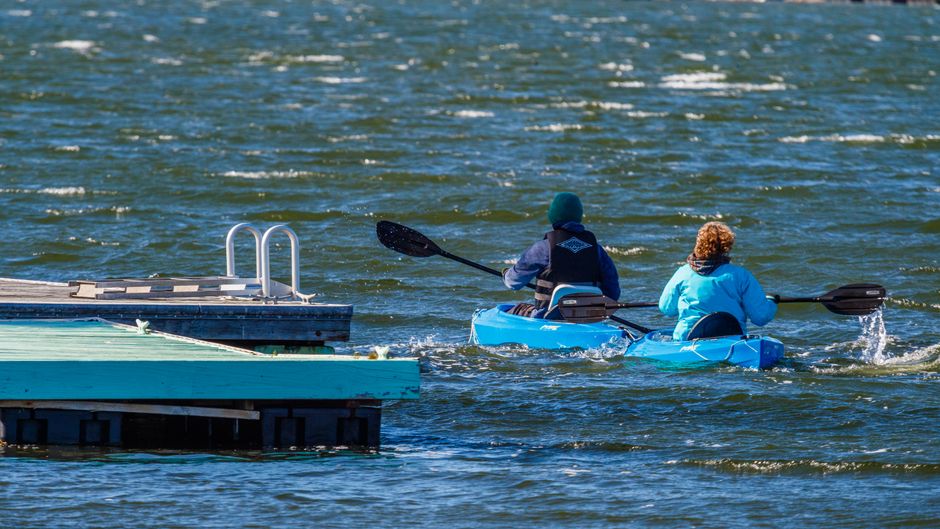
The hardest part of a paddle is often the first ten seconds: one foot on a fixed dock, one foot in a kayak that slides away, a paddle in your teeth. A kayak launch for a dock fixes that moment. It is a low, guided platform that holds the craft steady while you sit down, then lets you push off. Jet skis have their own version, the drive-on port, and stand-up paddlers want something low enough to step down onto the board. This page is about equipment and weight: what each launch is built to hold, how you get in and out, and what to check before you choose one.
In short: match the launch to your craft first (its width, its weight with gear, and for a jet ski its dry weight), then to your dock (fixed or floating, and how high it sits above the water). Use only the capacity and craft sizes the launch maker states, and check that the maker allows the way you plan to attach it.

Start with your craft: what to check for each
Every launch is designed around a craft. A kayak launch cares about the width of the hull and where you sit; a jet ski port cares about the weight of a machine that is several hundred pounds before anyone climbs on. Look up your craft’s numbers on its maker’s spec sheet before you compare launches.
| Craft | Weight to look up | What to check on the launch |
|---|---|---|
| Kayak or canoe | Hull weight from the maker, plus seat, gear and any pedal drive | Maximum craft width (one floating launch takes 34 in and under), entry width, grab bars, whether the launch floats or adjusts to water level |
| Fishing or pedal kayak | The rigged weight, not just the bare hull | The launch maker’s stated kayak weight limit (one lift-style launch lists 250 lb standard and 350 lb heavy-duty), entry width |
| Stand-up paddle board | Board weight plus rider, as the board maker rates it | A low deck close to the water, a guided slot or edge you can kneel from, and paddle notches |
| Jet ski (PWC) | Dry weight from the PWC maker (Sea-Doo lists 443 to 473 lb for its 2027 Spark X Trixx), plus fuel and gear | The port or ramp maker’s stated watercraft weight (EZ Dock gives its EZ Port 2i a 1,700 lb flotation capacity), length, rollers, bow stop |
Your own weight matters in a different way. On a kayak launch you are lowering yourself into a seat, so what counts is how well the launch holds the boat still and how many handholds it gives you. On a jet ski port you step on and off the deck, so check that the walking surface is slip-resistant and wide enough to stand beside the craft.
Kayak launch for a dock: kayak and SUP launches
A kayak launch is a cradle that sits beside your dock. You slide the kayak in, it rests at water level between guide rails, you sit down while holding the bars, and you pull yourself out along the rails. The best ones solve the two problems of a normal dock: the boat floats away from you, and the dock is too high above the water to sit down safely. There are two main kinds.
Floating launches are molded polyethylene and float, so they rise and fall with the water and the step-down stays the same all season. As an example of what makers state, YAKport lists its launch at 48 x 60 x 22 in outside with a 34 in wide inside slot, 99 lb, in UV-protected polyethylene, with guide rails on both sides, grab bars with paddle notches and an optional overhead handle. EZ Dock’s EZ Launch is a bigger one-piece unit at 58.5 x 168 x 25 in, with built-in handholds, a V-shaped entry that centers the kayak, entries on both sides and paddle notches.
Lift-style launches sit beside a fixed dock on a frame that you raise or lower as the water level changes. One sold for fixed docks, the Golden Kayak Launch, is listed as welded aluminum with stainless steel cables and a brake winch, in 3, 5 and 7 step versions with entry widths from 34 to 56 in, rated by its maker for kayaks up to 250 lb (standard) or 350 lb (heavy-duty).
Stand-up paddle boards launch most easily from something low. Kayak launches take SUPs too: YAKport’s instructions are to rest the board’s fins over the edge of the launch into the water, then back out. An inflatable platform anchored in open water is also low to the water, which makes kneeling onto a board easy. Before you tie an inflatable deck beside a dock as a launch, read its manual: RAVE, for example, tells owners of its Aqua Dock not to connect it directly to docks, piers or other hard objects. See inflatable docks for how those decks are meant to be used.
Jet ski launch platforms: ports and shore ramps
A jet ski needs a platform built for its weight. A drive-on port is a floating cradle with rollers: you idle up, ride onto it and the craft sits out of the water; to launch, you push off and it rolls back in. EZ Dock’s EZ Port 2i, for example, measures 168 x 59 x 15 in, has a 1,700 lb flotation capacity and adjustable rollers that adapt to different hull shapes, with a built-in bow stop so you don’t overshoot. It connects to EZ Dock sections or an existing dock, or it can be secured to the shore or lakebed without a dock.
A shore ramp does the same job from a beach: rollers and a winch pull the PWC up out of the water. Aluminum shore ramps sold online are listed at about 11 to 15 ft long with stated limits of about 1,000 to 1,200 lb, and some include a winch and strap; check the stated craft length as well as the weight. Our floating dock for jet ski guide compares ports, ramps and U-shaped inflatable jet ski docks in more depth.
Launch types compared
| Launch type | For | Getting in and out | Water level | What makers state (examples) |
|---|---|---|---|---|
| Floating kayak launch | Kayak, canoe, SUP | Slide in, sit down between rails, pull out along them | Floats, so the step-down stays the same | A maximum craft width (34 in on one model); weight limit not always given |
| Lift-style launch | Kayak, canoe, SUP at a fixed dock | Steps down to a cradle at water level | Raised or lowered with a winch | 250 lb or 350 lb kayak by model on one listing; 34 to 56 in entry |
| Anchored inflatable deck | SUP, swimmers, small kayaks | Kneel or sit down from a low deck | Floats | The deck maker’s people and weight rating; some say not to attach to hard docks |
| Drive-on PWC port | Jet ski | Drive on, step off; push off to launch | Floats | 1,700 lb flotation capacity on one model |
| Shore ramp | Jet ski, from a beach | Winch the craft up onto rollers | On the beach | About 1,000 to 1,200 lb and a maximum craft length |
How launches are built
Floating launches and ports are molded polyethylene, the same family of material as plastic dock sections, with UV protection added because they sit in the sun all season. Lift-style launches are aluminum frames with stainless steel cables. Shore ramps are aluminum with stainless hardware and soft, nonmarking rollers, including a keel roller under the center of the hull. Inflatable decks are drop-stitch; our what is drop stitch explainer covers why they’re firm enough to kneel on but not designed as hard-dock attachments.
Installing and attaching a launch
How a launch attaches depends on your dock. YAKport says floating dock installations use a set of metal hinges and fixed dock installations use pole connectors with 2 in schedule 40 galvanized steel pipe, which isn’t included, and that the launch has three connection points on one side and two on the other for different anchoring options. EZ Dock’s launch and port connect to its own dock sections with the same couplers as the dock, or to an existing dock. If your dock is a modular system, a launch or port is often just one more section; see modular platforms. If the launch floats on its own, it still needs anchoring against wind and waves; our guide on how to anchor an inflatable platform covers anchors and line.
A launch or port that stays in all season is part of your dock, so the same local rules apply. Structures in navigable waters can need a U.S. Army Corps of Engineers permit, and states and lake associations add their own rules, so check before you install. Our floating docks for ponds and lakes guide has more on permits and shore access.
Care, winter and lifespan
Polyethylene launches need little more than a rinse; EZ Dock says rain is normally all its products need to stay clean, and it uses UV-stabilized material for a longer life in the sun. Rollers, hinges, pins and winch cables are the parts to check each season, since they carry the load. Where lakes freeze, ask the maker whether to take the launch out for winter; one floating-dock maker says ice damage usually comes from the ice moving during the spring thaw. Inflatable decks used for launching come out of the water after each outing: rinse, dry, deflate and store them out of the sun. Warranties vary by maker and aren’t always published, so ask for the terms in writing.
What a launch costs
In October 2026, floating and lift-style kayak launches sold online were listed at roughly $2,000 to $2,200, and aluminum PWC shore ramps at roughly $900 to $1,000. Dock-system launches and drive-on ports are usually priced through dealers, often with installation. Budget for mounting hardware (pipe for a fixed-dock kit, for instance) and anchoring on top.
How to choose a kayak launch system
- Measure the widest point of your craft. A slot that’s too narrow simply won’t take the boat. Makers state widths like 34 in and under, or entry widths of 34 to 56 in by model.
- Weigh it the way you paddle it. Use the rigged weight of a fishing or pedal kayak, and compare it with the launch maker’s limit, not a guess.
- Know your dock. Fixed or floating, and how high above the water. A floating launch keeps the same step-down as the level changes; a winch launch needs adjusting.
- Count the handholds. Grab bars on both sides and an overhead bar make the sit-down and stand-up moments far steadier.
- Check the attachment kit. Floating and fixed docks use different hardware, and some kits need pipe you buy separately.
- Plan for the life jacket. The Coast Guard treats a SUP used outside a swimming, surfing or bathing area as a vessel, so a life jacket is required, and kayaks and canoes need one for each person aboard.
Who needs a launch, and what to compare it with
A launch suits anyone who paddles or rides from the same dock often, especially older paddlers, kids and anyone with a heavy fishing kayak. If you mostly launch swimmers rather than craft, a boat swim platform or a low inflatable dock may be all you need. Paddling, yoga and fitness ideas are under water sports and fitness, and anglers will find more on fishing platforms. Rental businesses and watersports centers launching many craft a day should read rental and tour operators.
Launch platform questions
Can a kayak launch go on a fixed dock?
Yes. Floating launches attach to fixed docks with pole connectors (YAKport’s kit uses 2 in pipe), and lift-style launches are made for fixed docks, with a winch to follow the water level. Floating docks use hinges or the dock system’s own couplers.
How heavy a kayak can a launch hold?
Only the launch maker can answer that. One lift-style launch is rated for kayaks up to 250 lb (standard) or 350 lb (heavy-duty); some floating launches give a width limit instead of a weight. If you can’t find a number, ask the maker before you buy.
Can I launch a paddle board from a kayak launch?
Usually, yes. Kayak launch makers list stand-up paddle boards along with kayaks and canoes; the board still has to fit the stated width, and YAKport says to rest the fins over the edge and back out.
What’s the difference between a jet ski port and a shore ramp?
A port floats at your dock and you drive on and push off. A shore ramp sits on the beach and a winch pulls the craft up onto rollers. Both should be chosen by the maker’s stated watercraft weight and length.
Can I use an inflatable dock as a kayak launch?
An anchored inflatable deck sits low and is easy to kneel from, so many people step onto a board from one. Follow the platform maker’s rules on where and how to attach it; some, like RAVE for its Aqua Dock, say not to connect it directly to docks or other hard objects.
How much does a kayak launch cost?
Kayak launches sold online were listed at roughly $2,000 to $2,200 in October 2026; dock-system launches are priced through dealers. Add mounting hardware and anchoring.
Do I need a permit for a kayak launch or jet ski port?
Possibly, if it stays in the water as part of your dock. Federal, state and local rules can apply, so check with your local permitting office or lake association first.
Keep exploring: go back to all platform types, read our guide to choosing an inflatable platform and the safety checklist, browse every use in the uses category, or if you’re new here, start here.