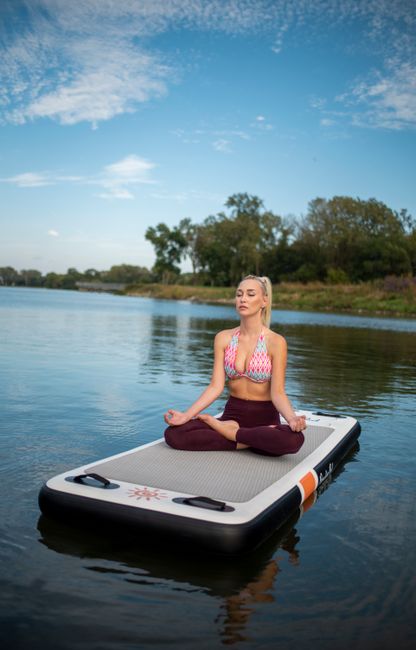
Seven in the morning, the lake is glass and nobody else is up. You roll out of the cabin with a paddleboard under one arm, step onto the floating deck, set the board down, kneel, slide on and push off without getting more than your toes wet. An hour later you’re back, the board is drying on the deck, and a friend is unrolling her mat for sun salutations while the platform barely moves. That’s what a good floating yoga platform and water sports base does: it’s the stable, dry spot where every activity starts and ends.
In short: for water sports and fitness, choose a platform by what you bring and what it all weighs. Add up riders, boards and gear and keep it under the maker’s stated capacity. For yoga, a dedicated drop-stitch fitness mat is the closest thing to a studio floor; for launching SUPs and kayaks or as a snorkeling base, a firm drop-stitch dock with D-rings and handles does the job.
This guide is part of Explore by Use. If you’re new to inflatable platforms, start here.
What are you bringing? Gear and weight come first
A party platform is about how many people fit. A sports platform is about equipment. A paddleboard, a kayak, fins, a dry bag and two adults all land on the same deck, and the platform has to hold them firmly enough that you can stand, kneel and step on and off a moving board. Start with your gear list.
| Activity | What lands on the deck | What the platform must give you | Best platform type |
|---|---|---|---|
| Floating yoga, pilates, stretching | You (and a strap or band) | A flat, firm, grippy surface, wide enough for poses; tie-off points | Drop-stitch fitness mat (one person) or a firm dock (a few friends) |
| Paddleboarding | Rider plus board; inflatable 10’6″–11′ boards weigh about 21–22 lb by their makers’ specs | Deck long enough to lay the board down; low, firm edge to slide on and off | Drop-stitch dock or launch platform |
| Kayaking | Paddler plus kayak (check your kayak’s stated weight) | Stable edge for sitting down into the cockpit; handles to hold | Launch platform or a thick, firm dock |
| Snorkeling and swim training | Swimmers, fins, masks, a dry bag | Handles all round for climbing on from deep water; room to sit and gear up | Drop-stitch dock anchored where you swim |
| Wakeboard and ski rest stop | Riders between runs | A soft place to rest and get your board on; easy climb-on | Foam mat or dock, well clear of boat traffic |
Then do the simple sum: the people who will be on the platform at once, plus boards and gear resting on it. Keep that total under the number the maker states. If a maker gives only a number of people and no weight, treat that number as the limit and leave room for the gear. Our guide on how to choose an inflatable platform goes through sizing step by step.
What makes a good floating yoga platform
Floating yoga feels harder than yoga on land because the water moves under you. That’s the appeal, and it’s why the surface matters so much.
- Firmness. Drop-stitch construction (thousands of threads holding the top and bottom flat) is what lets an inflatable feel almost rigid; our drop-stitch explainer shows how. Solstice, for example, says its fitness mat’s drop-stitch core takes up to 10 psi. A foam mat flexes too much for standing poses.
- Grip. Look for a full-length traction pad. Bare PVC gets slippery when wet.
- Width. A wider deck makes balance poses easier for beginners. Compare the width on the spec sheet, not just the length.
- Tie-off points. A mat that drifts during savasana ends up across the cove. Use the D-rings or handles to anchor it or clip it to a dock or line.
- Class use. For a class, one mat per person, tied in a row, keeps everyone on their own surface. A single large dock works for a few friends who don’t mind moving together.
Fitness mat, dock or foam mat? Sizes and what they suit
Three types cover most water workouts. The figures are makers’ own, given as examples of each size class.
| Type | Typical size and maker figures (example) | Suits | Less good for |
|---|---|---|---|
| Drop-stitch fitness mat | About 8 ft x 3 ft x 6 in; 275 lb capacity, 26 lb (Solstice) | One person: yoga, pilates, band work; also paddled short distances | Groups, launching other craft |
| Small drop-stitch dock | About 8 x 5 ft; 4 to 6 persons (Solstice) | A launch pad for one or two boards; a rest stop | A full yoga class |
| Large drop-stitch dock | About 10 x 10 ft, 6 in thick; 10 adults or 14 children, 1,800 lb (RAVE) | Two boards side by side; snorkel base; a few friends stretching | Carrying far; small lockers |
| Foam floating mat | About 6 ft wide, 9 to 20 ft long; 1 to 12 adults by length (Aqua Lily Pad) | Rest stops, play, cooling off | Standing poses, launching boards |
The difference between the foam and the inflatable is covered in depth in inflatable platform vs floating mat. As a rough cost guide, the drop-stitch docks whose makers we checked in October 2026 listed from about $350 for smaller sizes to about $800 for a 10 x 10 ft deck.
Launching paddleboards and kayaks
Getting on a board from a high wooden dock is the moment most people fall in. A floating platform sits low, only a few inches above the water, so you can kneel beside the board and slide on. On a 10 ft deck you can set a 10–11 ft board down almost end to end; a 10 x 10 ft deck has room for two side by side. Handles along the edge help when you come back tired. If launching is your main use, read our launch platforms page, which covers dedicated kayak launches with rails and rollers, and for jet skis see floating dock for jet ski.
A base for snorkeling and swim training
Anchored over a reef edge or out in the middle of a lake, a platform gives swimmers a place to rest, adjust a mask and climb back on. For this, handles matter more than anything: RAVE’s 10 x 10 ft dock has ten neoprene-covered handles, and Island Hopper’s 10 x 6 ft yacht dock has stainless steel D-rings and rubber corner bumpers. Anchor it securely before anyone swims away from it. One dock maker suggests 150 to 200 lb of anchor weight for its dock, depending on the lake and bottom; our guide to anchoring an inflatable platform explains the options. Swimming off a boat instead? Boating and yachts covers tying a platform to the stern.
Care: water, sun and sweat
Fitness and sports platforms get more wear than most: wet feet, sunscreen, fins and board fins on the deck every day. Inflate to the maker’s pressure and check it again in the heat, since air expands in the sun. One dock maker’s care instructions ask for mild soap only (no petroleum products, solvents or power washers), drying before storage, rolling loosely and storing somewhere cool, dry and shaded. Keep board fins and dive knives off the deck surface, and carry the maker’s repair kit.
A morning class on the water
Here’s how a small floating yoga session for four friends might run. The evening before, the instructor checks the forecast: a calm morning, light wind. At 7:00, four fitness mats are inflated on the beach to the maker’s pressure and carried, not dragged, to the water. A line with an anchor at each end is set parallel to shore in calm water away from any boat lane, and each mat is clipped to it from its D-ring, a few feet apart. Everyone wears or keeps a life jacket within reach, and the instructor stays on a mat at the end of the line where she can see everyone. Forty-five minutes later, the mats come in, are rinsed, dried in the shade and rolled. If the wind picks up halfway through, the class simply paddles in; nobody fights a drifting mat.
Running classes or rentals as a business is a different job, with daily use, insurance and liability; see our pages for rental and tour operators and resorts and hospitality.
Safety for water workouts
- Your paddleboard can be a boat. The U.S. Coast Guard says a SUP used beyond the narrow limits of a swimming, surfing or bathing area is a vessel, which means carrying a Coast Guard-approved wearable life jacket for each person.
- Cold water is a shock. The National Weather Service warns that sudden immersion can cause involuntary gasping, and that water of 50–60°F can be as dangerous for cold shock as near-freezing water. Early-morning sessions in spring and fall call for a life jacket and a wetsuit.
- Watch the sky. “When thunder roars, go indoors,” and stay off the water at least 30 minutes after the last thunder (NWS).
- Stay visible. Anchor your platform away from boat lanes and ski runs.
More in the inflatable platform safety checklist.
Water sports base checklist
- People plus boards plus gear added up and kept under the maker’s capacity.
- Deck long and wide enough for your board, and low enough to slide on.
- Traction pad or non-slip surface for standing work.
- Inflated to the maker’s pressure; checked again in the midday sun.
- Anchored or clipped to a line, away from boat lanes and ski runs.
- Life jacket for each paddler; wetsuit when the water is cold.
- Forecast checked; a plan to come in if wind or thunder arrives.
- Rinse, dry in the shade, roll loosely after each session.
Floating yoga and water sports questions
What’s the difference between a floating yoga mat and a paddleboard?
A floating yoga mat is usually shorter and wider, built to sit still for poses, often with a full-length traction pad and tie-off points. A paddleboard is longer and narrower for gliding. Some fitness mats are designed to do a bit of both.
Can I do yoga on an inflatable dock?
Yes, a firm drop-stitch dock is steadier than most fitness mats because it’s bigger. Anchor it, check that the surface isn’t slippery, and keep the number of people within the maker’s rating.
How do I keep a floating yoga mat from drifting?
Clip it to an anchored dock, buoy or line, or anchor it on its own with a small anchor and a line to its D-ring or handle. In wind or current, use the anchoring the maker recommends, or don’t go out.
How much weight does a platform need for a paddleboard launch?
Add up the people standing on it and the boards resting on it, then stay under the maker’s stated capacity. An inflatable SUP adds about 21–22 lb according to makers like Atoll and Red Paddle Co; a kayak adds its own stated weight.
Do I need a life jacket for floating yoga?
It’s always a good idea for weak swimmers and in cold water. If you paddle the board beyond a swimming area, the Coast Guard treats it as a vessel and requires carrying an approved wearable life jacket.
Can a fitness mat hold two people?
Go by the maker’s number. Fitness mats are usually rated for one person; Solstice, for example, gives its 7’10” fitness mat a 275 lb capacity. For partner work or a small group, use a larger dock rated for it.
Can I use a foam mat as a launch pad?
It works as a rest stop, but a foam mat bends under weight and sits at the waterline, so it’s awkward for setting down a board or climbing into a kayak. A firm drop-stitch dock or a dedicated launch platform is easier.
Keep exploring
Spending a calm morning with a rod instead? Try fishing platforms; turning the afternoon into a gathering, see fun and recreation; out with the kids, read family lake days; and compare every kind of deck in inflatable docks or the whole uses category.