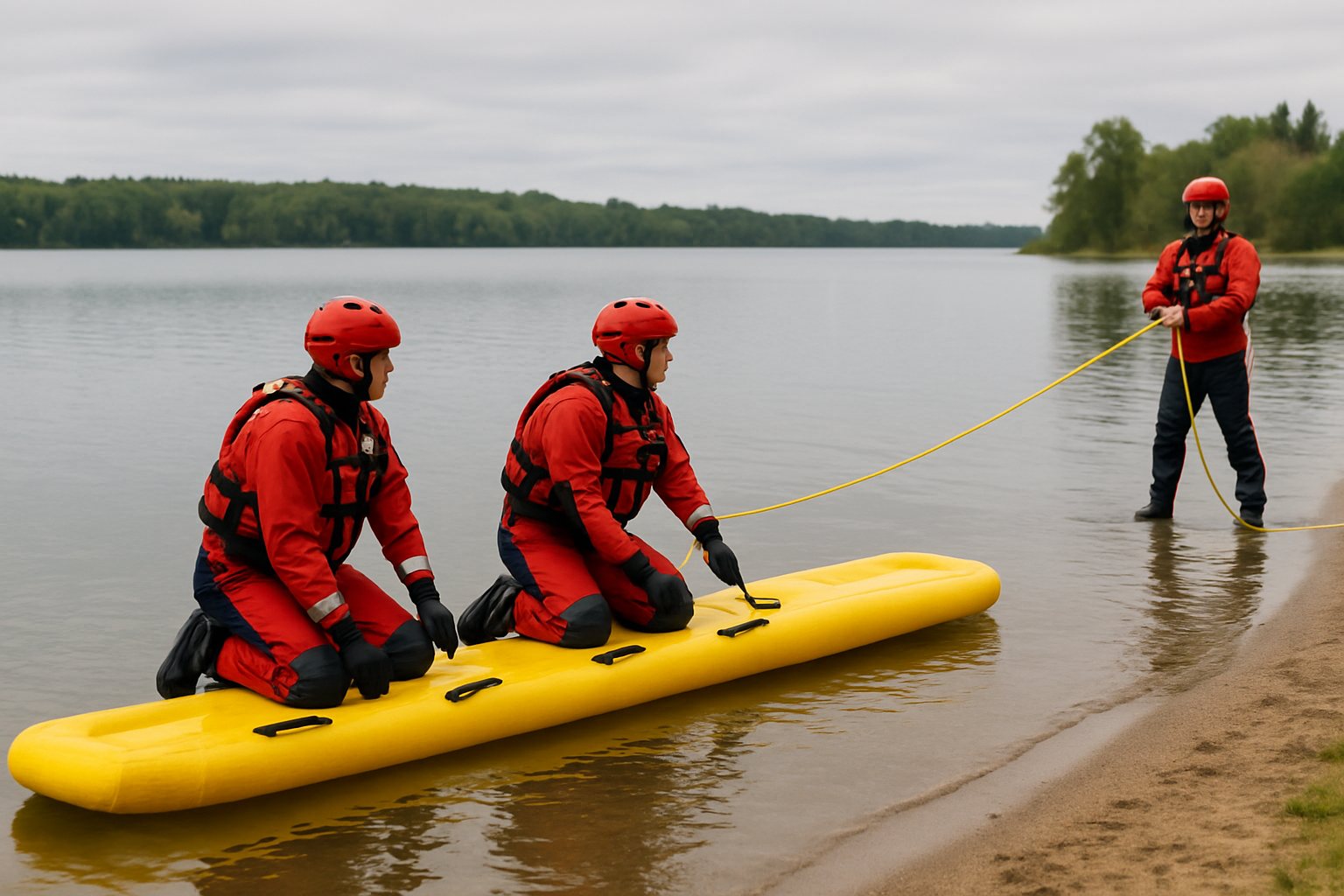
A call comes in for someone through the ice thirty yards off a frozen pond. The crew pull a long orange roll from the engine, run a hose from the apparatus air supply, and within a few minutes a flat, stiff walkway lies across the ice toward the hole, spreading a rescuer’s weight over a wide area. That’s an inflatable rescue platform: a long, narrow inflatable path built for fire and rescue teams, not for swimming or lounging. This page explains what these platforms are, how they are built, who makes them, and what a rescue service should ask a supplier.

In short: inflatable rescue platforms (also called rescue paths, walkways or bridges) are linkable inflatable sections, roughly 1.3 to 1.4 m (about 4.5 ft) wide and 5 to 10 m long, that give rescuers a stable surface over ice, water, mud and wetland. Documented examples are Paratech’s AIRTRACK, I.C. Brindle’s Fast Path and Covertex’s Rescue Bridge. They are sold to emergency services; recreational platforms are not rescue equipment.
What an inflatable rescue platform does
The job is to reach a casualty across a surface that won’t hold a person on foot: thin ice, deep mud, a marsh or open water near the bank. The platform is pushed or laid out from firm ground, and rescuers crawl or walk along it. Because it’s long and wide, it spreads load; because it floats, it stays up if the ice breaks; and because it’s rigid when inflated, it can be used as a working surface to lift a casualty out. Paratech’s own description, reported by Fire Apparatus Magazine, is “a safe, stable work platform on ice, water, mud, and wetlands”.
How rescue teams use them in real call-outs is on our rescue and emergency response page. Buying and procurement questions for agencies are on emergency services and government.
How rescue platforms are built
Rescue platforms share a few design choices that set them apart from lake decks:
- Catamaran footprint. Both Paratech and I.C. Brindle describe a catamaran-style footprint, with the floating volume split between the sides of the path rather than one flat slab.
- Chamber isolation. I.C. Brindle’s Fast Path has three chambers, each with an isolation valve, so a damaged section can be sealed off during a rescue.
- Fast inflation from air the crew already carries. AIRTRACK inflates from apparatus-mounted or other air supplies; Fast Path from an electric pump or a standard breathing-apparatus cylinder.
- Moderate pressure and a relief valve. Paratech gives 7.8 psi operating pressure and a built-in safety relief valve, lower than the 12 to 18 psi of stiff yacht and fitness decks.
- Tough, visible skins. AIRTRACK is heavy-duty nylon with reflective tape, an anti-slip surface, a grab line and ring connectors.
The documented rescue platforms
| Paratech AIRTRACK | I.C. Brindle Fast Path | Covertex Rescue Bridge | |
|---|---|---|---|
| Maker | Paratech (USA) | I.C. Brindle & Co (UK) | Covertex (Germany) |
| Width | 54 in (about 1.37 m) | 1.3 m (about 4.3 ft) | Not published |
| Lengths | 5 or 10 m, linkable | 2, 5 or 10 m, connectable | Not published |
| Height | 8 in inflated | Not published | Not published |
| Pressure | 7.8 psi | Not published | Not published |
| Inflation | Apparatus or other air supplies | Electric pump or BA cylinder | Not published |
| Stated use | Ice, water, mud, wetland | Water, mud, ice, sea rescue | Rescue and evacuation over water, wetland and ice; carrying equipment into emergency zones |
| Price | Not published | £1,650 on the maker’s site (October 2026) | Not published |
A note on dates: the AIRTRACK details come from a 2007 launch article. Check current availability and specs with Paratech before relying on them. Paratech adds that one person can handle the 5 m length, while the 10 m length needs two because of its weight, and both pack into a storage case.
Covertex Inflatable Rescue Bridge
by Covertex
Request more informationI.C. Brindle Fast Path rescue walkway
by I.C. Brindle
- Size (as stated): 1.3 m wide; 2, 5 and 10 m lengths that connect
Paratech AIRTRACK
by Paratech
- Size (as stated): 5 or 10 m lengths that link; 54 in wide x 8 in high
Related products that are not rescue platforms
A few products sit nearby and get confused with rescue gear. FloatDeck, a UK platform sold by Ndiver in 1 to 10 m lengths, says it grew out of rescue-platform work, but it’s sold for yacht support, maintenance access and watersports, with optional cylinder inflation. Recreational docks and lounges can look similar from a distance, but their ratings are for leisure use: no consumer maker we found presents a lake platform as rescue equipment, and neither do we. The work platforms page explains why a recreational rating doesn’t carry over to other jobs.
At the large end, the U.S. Army evaluated a Lightweight Modular Causeway System on inflatable tubes from 2008 for ship-to-shore access, including disaster relief. That was an evaluated military system, not a product on sale. It’s covered on emergency services and government.
What a rescue service should ask a supplier
- The rated working load per length and per linked set, and how it was established.
- Which standards or certifications apply. None of the listings we found names one, so ask directly.
- Inflation time from your crew’s air supply (cylinder size and number), and the pressure and relief-valve setting.
- What happens if one chamber is punctured: isolation valves, number of chambers, field repair kit.
- Packed size and weight, and how many crew it takes to deploy each length.
- Training, inspection intervals and service life recommended by the maker.
We don’t sell rescue equipment. If your service wants help reaching makers or comparing published specs, use Request more information.
Rescue platform questions
What is an inflatable rescue platform?
A long, narrow, linkable inflatable path that emergency crews lay over ice, mud, wetland or water to reach a casualty, spreading the rescuer’s weight and floating if the surface gives way.
How is a rescue platform inflated at the scene?
From air the crew already has: Paratech’s AIRTRACK from the apparatus air supply, I.C. Brindle’s Fast Path from a breathing-apparatus cylinder or an electric pump.
Can a homeowner keep an inflatable dock for ice rescue?
We don’t recommend it. Recreational docks aren’t designed, rated or presented by their makers as rescue equipment. Call emergency services; ice and water rescue is trained-crew work.
How much does an inflatable rescue walkway cost?
Few prices are published. I.C. Brindle listed its Fast Path at £1,650 in October 2026, with trade pricing for government, NHS, schools and blue-light services. Paratech and Covertex quote directly.
Keep exploring: see the documented call-out uses on rescue and emergency response, agency buying on emergency services and government, other engineered products on work platforms, and every type on floating platform types.