This article contains affiliate links: if you buy through them we may earn a commission, at no extra cost to you. Read our affiliate disclosure.
Eight boards float in a line across the deep end of a hotel pool, each one clipped to the next. The instructor calls the next pose and eight people slowly rise into warrior two, wobbling and laughing as one board bobs and the water slaps the sides. A floating yoga mat turns a simple class into a balance workout, because every small movement shows up underfoot. This page covers what these mats are, how they differ from a paddle board or a swim deck, the makers that build them for pools and resorts, and what to look for if you want one for a lake.
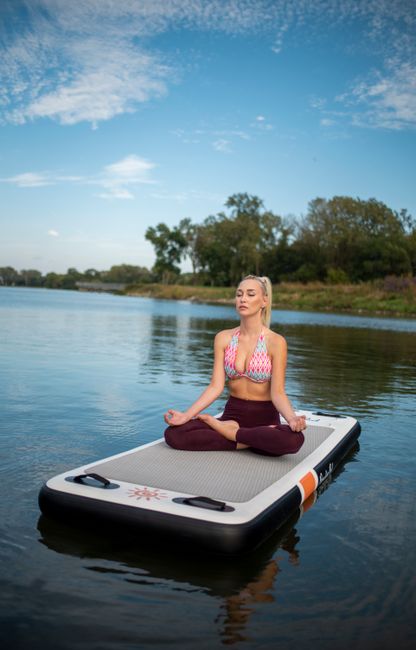
In short: a floating yoga mat or aqua fitness mat is a single-person drop-stitch board, usually about 6 in (15 cm) thick and roughly 8 ft (2.4 m) long, inflated firm (makers state 10 to 18 psi) so you can stand, kneel and balance on it. Pool versions from NSP, Glide and Aquafitmat clip together or to lane lines; lake versions tie to an anchor. Weight limits are per mat and set by each maker.
What a floating yoga mat is, and how it differs from a paddle board
It looks like a short, wide paddle board and uses the same drop-stitch construction, but the shape is built for standing still rather than moving. Fitness mats are wider and blunter, usually have no fin, and have a deck pad that covers most of the top so you can lie down, kneel and plank on it. Many add handles or rings for resistance bands. A paddle board is long and narrow so it tracks through the water; a fitness mat is short and wide so it sits steady in one spot.
A big inflatable deck is a third option. You can do yoga on a 10 x 10 ft swim deck, but it’s much steadier, which is restful but loses the balance challenge that makes floating fitness work. Our water sports and fitness page covers the class and activity side; this page is about the mats themselves.
Aqua fitness mats made for pools and resorts
Several makers build mats specifically for group classes, where the mats have to stay in rows and survive daily use:
| Mat | Build (as stated) | How it stays in place | Sold to |
|---|---|---|---|
| NSP NSPiration Mat | 6 in drop-stitch, 15 to 18 psi | Not stated in the listing | Gyms and resorts |
| Glide FIT | 6 in drop-stitch, 15 psi | Sized to fit between pool lanes | Gyms and pools |
| Aquafitmat | Inflatable floating mat | Clips to lane lines and to other mats | Public pools |
| Aqua Marina Peace | 8 ft 2 in fitness mat | Not stated in the listing | Retail; 330 kg payload (retailer listing) |
| Solstice SolFit | 7 ft 10 in x 36 in x 6 in, up to 10 psi | D-rings to tie off | Retail; 275 lb capacity (maker) |
Two things stand out. First, pressure: these mats run at 10 to 18 psi as their makers state, higher than most lake lounges and docks (often 5 to 10 psi), because a narrow board needs to be very stiff to stand on. Second, the clip-together systems: Aquafitmat’s lane-line and mat-to-mat clips and Glide’s lane-width sizing are what make a class of twenty workable in an ordinary pool.
A floating yoga mat for the lake: two pieces to start
For home use you need the mat and a way to keep it from drifting. A small anchor on a line from one of the mat’s D-rings is the simple answer in calm water. Prices are about what Amazon showed in October 2026.
Solstice SolFit inflatable fitness mat
- 7 ft 10 in x 36 in x 6 in (maker)
- 275 lb capacity (maker)
- About $350, seen October 2026
WCSS mushroom anchor kit, 8 lb
- 8 lb mushroom anchor, 20 ft rope, hook, float
- Listed for shallow water and paddleboards
- About $30, seen October 2026
One detail worth knowing: the Amazon listing for the SolFit suggests 15 psi, while Solstice’s own product page says the core takes up to 10 psi. Follow the maker’s page and the label on the mat. For anchor weight and line length, see how to anchor an inflatable platform.
What to look for in an aqua fitness mat
- Width and length. Around 3 ft (90 cm) wide and 8 ft (2.4 m) long is the common size for one person. Wider is steadier; narrower is harder.
- Maker’s weight limit. These are one-person boards. Use the maker’s figure (275 lb for the SolFit, for example) and include any weights you carry.
- Deck pad coverage. A pad over most of the top means you can kneel and lie down without slipping.
- Attachment points. D-rings for an anchor line or a tether to the next mat; handles that double as band anchors.
- Pressure and pump. 10 to 18 psi takes effort by hand. Classes with many mats usually use an electric pump.
- Warranty for the way you’ll use it. Home use and a daily class are different jobs; ask whether commercial use is covered.
Running floating fitness classes as a business
Gyms, hotels and resorts are the main buyers of the pool systems above. Before buying a set, check with the pool operator how mats will be secured (lane lines, anchors or tethers), how many fit your pool, how they’ll be dried and stored between classes, and whether your insurer has rules for in-water classes. Our pages on resorts and hospitality and rental and tour operators cover the business questions. For a quote on a set of class mats, use Request more information.
Care and safety
Rinse mats in fresh water after a chlorinated pool or the sea, let them dry fully before rolling, and store them out of direct sun, the same routine makers give for drop-stitch docks. In open water, cold is the bigger risk than falling off: the National Weather Service warns that cold shock and involuntary gasping can happen in water well above freezing. If you paddle your board beyond a swimming area, the U.S. Coast Guard treats a paddleboard as a vessel, with life jacket rules that apply. Our safety checklist has the full list.
Floating yoga mat questions
Can you do yoga on an inflatable paddle board instead?
Many people do, but a paddle board is longer and narrower, so it’s harder to balance on and may not have pad under your hands and knees. A fitness mat is shorter, wider and padded over most of its top.
How do pool classes keep the mats in rows?
With the system the mat was made for: Aquafitmat clips to lane lines and to other mats, and Glide sizes the Glide FIT to fit between pool lanes.
How firm should a floating yoga mat be?
As firm as its maker says: Solstice gives up to 10 psi for the SolFit, Glide 15 psi and NSP 15 to 18 psi. Use a pump with a gauge.
Can two people share an aqua fitness mat?
They’re designed for one. Stay within the maker’s weight limit; for partner work, two mats tied side by side work better.
Keep exploring: plan a class on water sports and fitness, compare bigger decks on floating mats and launch platforms, or see every type on floating platform types.