This article contains affiliate links: if you buy through them we may earn a commission, at no extra cost to you. Read our affiliate disclosure.
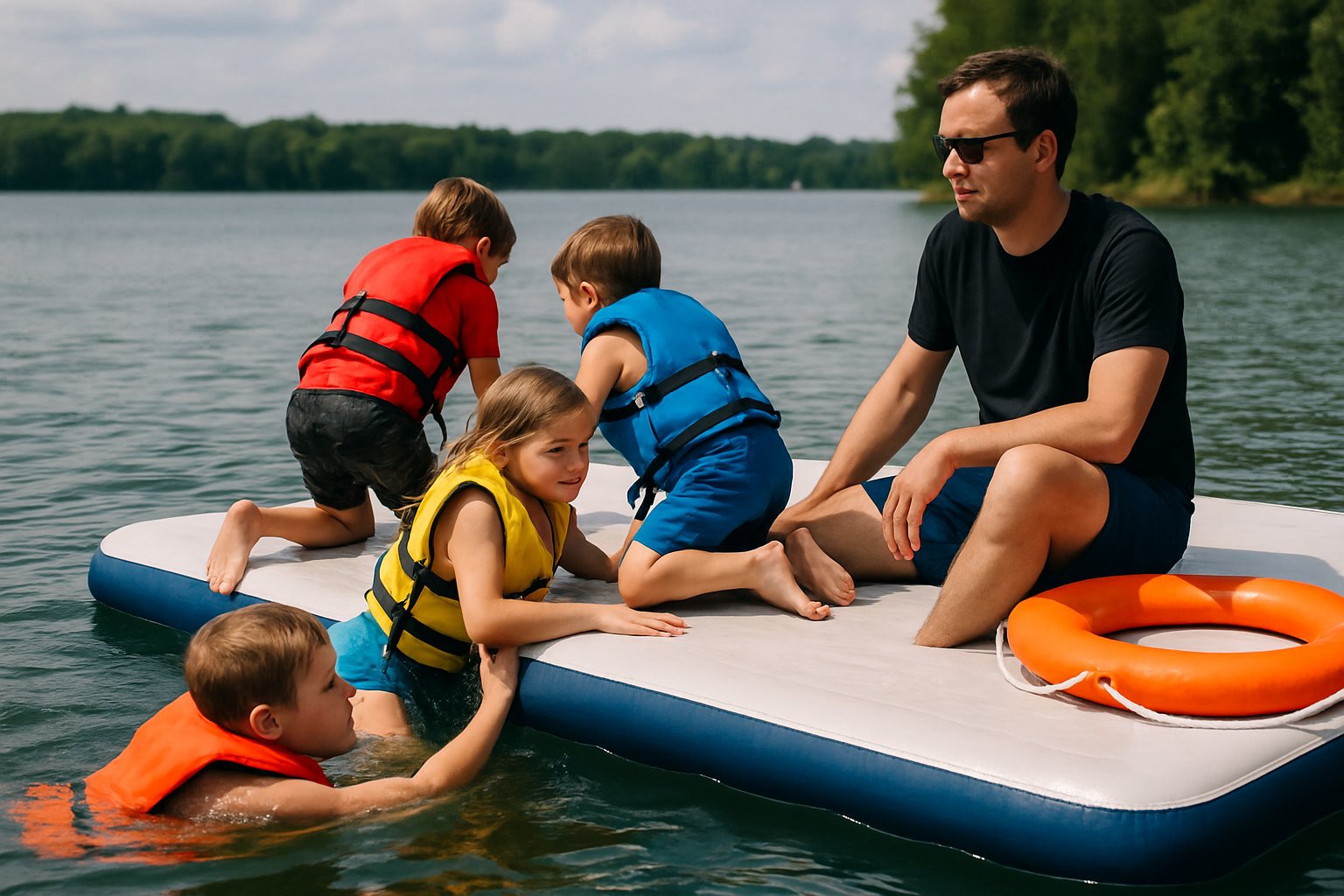
The boat is anchored off the sandbar, engines off, and the platform is tied off the stern. Two kids are already on it in their life jackets, an aunt is lying on the far corner, and someone asks the question every boat owner eventually hears: “Do we need anything for this? Does the Coast Guard have rules about it?” Inflatable platform water safety covers two things: the boat you came on, which the law treats as a vessel with required gear, and the people on the platform, mats and trampolines, who are swimmers in open water. We gathered what the U.S. Coast Guard, the CDC, the National Weather Service, the Red Cross, state agencies and the makers publish.
In short: the Coast Guard’s equipment rules apply to the boat, not to a floating mat or swim platform. The boat needs a life jacket for every person, a throwable device if it is 16 ft or longer, and the extinguishers, signals and lights its size and waters call for. The people on the platform need what keeps swimmers alive: life jackets that fit, one adult watching the water, engines off, calm weather and a plan for an emergency.
Where the Coast Guard applies, and where it doesn’t
Federal law defines a vessel as a watercraft or other contrivance used, or capable of being used, as a means of transportation on water. Your boat is one. A floating mat, lounge or swim deck tied behind it is built for play, not transport, and the Coast Guard’s equipment rules are written for boats. But the boat it is tied to still has to carry its required gear, and states write their own rules for swim rafts, buoys and floats left in the water. How your state treats a particular float is a question for your state boating agency; this section is not legal advice.
A note on numbers. The Coast Guard’s 2024 boating statistics (556 deaths) count boating incidents; people hurt while voluntarily swimming or jumping from an anchored or moored boat are listed separately as “not reportable” (8 incidents and 4 deaths in 2024). Nobody publishes a national count for inflatable platforms, and we don’t invent one.
Inflatable platform water safety: what each page covers
| Page | The question it answers |
|---|---|
| Coast Guard requirements | What the boat must carry, how platforms fit in, and state rules for swim rafts and anchored floats |
| Life jackets on platforms | Do you need a life jacket on a floating mat? Types, kids’ sizes, weak swimmers and what makers say |
| Swimming and supervision | Water safety for kids: the water watcher, depth, boat traffic, propellers |
| Carbon monoxide near boats | Why platforms and mats belong away from the stern, exhaust and generators |
| Weather, wind and cold water | Forecasts, offshore wind, lightning and cold-water shock |
| Commercial operator safety | What resorts and rental operators should check: state rules, lifeguards, standards, insurers |
| First aid and emergencies | What to do in a water emergency: reach or throw, calling for help, CPR, VHF channel 16 |
Two practical guides sit alongside this section: the inflatable platform safety checklist for a normal day out, and how to anchor an inflatable platform for anchors, rope and scope. We don’t repeat them here.
Safety for the boat
The Coast Guard’s own guide says federal equipment requirements are minimums that don’t guarantee safety, and states may add more. For a platform day, three boat points matter most: the required gear is aboard and reachable (life jackets for everyone and, on a boat 16 ft or longer, a throwable within arm’s reach); engines and generator are off while people are in the water, which the Coast Guard calls the best and safest action; and someone knows how to call for help, by phone or on VHF channel 16. The Coast Guard requirements page has the full checklist table.
Safety for the people
The CDC recommends a responsible adult supervising closely and constantly when children are in or near water, and life jackets for children in and around natural water. The Red Cross suggests naming a “water watcher” and rotating the job, for example every 15 minutes. Makers add their own rules: RAVE’s dock manual asks every user to wear an approved life jacket and says the dock is not a life-saving device. Start with life jackets on platforms and swimming and supervision.
Two dangers people don’t see coming
Carbon monoxide. The CDC says CO near the swim deck can kill someone in seconds, and a platform tied right at the stern puts people exactly there. See carbon monoxide near boats.
Wind. A light float can be pushed away from shore fast when the wind blows off the land. Wisconsin’s DNR advises caution with, or avoiding, recreational flotation devices when strong offshore winds are present. No platform maker we found publishes a wind-speed limit. See weather, wind and cold water.
Safety gear worth keeping on board
Two items cover most platform afternoons: a properly sized life jacket for each child and an approved throwable for the boat.
Airhead Treasure Kids' Life Jacket
- USCG Type III, Child size (listing)
- Closed sides, crotch strap
- Front zipper, adjustable belt
Bradley Type IV Boat Cushion
- USCG approved Type IV (listing)
- About 16 x 14.5 x 2.5 in
- Doubles as a seat
About $27 for the Airhead child jacket and about $36 for the Bradley cushion, seen in October 2026; both were in stock when we checked. More choices are on our life jackets page.
For businesses
If you put guests on platforms, aquaparks or rental mats, the rules come from your state, your insurer and your equipment’s standards. Our commercial operator safety page lists the questions to ask, and the commercial platforms section covers equipment. When something goes wrong on any day, first aid and emergencies covers the first minutes.
Water safety questions
Is an inflatable swim platform a vessel?
Federal law defines a vessel by its use for transportation on water, and a play platform isn’t built for that. The Coast Guard’s equipment rules apply to the boat it is tied to. State rules can still cover anchored floats and rafts, so ask your state boating agency about your water.
Who sets the rules for a swim raft in front of my house?
Usually the state, sometimes the county. Minnesota, for example, needs a sheriff’s permit for a raft left out overnight; New Jersey needs State Police approval for a float more than 25 ft from shore on power-boat waters. Our Coast Guard requirements page lists the state rules we checked.
Where do I find my state’s boating rules?
The Coast Guard points boaters to NASBLA’s list of state boating agency contacts at nasbla.org. Your state’s boating guide, usually published by its natural resources or wildlife agency, is the place to start.
New to platforms? Begin at Start here, read how they are built in Learn, or see real family setups in family lake days and boating and yachts.