This article contains affiliate links: if you buy through them we may earn a commission, at no extra cost to you. Read our affiliate disclosure.
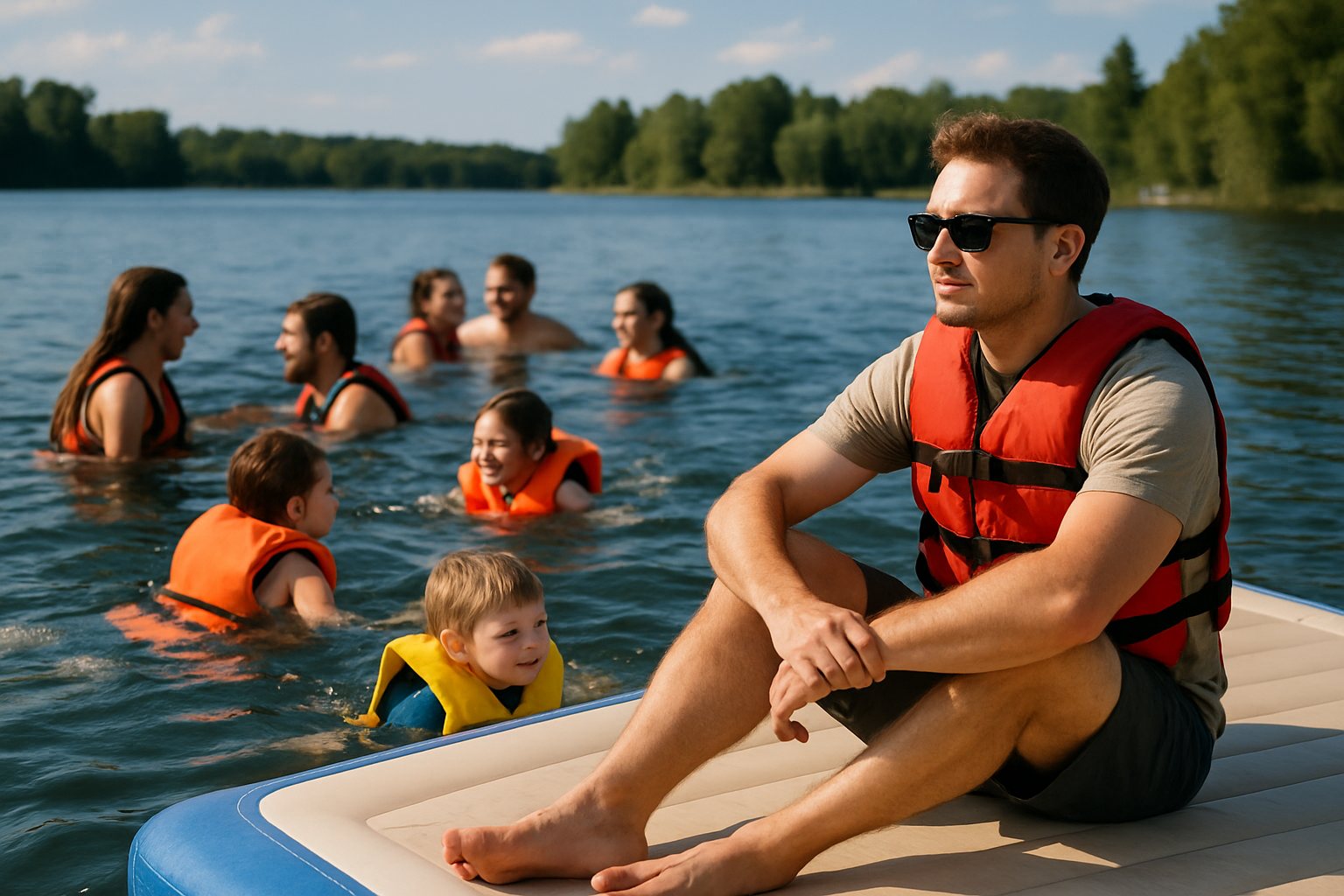
It’s the busiest hour of a lake afternoon. Four kids are taking turns jumping off the platform, two adults are chatting on the boat, another is grilling, and everybody assumes somebody else is watching. That assumption is the gap. Good water safety for kids on platforms and floats is less about rules than about attention: one named adult watching the water, life jackets on, the right depth, and boats and propellers kept well away. Here is what the CDC, the Red Cross, the Coast Guard and the platform makers say, turned into a routine you can use.
In short: name one adult as the water watcher, with no phone and no drinks, and rotate the job. Put children and weak swimmers in Coast Guard approved life jackets. Use the platform only in the depth its maker states, feet-first jumps only, nobody under it. Engines off, propellers clear, and the platform positioned away from boat traffic.
Water safety for kids: why open water needs closer watching
The CDC’s figures are sobering. From 2012 to 2021 an average of 4,083 people died each year in the U.S. from unintentional drowning. More children ages 1 to 4 die from drowning than from any other cause of death, and for ages 5 to 14 it is the second leading cause of unintentional injury death after motor vehicle crashes. The Red Cross adds that people aged 5 to 17 are more likely to drown in natural water such as a pond or lake. The CDC describes drowning as quick and quiet, and notes that lakes and rivers have hidden hazards such as currents and waves. A child who swims well in a pool may not be ready for deep, dark, moving water off a platform.
Name a water watcher
The Red Cross explains why group settings are risky: tragedies often happen because people assume someone else is supervising. Its fix is a designated water watcher whose only job is to watch the children in the water. Its water watcher guidance describes that person as:
- At least 16 years old, with adults preferred.
- Able to recognize someone in trouble and either rescue them or alert someone who can.
- Trained in CPR or able to immediately alert someone who is.
- Carrying a working phone and a flotation device or reaching object.
- Alert, sober and not distracted by texting, phone calls or conversation.
Rotate the role on a schedule (the Red Cross suggests every 15 minutes) and hand over a card or a lanyard so everyone knows who is on duty. The CDC’s advice matches: a responsible adult supervising closely and constantly, without phones or alcohol. The Coast Guard’s boater’s guide recommends a water watcher for adults as well as children.
What the watcher looks for
The Red Cross lists three signs that a swimmer needs help right away: they aren’t making forward progress, they are vertical in the water but can’t move or tread water, or they are motionless and face down. On a platform day, also watch the gap between the boat and the platform, the far edge where kids jump, and anyone who has been knocked off by someone else’s landing.
Depth and jumping
Depth is set by the maker, not by guesswork, and it differs a lot by product:
| Product (maker’s manual or page) | Minimum depth stated | Other rules for kids |
|---|---|---|
| RAVE Aqua Dock (inflatable dock) | 4 ft | Constant adult supervision; feet first; no flips; never swim under it |
| Aqua Lily Pad (foam mat) | 6 ft | PFD recommended; not designed to be towed |
| RAVE Aqua Jump Eclipse (water trampoline) | 10 ft | Not recommended for children under 6; bounce in the center; no flips or somersaults |
The Red Cross advises entering unknown or shallow water feet first, diving only where it is clearly marked safe for diving with at least 9 ft of depth and no obstacles, and not entering the water from a height such as a boat. Check under and around the platform before the first jump of the day; RAVE’s manuals ask users to make sure the water is free of rocks, logs, sandbars and other obstructions. Our safety checklist has the full pre-launch routine.
Boats, propellers and traffic
Propellers are the injury nobody forgets. The Coast Guard counted 169 incidents in 2024 in which at least one person was struck by a propeller, with 30 deaths and 158 injuries. Its guidance for boaters is direct: shut off your engines when approaching swimmers, keep people in the water on the operator’s side and in view, and remember that the best and safest action when people are near the boat is to turn the engine off. Propeller guards help but aren’t suitable for every boat.
- Keep the platform clear of the stern. RAVE asks users to keep a safe distance from engines and propellers and warns that tethering to boats raises the potential for injury. Tie it off on a line long enough that it can’t drift under the swim ladder or outdrive.
- Engine off stays off. Nobody starts the engine to reposition the boat while anyone is in the water or on the platform.
- Watch other boats. The Red Cross lists other people’s boating among the hazards of natural water. Set up away from channels and ski lanes. Some states protect swimmers and rafts by law: Minnesota requires personal watercraft to stay at slow no-wake speed within 150 ft of swim rafts, swimmers and anchored boats.
- Use proper swim-area markers where allowed. In the U.S. marking system, a white buoy with orange bands and an orange diamond with a cross means boats keep out; your state may require a permit to place them.
Engines matter for another reason too: exhaust. Our carbon monoxide near boats page explains why the swim platform area is the worst place to be with an engine or generator running.
Layers, not a single rule
The Red Cross talks about layers of protection: barriers, life jackets and close supervision together, plus swimming skills. Its idea of water competency is being able to enter the water, get a breath, stay afloat, change position, swim a distance and get out safely. The CDC says formal swimming lessons can reduce drowning risk but that children who have had lessons still need supervision. When the day is over, secure the platform against unsupervised use, as the makers ask, so nobody goes out alone. See life jackets on platforms for sizes.
Aqua Oceans 7 Kids' Life Jacket
- USCG approved, Child 33-55 lb (listing)
- Over 45 lb: listing suggests trying Youth
- 3 adjustable straps
Taylor Made Coast Guard Approved Life Ring 20 in
- USCG approved Type IV (listing)
- 20 in OD, 3.5 in thick
- Floating grab line
About $38 for the Aqua Oceans child jacket and about $88 for the Taylor Made ring, seen October 2026. Keep the throwable on deck facing the platform, where the water watcher can reach it.
Kids’ water safety questions
How old should a water watcher be?
The Red Cross says at least 16, with adults preferred, and someone who can recognize trouble, call for help and isn’t distracted or drinking.
Is there a minimum age for water trampolines?
Some makers set one. RAVE’s Aqua Jump Eclipse manual says it is not recommended for children under six. Check your model’s manual.
How deep should the water be under a platform?
At least the maker’s stated depth for that product: 4 ft for RAVE’s Aqua Dock, 6 ft for Aqua Lily Pad mats and 10 ft for RAVE’s Aqua Jump trampolines, for example.
Can kids dive off the platform?
RAVE says never head first, and to enter feet first. The Red Cross advises diving only in water marked safe for diving, at least 9 ft deep with no obstacles.
How far should the platform be from the boat?
No maker publishes a number we could find. RAVE asks for a safe distance from engines and propellers, and the CDC says to stay at least 20 ft from any boat running an engine or generator. Keep engines off while people are in the water.
Back to the water safety hub. For emergencies, see first aid and emergencies; for slides off the boat into the same water, BoatSlide has boat slide safety tips.