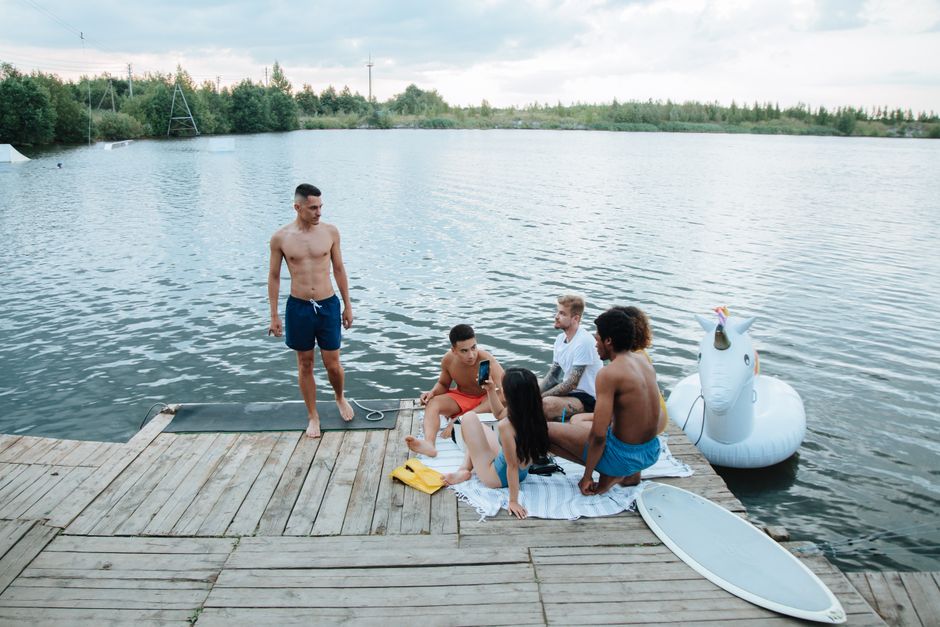
The questions usually come at the shoreline, pump in hand: will it hold all of us, how far out can it go, what happens if a dog’s claw catches it? We’ve collected the questions buyers ask most about inflatable platforms and answered each one briefly, using makers’ own figures and official safety sources. Each answer links to the guide that goes deeper.

In short: an inflatable platform is a firm floating deck made of high-pressure drop-stitch fabric. How many people it holds, how deep the water must be, how to anchor it and how firm to pump it are all set by its maker, so the label and manual always win over a rule of thumb. Business, work and rescue uses need products and paperwork made for them.
Beginner questions
What is an inflatable platform?
A floating deck you pump up. Most use drop-stitch: two fabric skins joined by thousands of threads, so the deck stays flat and stiff enough to stand and sit on. Start Here explains the basics.
What’s the difference between a platform, a floating mat and a lily pad?
A lily pad or floating mat is usually a flexible sheet of closed-cell foam that bends with the water; an inflatable platform is pumped firm and stays flat. Drop-stitch “water mats” sit in between. See inflatable platform vs floating mat.
What are the main types?
Swim and boat platforms, yacht platforms, floating islands and lounges, mats, water trampolines and parks, sea pools, launch platforms, fitness mats, fishing boards, and engineered work and rescue platforms. All are on floating platform types.
How long does it take to set one up?
It depends on size and pump. Small decks go up with a hand pump; large and high-pressure platforms are much faster with an electric pump. Check the maker’s stated pressure first, because it decides which pump you need.
Can I leave it in the water all summer?
Many owners do, anchored, but bring it in for storms and high wind. RAVE’s manual also notes that keeping a dock at full pressure helps discourage muskrats from chewing it. Rinse and check it regularly.
How long do inflatable platforms last?
No maker publishes a life in years. Warranties hint at expectations: from 1 year (light commercial, Aquaglide) to a limited lifetime for personal use (RAVE docks). Sun, heat and dragging do the most damage.
Sizes and capacity
How many people can stand on an inflatable platform?
Only as many as its maker states. Examples: RAVE’s 10 x 10 ft Aqua Dock 10, 10 adults or 1,800 lb; Aquaglide’s Ohana, 6 adults or 544 kg; NautiBuoy’s 4 x 2 m Voyager 800, 5 people or 700 kg.
Why do two listings give different capacities for the same platform?
Retailers copy and round figures. We’ve seen 1,500 vs 2,000 lb for one RAVE mat and 2,100 vs 1,500 lb for one BOTE dock. Use the maker’s own page and the label.
What size should I buy?
Start from how many people will be on it at once and how you’ll carry and store it. How to choose an inflatable platform has a size table.
What do yacht platform numbers like 525 and 800 mean?
Area codes: 375 is 2.5 x 1.5 m, 525 is 3.5 x 1.5 m, 675 is 4.5 x 1.5 m and 800 is 4 x 2 m. See yacht platforms.
How thick should a platform be?
Thickness classes we see: about 3 in (8 cm) mats, 4 in (10 cm) small decks, 6 in (15 cm) most consumer decks and 8 in (20 cm) yacht platforms. Thicker is common on larger and yacht-grade decks.
Anchoring and placement
How deep does the water need to be?
Follow the manual: about 1 m (3.3 ft) for Aquaglide’s Solarium, 1.2 m (4 ft) for RAVE’s Aqua Dock, and 8 to 10 ft under water trampolines. Allow more where people jump.
How heavy an anchor do I need?
Use the maker’s figure where it gives one. Aquaglide asks for at least 250 kg for its Solarium and 2,000 kg across four points for its Ohana, far more than most people expect. See how to anchor an inflatable platform.
Can I tie a platform to my boat?
At anchor, yes, if the maker allows it. Keep it clear of engines and exhausts, and never tow it with people aboard. RAVE’s manual warns that tethering to boats and hard objects increases the risk of injury.
Do I need a permit to keep a platform on a lake?
It depends on the state and the water body. Minnesota, for example, doesn’t allow swimming rafts that don’t extend from shore to stay in the water from sunset to sunrise without a county sheriff’s permit. Check with your state and local authority.
Materials and care
What is drop-stitch?
A fabric with two skins tied by thousands of threads; air pressure pushes the skins apart and the threads keep them flat. Goodyear patented it in the 1960s. Full story: what is drop-stitch.
PVC, Hypalon or TPU: which is better?
Most platforms use PVC-coated polyester. Hypalon appears on some heavy-duty tubes (Henshaw) and is known for resisting chemicals and UV. TPU is lighter with better UV life but costs more. Each needs its own repair glue.
What pressure should I pump it to?
The figure printed for your model, never more. Makers state anything from about 3.5 psi (some lounges) to 15 psi (yacht platforms) and up to 18 psi (fitness mats). Recheck after it sits in the sun.
Can I repair a puncture myself?
Small holes, usually yes, with the kit that comes in the box and a glue suited to the coating; let it cure fully. For seam failures or large tears, contact the maker.
How should I store it over winter?
Wash with mild soap, dry both sides completely, roll loosely and store cool, dry, shaded and away from rodents, as RAVE’s manual describes. Avoid solvents and power washers.
Commercial and work use
Can a resort or rental business use a consumer platform?
Check the warranty and your insurer. Some consumer warranties cover personal use only; Aquaglide separates residential (3 years) from light commercial (1 year). See commercial platforms.
Does “commercial grade” mean anything?
Not on its own: no standard sits behind the phrase. Ask for the rated load, the commercial warranty and any certification.
Can I use a swim deck as a work platform?
A recreational rating doesn’t make a deck suitable for crews, tools and materials. Work platforms such as FunAir’s (300 kg) and VersiFloat’s (2,149 lb) are sold for that job. See work platforms.
Are there inflatable platforms for rescue services?
Yes: rescue paths for ice, mud and water from Paratech, I.C. Brindle and Covertex. See rescue platforms.
Can I get a custom-size platform?
Several yacht and commercial makers build bespoke (FunAir, Henshaw, SeaRaft). Use Request more information to tell us what you need.
Safety
Do I need life jackets on a platform?
A platform isn’t a life jacket. The U.S. Coast Guard reports that where cause of death was known, most boating victims drowned, and most of those weren’t wearing a life jacket. Have a properly fitted, Coast Guard approved life jacket for each person, especially children and weaker swimmers.
When should we get off the platform?
Before storms, high wind or waves. NOAA advises getting out and away from lakes when lightning threatens and waiting 30 minutes after the last thunder.
Is it safe near a boat that’s running?
Keep clear. The CDC warns that carbon monoxide can build up around a boat’s stern and swim platform and advises staying at least 20 ft from boats running an engine or generator.
How should kids use a platform?
With an adult watching closely and constantly, as the CDC advises, feet-first entry into water of the depth the maker requires, and the maker’s limits for bouncing or standing. Our safety checklist has the full list.
Keep exploring: learn the basics on how inflatable platforms work, look up a word in the glossary, browse platform types or start with Start Here.