This article contains affiliate links: if you buy through them we may earn a commission, at no extra cost to you. Read our affiliate disclosure.
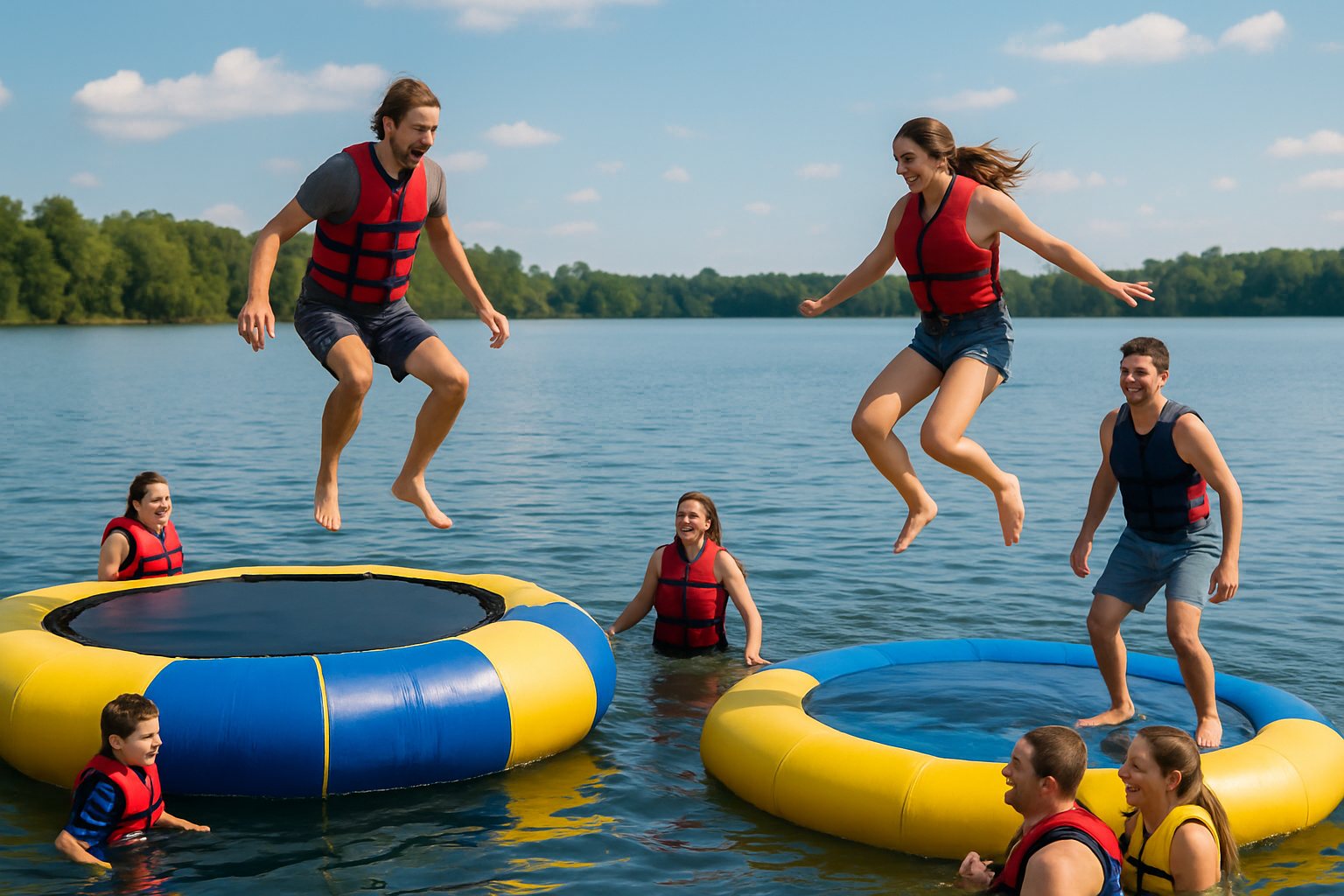
The teenagers want height. They’ve seen the videos of backflips off a floating trampoline and that’s all they talk about at dinner. The younger kids just want something to bounce on, slide off and climb back onto all afternoon, and the parents want something that won’t take a whole weekend to set up or rust by August. Standing in that conversation is the question every lake family hits: water trampoline or water bouncer? They look alike from the dock, but they’re built differently, bounce differently and need different water. Here’s how to tell them apart and choose.
In short: a water trampoline has steel springs (and often a frame) between the tube and the jump mat, so it bounces higher but weighs more, needs deeper water and more care. A water bouncer laces the mat straight to the tube with no springs: a softer bounce, a bigger jump surface for the price, less weight and nothing to rust. Choose by who jumps, how deep your water is, and how much setup you want.
Water trampoline vs water bouncer: the difference
Both start with a big inflatable ring that floats. The difference is how the jumping surface hangs inside it:
- Spring trampoline: the jump mat is held by heavy metal springs. RAVE says the springs on its Aqua Jump add bounce, and Aquaglide says its Supertramp 17’s galvanized steel frame and stainless springs give “superior bouncing”.
- Springless bouncer: the mat is connected directly to the tube. RAVE says its Bongo bouncers are lightweight and portable, offer a larger jump surface but give up some bounce compared with its spring trampoline, and have no rust-prone hardware for fresh or salt water. Island Hopper describes the bounce on its springless model as less than a steel-frame trampoline.
- A third kind, elastic bands: some budget models sold as “water trampolines” use elastic bands instead of metal springs. Goplus describes its 10 ft model this way and rates it at 330 lb.
Side by side, using makers’ figures
| Model | Type | Size | Capacity (maker) | Unit weight | Water depth (maker) | Maker price (Oct 2026) |
|---|---|---|---|---|---|---|
| RAVE Aqua Jump 150 | Spring | 15 ft | 2 adults or 4 children, 700 lb | 142 lb | 10 ft | $3,799.99 |
| Aquaglide Supertramp 17 | Spring, steel frame | 17 ft | 3 bouncing / 4 lounging, 800 lb | 65 kg (Amazon listing) | 8 ft | $3,889.99 |
| RAVE Bongo 13 | Springless | 13 ft (12 ft 6 in) | 2 adults or 4 children, 700 lb | 50 lb | 8 ft | $1,399.99 |
| RAVE Bongo 20 | Springless | 20 ft | 5 adults or 10 children, 1,500 lb | 135 lb | 8 ft | $2,799.99 |
| Island Hopper 17 Bounce N Splash | Springless, padded rim | 17 ft | 5 people, 1,000 lb (Amazon listing) | 132 lb (listing) | Not on the listing | $1,929 (Amazon) |
| Goplus 10 ft | Elastic bands | 10 ft | 330 lb | 18 kg (listing) | Not on the listing | $229.99 (Amazon) |
A few patterns jump out. Springless bouncers are cheaper at the same size: RAVE’s 13 ft Bongo costs well under half its 15 ft spring trampoline. Spring models are much heavier. And depth differs: RAVE asks for 10 ft of water under the Aqua Jump, 8 ft under the Bongo. Across its whole range, RAVE says Bongo bouncers carry 500 to 1,500 lb in four sizes, and its largest spring trampoline holds up to 1,400 lb.
Who should get which
RAVE frames the choice around three questions: how many users, what ages, and how often. That’s a good way to think about any brand.
- Young kids, occasional use: a small starter bouncer. RAVE suggests its O-Zone for this, with a suggested maximum of 300 lb.
- A family of mixed ages, most weekends: a mid-size springless bouncer, 13 to 17 ft. Bigger jump surface, easy fall takedown.
- Teens and adults who want height, every day: a spring trampoline. RAVE suggests its Aqua Jump for “a bunch of teenage boys”.
- Salt water: springless avoids metal springs in the water; RAVE notes its Bongo has no rust-prone hardware.
Water depth and where to put it
People drop off the sides of a water trampoline from height, so depth is non-negotiable. Use the maker’s figure and measure on every side, at the lowest water of the summer. Most makers we checked ask for 8 ft; RAVE asks 10 ft for the Aqua Jump and its add-ons. Some also set a distance from shore: Aquaglide asks for its Rebound 20 bouncer to sit at least 15 ft out. Keep it out of boat traffic and away from docks, swim ladders and other floats that someone could land on.
Anchoring a water bouncer or trampoline
A big round float catches wind, and jumping makes it walk. Most makers include an anchor harness or bridle but not the anchor or line: RAVE includes a heavy-duty harness with the Aqua Jump and says the anchor line is extra; Aquaglide lists anchor weights, mooring lines and the pump as not included with the Supertramp. Where makers state a minimum anchor weight, it’s substantial: Aquaglide gives 1,100 lb (500 kg) of total anchor weight for the Supertramp 17 and 500 lb for the Rebound 20, and recommends a dock and mooring specialist for installation. Budget models sometimes include a fill-it-yourself anchor bag (Goplus does, for water or sand). See how to anchor an inflatable platform.
Setup and fall takedown
A springless bouncer is mostly inflation: RAVE says 20 to 40 minutes for a Bongo 13 with a high-capacity pump; the Island Hopper 17 listing says about 15 minutes with a standard inflator; Goplus says 10 minutes with its included 500 W inflator. A spring trampoline adds assembly: RAVE’s steps for the Aqua Jump are inflate the tube, attach the ladder, springs, jump surface and spring pad cover, then position and anchor it. At 142 lb for a 15 ft spring model against 50 lb for a 13 ft bouncer, taking it out in the fall is a very different job.
Add-ons: slides, logs, launches and boarding steps
Both types take attachments from their own maker. RAVE sells an Aqua Slide (about $950) that fits the Aqua Jump 150 and the Bongo 15 and 20, a smaller slide (about $650) for the Bongo 10 and 13, and an Aqua Launch (about $800). Island Hopper sells a Bounce N Slide attachment. Aquaglide ships the Supertramp 17 with its low Swimstep boarding platform and lets it link to its aquapark pieces with five D-rings and Vario-Lock straps. Buy add-ons from the same maker and check the fit list; attachments aren’t universal. Building a full play area? See best inflatable water parks and the water trampolines and water parks overview.
One of each kind to compare
A spring trampoline, a springless bouncer and a budget elastic-band model, all in stock on Amazon when we checked in October 2026 (prices change often). For our ranked list, see best water trampolines.
Aquaglide Supertramp 17
- Steel frame, stainless springs
- 800 lb; 3 bouncing (maker)
- Swimstep included; 8 ft depth
Island Hopper 17' Bounce N Splash
- Foam-padded rim
- 1,000 lb, 5 people (listing)
- 6 anchor D-rings
Goplus Inflatable Water Trampoline
- 10, 12 or 15 ft
- 330 lb (10 ft listing)
- Inflator, ladder, anchor bag included
We saw the Supertramp 17 at about $3,690 on Amazon (Aquaglide lists $3,889.99; pump and anchors extra; 3-year limited warranty), the Island Hopper 17 ft at about $1,930 (5-year seam warranty, ages 14 and up, rope ladder and carry bag included), and the Goplus 10 ft at about $230 (90-day warranty). The Goplus is a light-duty choice for one adult or two teenagers at a time by its own rating.
Check the Island Hopper 17' Bounce N Splash price on Amazon
Safety on any water trampoline
- Stay within the maker’s numbers, both for total weight and for how many people jump at once.
- U.S. Coast Guard approved life jackets for kids and weak swimmers, and an adult watching.
- Check pressure, springs or lacing, and anchor lines regularly; bring it in before storms. The National Weather Service says to get out of the water when a thunderstorm approaches.
More in the safety checklist, plus ideas for the whole summer in fun and recreation and a quieter deck nearby in lake swim platforms.
Water trampoline questions
Is a water bouncer the same as a water trampoline?
No. A water trampoline uses metal springs between the tube and the mat; a water bouncer connects the mat directly to the tube. Bouncers are lighter and cheaper with a softer bounce.
How deep does the water need to be for a water trampoline?
Follow the maker: 8 ft for most bouncers and for Aquaglide’s Supertramp 17, 10 ft for RAVE’s Aqua Jump spring trampolines.
Which bounces higher, a trampoline or a bouncer?
The spring trampoline. RAVE, which makes both types, says its springless Bongo gives up some bounce compared with its spring Aqua Jump.
What size water trampoline should I get?
Go by how many will jump at once and the maker’s rating. RAVE’s 13 ft Bongo is rated for 2 adults or 4 children; its 20 ft Bongo for 5 adults or 10 children.
Can I use a water trampoline in salt water?
Many owners do. Springless bouncers avoid metal springs in the water; RAVE says its springless design reduces long-term wear in both fresh and salt water. Rinse any model with fresh water when you bring it in.
Leave a Reply