This article contains affiliate links: if you buy through them we may earn a commission, at no extra cost to you. Read our affiliate disclosure.
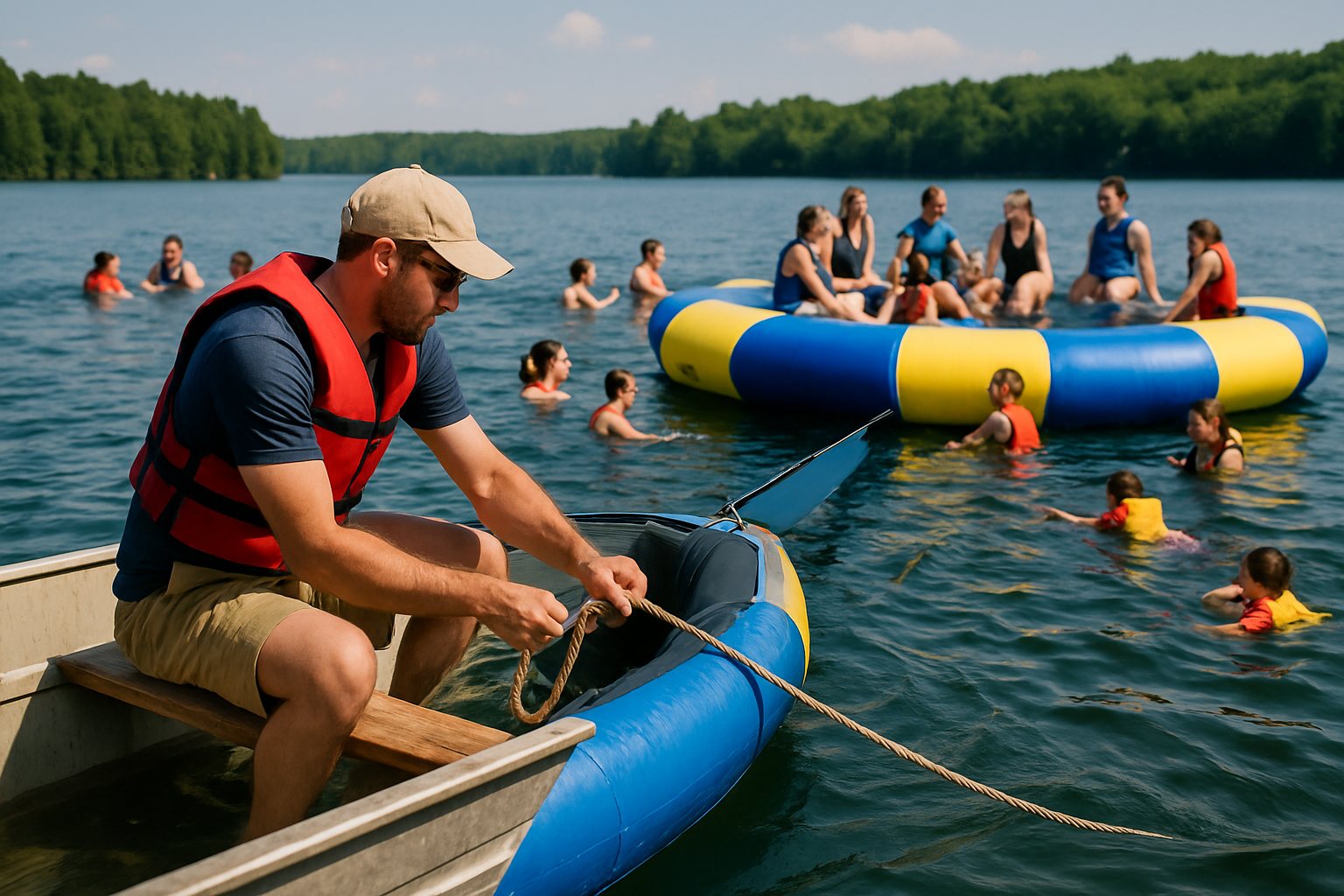
The first jump of the summer is the best one. The trampoline went out on Saturday morning, the kids raced to the ladder, and by lunch everyone had a favorite trick. Then a thunderstorm front rolls across the lake in the afternoon and the question becomes very practical: is it going to stay where we put it? Knowing how to anchor a water trampoline is what makes the answer yes. A trampoline is a big, light, round shape that catches wind like a sail, so the anchor setup matters more than on almost anything else you can float. This guide uses only what the makers say in their manuals: how much weight, which anchor, how much line, and why too much slack can flip it.
In short: water trampoline anchoring is a single, heavy anchor on a short line. RAVE asks for at least 150 to 200 lb of anchor weight for most setups, a line only 1 to 2 ft longer than the water depth, and no more than 3 ft of total slack so the trampoline can’t stand on edge and flip in wind. Aquaglide asks for far more on its larger models (1,100 lb total for the Supertramp 17), so always use your own model’s figure.
New to these? Our water trampolines and water parks guide explains how trampolines, bouncers and add-ons differ, and best water trampolines compares the models on sale.
What the makers ask for: water trampoline anchor weights
There’s no industry standard for water trampoline anchoring. Each maker publishes its own numbers for its own products, and they are not the same. Here is what we found in the manuals and product pages:
| Maker and model | Anchor weight (as stated) | Water depth | Other requirements |
|---|---|---|---|
| RAVE Aqua Jump Eclipse (120, 150, 200) | At least 150–200 lb (68–91 kg) for most uses; larger trampolines on larger lakes may need more | At least 10 ft (3.1 m) | Line 1–2 ft longer than the depth; no more than 3 ft of total slack |
| RAVE (general FAQ) | 150–200 lb, depending on your lake and its bottom | At least 10 ft | Anchor connector rope sold separately |
| RAVE Splash Trax (linked modules) | About 100–120 lb (45–55 kg) at each anchor point | See manual | Anchor every third activity module; take it out if strong winds are expected |
| Aquaglide Supertramp 17 | At least 1,100 lb (500 kg) total | At least 8 ft (2.44 m) | At least 15 ft (4.5 m) from shore; one anchor ring |
| Aquaglide Rebound 20 | 500 lb | See maker page | 15 ft from shore |
Two things stand out. First, the spread is huge: 150 lb for one maker’s trampoline, 1,100 lb for another’s. That’s why you can’t borrow a number from a friend’s setup or from a different brand. Second, the makers all say the same thing about conditions: Aquaglide recommends more weight for extreme weather or waves and suggests talking to a dock and mooring specialist, and RAVE says larger trampolines on larger bodies of water may need more than its baseline. Use the figure for your model as the minimum, not the target.
How to anchor a water trampoline, step by step
This order follows RAVE’s Aqua Jump Eclipse manual and Aquaglide’s owner’s manuals. Where your manual differs, your manual wins.
- Pick the spot. RAVE asks for the location most protected from wind, at least 10 ft deep for its Aqua Jump Eclipse, and free of obstructions a safe distance in every direction. Aquaglide’s manuals add a safe distance from docks, boats, boat lifts and other structures. Measure the depth at the lowest water level you expect, not the day you set up.
- Set the anchor first. Aquaglide says to install anchors and mooring lines before inflating the product. RAVE says to set the anchor in position and put a float on the anchor line so you can find it.
- Fit the harness or bridle. On the Aqua Jump 150 and 200, RAVE supplies an anchor harness and says it must go on the proper anchor points, both for holding power and to prevent flipping in windy conditions. Aquaglide’s manual describes one vertical mooring line to the center swivel of a 4-way mooring bridle.
- Carry it to the water. RAVE asks owners to carry, not drag, the trampoline.
- Connect and adjust the line. Attach the anchor line to the open loop of the swivel on the harness, then set its length (next section).
- Inflate to the maker’s pressure. RAVE’s Aqua Jump Eclipse runs at 2 psi and the manual warns not to exceed 2.5 psi with compressed air. Our pump guide explains which pumps suit low-pressure tubes.
- Check it after the first windy afternoon. If it has moved, you need more holding power: more weight or a different type of anchor.
Line length and slack: why a short line matters
This is the part people get wrong, because it’s the opposite of anchoring a boat. A boat wants a long line (BoatUS recommends seven times the depth for a boat). A trampoline doesn’t. RAVE’s manual says to set the anchor line about 1 to 2 ft (0.3 to 0.7 m) longer than the depth of the water, and not to exceed 3 ft (1 m) of total slack. The reason is in the same paragraph: more slack improves holding, but too much lets the trampoline stand on edge and flip over in strong wind.
The give comes from a shock cord, not from slack. RAVE says its anchor connector shock cord provides about 2 ft of stretch to absorb waves and the bouncing of people jumping. Its advice for better holding is to add weight or change the anchor type while keeping the line short. Splash Trax’s manual says the same thing in fewer words: provide no slack in the anchor line, and let the shock cord take the vertical movement.
Worked example in 10 ft of water: a line of 11 to 12 ft from the anchor to the harness swivel, plus the shock cord. If your lake rises or drops through the summer, recheck the length, because the slack changes with the water level.
Which anchor for which lake bottom
- Bell (mushroom-style) anchors: RAVE says these are not typically recommended for its trampolines because they’re easily dragged, especially on flat, sandy bottoms.
- Dead weights: RAVE’s Splash Trax manual shows septic tank covers and cinder blocks as options, connected with chain to the anchor connector kit. Aquaglide sells sand-filled anchor bags.
- Screw-type anchors: RAVE says screw-type or more permanent toggle-type anchors may be needed in more extreme conditions. Its Splash Trax manual describes land screws set just over 3 ft into a sand bottom, and says placement needs a trained, certified scuba diver.
- Several anchors: once you add a slide, a log or a second trampoline to make a mini park, Aquaglide’s manual says multiple anchors should be used. RAVE suggests anchoring every third module of a linked course.
A practical tip from RAVE’s Splash Trax manual: connect the weights to each other with chain and to the connector kit on the beach, then move the whole group out on top of a flotation device and lower it at the spot. It’s far easier than wrestling 200 lb of weight off the side of a small boat.
Water trampoline anchor kits and bags we checked
Makers sell the line, shock cord and bags separately; the weight is usually up to you. These were on sale on Amazon when we checked in October 2026. Prices change often, so check the current price before you buy.
RAVE Sports Anchor Connector Kit
- 6 ft shock cord
- 15 ft x 1/2 in braided nylon line
- Galvanized chain and foam float
Aquaglide Lakefront Anchor Bag Complete Set
- About 110 lb when filled with sand
- 20 ft line for 2 to 20 ft of water
- Line float and locking carabiner
Aquaglide Anchor Bag Set with Line
- 750 lb load capacity (seller-stated)
- 20 ft nylon line
- Stainless shackles at each end
Keep the arithmetic honest. One sand bag of about 110 lb is less than RAVE’s 150 to 200 lb baseline and a tenth of the 1,100 lb Aquaglide asks for on the Supertramp 17. A bag is one part of an anchor system, not the whole of it. The RAVE kit is the shock cord and line RAVE’s manuals are written around (RAVE part 01024), and it already comes in the box with the Aqua Jump 120, 150 and 200.
Check the RAVE Anchor Connector Kit price on Amazon
Wind, storms and taking it out
No maker we checked publishes a wind speed limit for its water trampolines. What they do say: choose the location most protected from wind (RAVE), add more weight or holding power for extreme weather, strong tides, currents, winds or swell (Aquaglide’s manual suggests up to 50% more in those conditions), and remove the product from the water if strong winds are expected (RAVE Splash Trax). Get everyone off at the first sign of a storm; a trampoline is a poor place to be in lightning.
One more reason to take it out at night: RAVE’s manual warns that muskrats and other rodents can be attracted to the PVC, and suggests keeping full air pressure on the water or taking the product out overnight. If you leave it out, secure it against unsupervised use, as the manuals ask.
Local rules for an anchored trampoline
RAVE’s manuals tell owners to check with local authorities about anchoring restrictions in their area. Some states treat anything moored away from shore as a structure that needs a permit: Minnesota’s 2026 Boating Guide, for example, says swimming rafts and similar structures that don’t extend from shore can’t be in the water between sunset and sunrise without a county sheriff’s permit. Ask your state boating agency or county before you set a seasonal mooring. Our platform anchoring guide covers the general rules for anything floating offshore.
Before every jumping day
- The trampoline is where you left it, and the line is still short (1 to 2 ft over the depth on RAVE models).
- The shock cord isn’t cracked or faded, and the swivel and shackles are tight.
- The tube is at the maker’s pressure (2 psi on the Aqua Jump Eclipse).
- Everyone knows where the line runs: RAVE’s manual says never swim or play under or around the trampoline.
- Jumpers wear a U.S. Coast Guard approved Type III life jacket, as RAVE’s manual asks, and no more people than the maker states (4 users or 700 lb on the Aqua Jump 150). Our safety checklist has the rest.
Water trampoline anchor questions
How much weight do I need to anchor a water trampoline?
Whatever your maker states for your model. RAVE’s baseline is 150 to 200 lb for most applications; Aquaglide asks for 1,100 lb total on the Supertramp 17 and 500 lb on the Rebound 20. Both say to add more for rough conditions.
Can I use a mushroom anchor?
RAVE says bell anchors are not typically recommended because they drag easily on flat, sandy bottoms. Dead weights, sand bags and screw anchors are the options the makers describe.
Why did my water trampoline flip over?
RAVE’s manual names two causes: too much slack in the anchor line, which lets the trampoline stand on edge in strong wind, and a harness not connected to the proper anchor points. Keep slack under 3 ft and use the maker’s harness or bridle.
Can I tie a water trampoline to my dock?
The manuals we read say the opposite: keep the product a safe distance from docks, boats, boat lifts and other structures, and anchor it on its own. If you also need somewhere to tie up the boat, that’s a separate dock question, covered by our sister site, InflatableDocks.
How deep does the water need to be?
At least 10 ft for RAVE’s Aqua Jump Eclipse and at least 8 ft for Aquaglide’s Supertramp 17. Check your manual, and measure at the lowest water you expect.
Do I anchor each piece of a mini water park?
Aquaglide says to use multiple anchors once you add other main features; RAVE suggests anchoring every third module of a linked Splash Trax course, at about 100 to 120 lb per point. Running a bigger park for paying guests? See our commercial aquapark guide.
Keep exploring
Compare models in best inflatable water parks, learn how to fix a slow leak in our repair guide, find more setup and care guides on our Learn page, or look up a term in the glossary.
Leave a Reply