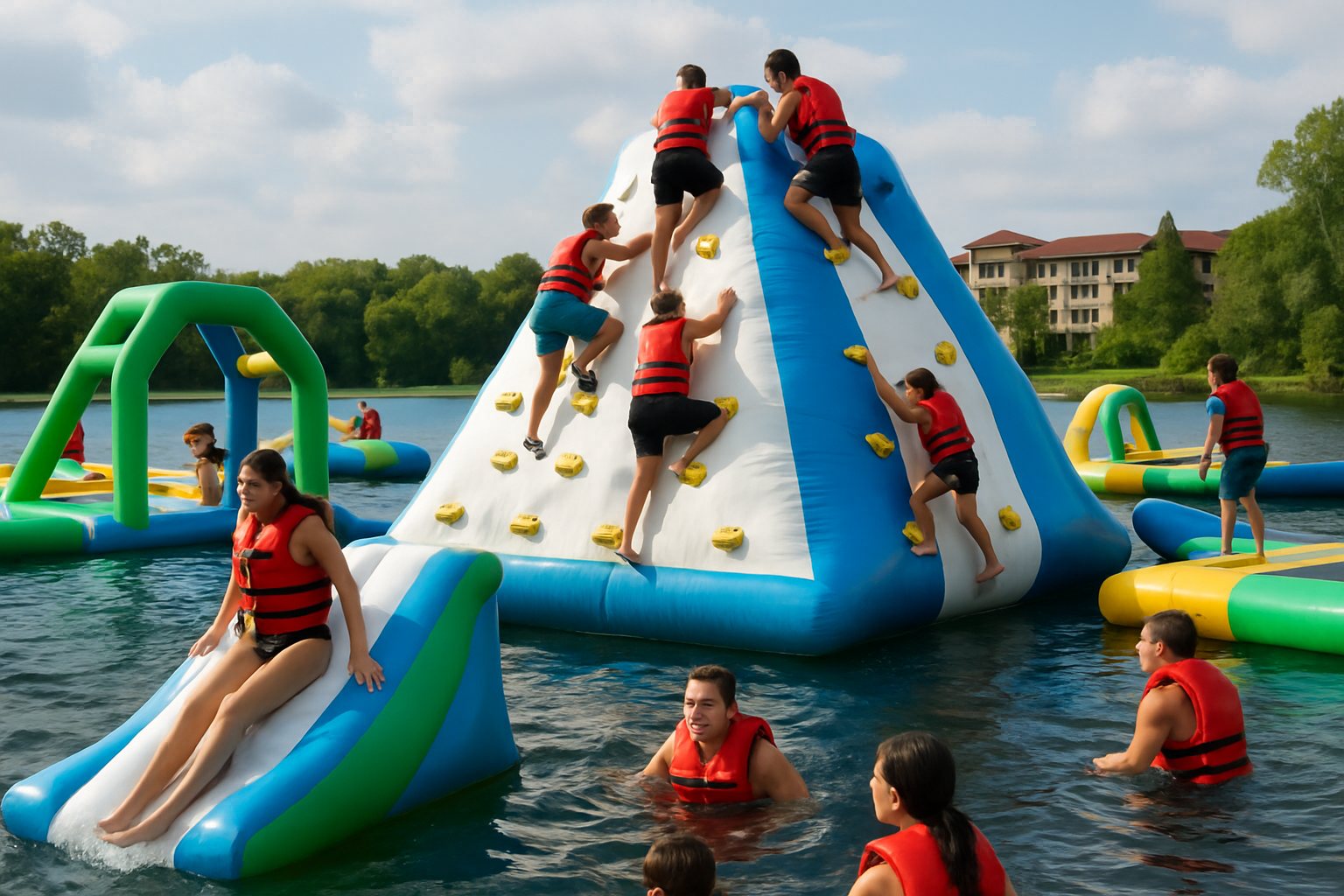
Nine in the morning, opening day. The lake is still flat, the lifeguards are climbing onto their stands, and a line of kids in life jackets is already shuffling at the check-in tent, staring at a floating maze of slides, climbing walls and trampolines anchored a short swim offshore. For the guests it’s pure fun. For the operator, every piece of that morning was planned months earlier: the site survey, the anchors, the insurance, the staff roster. This guide is for that operator. It covers what a commercial inflatable water park is, how real parks are set up and staffed, which standards and rules to ask about, and the questions to put to suppliers and insurers before you sign anything.
In short: a commercial aquapark is a set of modular floating play pieces, linked together and anchored as one system, that a business runs for paying guests under lifeguard supervision. Before you buy, settle four things: a surveyed site and permission to use it, an anchoring plan from the maker or a mooring specialist, insurance that covers the activity, and a staffing plan your regulator and insurer accept. Ask suppliers which safety standard their products were tested to, and for the documents.
Looking for a backyard trampoline or a mini park for a lake house instead? See best inflatable water parks and our hub on water trampolines and water parks. This page is about running one as a business.
What a commercial inflatable water park is
A commercial aquapark (also called an inflatable obstacle course or floating water park) is built from separate inflatable modules: slides, climbing towers, bouncers, balance beams, trampolines, swings and flat walkways. They connect to each other with straps or interlocking fittings and are anchored as one layout. Aquaglide describes its commercial range as modular and third-party tested, with a 3-year warranty; its accessories show how far the system goes, down to a floating lifeguard station that attaches to any Aquaglide aquapark layout with its D-ring Interloc system and Vario-Lock straps.
The European standards family for these products shows what they are. EN 15649-6, the part for “Class D” floating leisure articles, lists inflatable climbing structures on water, bouncing platforms, inflatable slides, water trampolines, teeter totters and obstacle courses, for pools, lakes and ponds, open sea and sheltered sea shores. The EN 15649 parts were withdrawn in 2017 and replaced by the EN ISO 25649 series, so ask suppliers which edition they tested to.
Consumer mini parks vs commercial aquaparks
| Consumer lakefront mini park | Commercial aquapark | |
|---|---|---|
| Who uses it | A family and friends | Paying guests, in timed sessions |
| Size | One trampoline plus a slide or log | Dozens of modules; Cosmeston’s park is 65 x 45 m (3,000 m²) |
| Supervision | The owner | Lifeguards in and out of the water |
| Warranty | Residential terms; commercial use often limited (Aquaglide gives 1 year for light commercial use on some consumer pieces) | Commercial terms (Aquaglide commercial range: 3 years) |
| Anchoring | One anchor system per the manual | Multiple anchor points across the layout, planned with the maker or a mooring specialist |
| How you buy | Retail | Quote, layout design and delivery from the maker or a dealer |
A consumer trampoline that’s fine for a lake house isn’t a commercial product just because it’s big. Check the warranty’s commercial-use line, and don’t put paying guests on equipment the maker sells for residential use.
Documented parks: how real operators set up
Three public examples show the decisions operators actually make.
- Cosmeston Country Park, Wales (2025 pilot). The Vale of Glamorgan Council partnered with Aqua Park Group to run a summer aquapark on the 65,000 m² east lake. The park measured 65 x 45 m, about 5% of the lake. Visitors had to be eight or older, 1.2 m tall and able to swim 25 m unaided, and the council said lifeguards would be on duty in and out of the water all day. Before opening, the council listed ecology reports, a Natural Resources Wales assent, a bird survey, a water quality report, a divers’ report and a bathymetric (depth) survey among its supporting documents.
- Cali Splash Park, Castaic Lake, California. Run by California Bounce Systems, with more than 45 obstacles (the site also says over 50). Children 9 and up may play alone; ages 4 to 8 need an adult, with no more than two children per adult. Sessions last two hours, and guests under 18 need a waiver signed by a parent or guardian.
- Alamitos Beach, Long Beach, California (2022). The city opened a Wibit water playground that CBS Los Angeles reported cost $400,000 for the larger version. The staffing plan: at least six lifeguards on stand-up paddleboards plus a dedicated supervisor at the playground at all times, with children under 14 supervised by adults.
Notice what they have in common: entry rules written down (age, height, swimming ability), a set session length, a staffing number, and a site studied before anything was anchored.
Site, depth and anchoring
Every aquapark is anchored as a system, and the makers publish minimums that are far heavier than consumer anchoring. Aquaglide’s floating lifeguard station alone asks for at least 1,100 lb (500 kg) of total anchor weight, at least 10 ft (3 m) of water and at least 10 ft from shore, and the company recommends heavier anchoring for extreme weather or waves. Its owner’s manuals say multiple anchors are needed once several main features form a park, and suggest up to 50% more holding power in sites with strong winds, currents or swell.
That’s why commercial operators start with a depth survey and a mooring plan rather than a product catalog. Ask the maker for the anchor layout and loads for your exact configuration, and have a dock and mooring specialist design and install it. Our water trampoline anchoring guide explains the basics (weight, short lines, shock cords) that a full park multiplies.
Rules and inspections: it depends on your state
There is no single US rule for floating parks. Some states treat inflatables as amusement devices that need registration and inspection; some carve out floating ones. Oklahoma’s Department of Labor, for example, announced in July 2021 that inflatable devices designed primarily as floating devices installed in or on bodies of water no longer need annual inspection or registration with the department. Other states may handle it differently, and on top of state rules you’ll likely need permission from whoever controls the water: a park authority, a utility, a county or the owner of the lake bed.
Ask three offices before you commit: your state’s amusement ride or labor department (is a floating park covered?), your state boating or natural resources agency (can you moor structures here, and for how long?), and the landowner or park authority (lease, environmental checks, public access).
Insurance questions to settle first
We don’t sell insurance and won’t quote figures; coverage depends on your location, your insurer and your operation. These are the questions operators should put to a broker who knows water recreation:
- Does the policy name a floating aquapark as a covered activity, or does it exclude inflatables or water attractions?
- What does the insurer require: lifeguard certifications, staff ratios, waivers, minimum age or height, a written emergency action plan?
- Does the landowner or park authority need to be named as an additional insured, and at what limits?
- Which documents does the insurer want from the equipment maker: test reports, standards, inspection and repair logs?
- Is product damage covered (storms, vandalism, rodents chewing PVC), or only liability?
Staffing: lifeguards, check-in and the daily routine
There is no published staffing ratio we could verify from the makers. The numbers come from your regulator, your insurer and a risk assessment of your layout: how many modules, how far from shore, how many blind spots behind slides and towers. The documented parks above show the shape of it: lifeguards on the water (Long Beach used paddleboards), a supervisor, lifeguards on shore, and a check-in team that enforces entry rules and life jackets before anyone swims out.
A typical day, built from what the manuals and operators publish:
- Morning check: pressures to the maker’s figure, connections tight with no gaps (Aquaglide’s manual asks for exactly that), mooring lines checked, no debris or hazards under the layout.
- Weather call: wind, lightning and water quality checked before opening and through the day. Decide in advance who closes the park and on what trigger.
- Sessions: timed groups, a safety briefing, life jackets fitted, entry rules enforced at check-in.
- Close: walk the layout, log any damage, repair or remove modules as the maker directs, secure the park against unsupervised use overnight.
For repairs, keep the maker’s kit and instructions on site; our repair guide covers what owners can patch and what goes back to the maker.
Questions to ask an aquapark supplier
- Which safety standard and edition were the modules tested to, by whom, and can we see the reports?
- What is the rated number of users for each module, and for the whole layout?
- What minimum depth, shore distance and clearance does each module need?
- What anchor layout and loads do you specify for our site, and who installs it?
- What are the commercial warranty terms, and what voids them? (Aquaglide’s manuals say its aquapark parts are not authorized for use with other makers’ products.)
- What training, inspection checklists and spare parts come with the park, and how fast can you supply a replacement module mid-season?
Commercial aquapark products in our catalog
Commercial parks are sold by quote, not off a shelf. These records show what makers document; use them as a starting point for supplier conversations.
Planning a park for a resort, campground or lake concession? Request more information and tell us your site, season and guest numbers; we’ll point you to makers who build for commercial use. We’re an independent guide: we don’t sell or install parks. For the wider business picture, see resorts and hospitality and rental and tour operators.
Commercial aquapark questions
How big is a commercial inflatable water park?
Sizes vary with the layout. The Cosmeston pilot covered 65 x 45 m (3,000 m²), and Cali Splash Park lists more than 45 obstacles. Start with your site survey; the maker designs the layout to fit it.
Do floating water parks need lifeguards?
Every documented park we found staffs them: Cosmeston had lifeguards in and out of the water, and Long Beach assigned at least six lifeguards on paddleboards plus a supervisor. Your regulator and insurer set the requirement.
Can I use consumer water trampolines for a rental business?
Check the warranty and manual first. Consumer warranties often limit or exclude commercial use, and insurers usually want commercial-rated equipment. Our rental operators page covers this in more depth.
What standard do aquapark modules meet?
In Europe, floating play products were covered by EN 15649 (Class D includes trampolines, slides and obstacle courses), replaced in 2017 by EN ISO 25649. Ask each supplier which standard and edition apply, and for the test report.
How much does a commercial aquapark cost?
It’s quoted per layout. The one public figure we found is Long Beach’s: $400,000 for the larger version of its Wibit playground, as reported in 2022. Budget separately for anchoring, staff, insurance and storage.
Does a floating park need a state inspection?
It depends on the state. Oklahoma, for example, stopped requiring annual inspection and registration for floating inflatable devices in 2021. Ask your state’s amusement ride authority directly.
Keep exploring
See all commercial platforms, compare commercial recreation platforms, read the FAQ, or go back to Start here.
Leave a Reply