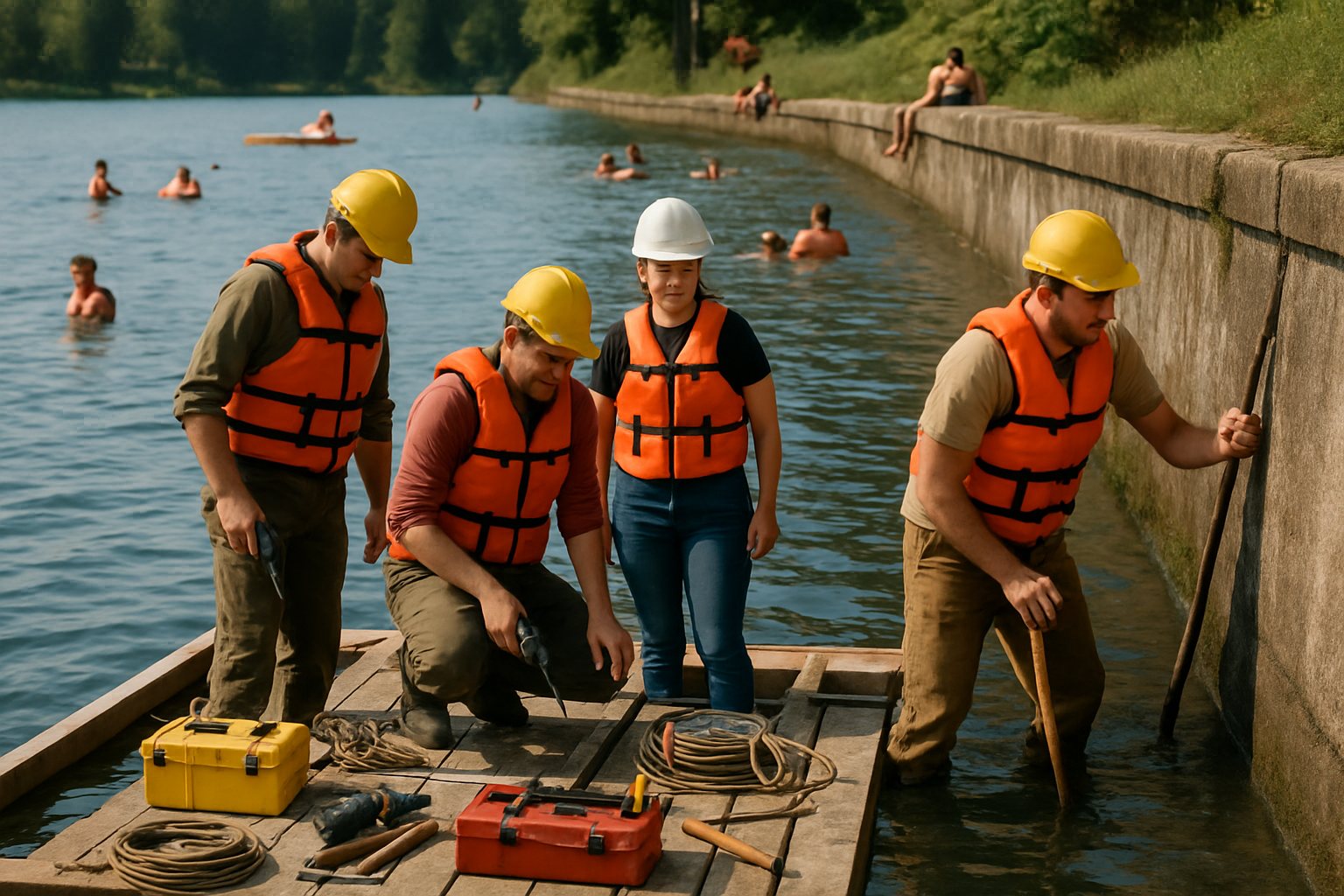
The job sounds simple: a marina crew needs to replace a fender board on a piling, a contractor has to inspect a culvert from the water side, a yacht engineer wants to touch up the boot stripe. Somebody says “get a floating pontoon,” and suddenly there are two very different things on the table: a roll-up inflatable deck that fits in a van, or a steel sectional barge that arrives on trucks. Both are a floating work platform. Picking the right one depends on what you’re putting on it, and on what its maker will put in writing. This guide compares inflatable work platforms with rigid work barges, using only the ratings the makers and dealers publish.
In short: inflatable work platforms carry people and hand tools at the waterline on sheltered water; the makers we found rate them from 300 kg (about 660 lb) to 3,306 lb. Rigid sectional barges carry machinery: one dealer lists Flexifloat’s series from up to 100 tons to static loads of about 2,000 tons, supporting cranes up to 400 tons. If your job involves an excavator, a crane, a generator or a pallet of materials, you need a barge. A recreational swim dock is neither, whatever its size.
Floating pontoon, work barge, floating barge: what the words mean
- Floating pontoon: a general term for a floating deck held up by buoyant bodies. It can mean a dock section, a boat landing or a work float. On this site, a pontoon carries people, not vehicles.
- Work barge / floating barge: a flat working hull, usually steel, used to carry equipment and materials. Sectional (modular) barges are built from truckable units that pin together on site.
- Inflatable work platform: a drop-stitch deck (two fabric skins held flat by internal threads) inflated to a set pressure, sized for crews working at the waterline. Our drop-stitch guide explains the construction.
Inflatable work platform vs rigid barge, side by side
| Inflatable work platform | Rigid sectional barge | |
|---|---|---|
| Rated load (as published) | 300 kg (FunAir) to 3,306 lb (VersiFloat 6 x 12 ft) | Up to 100 tons (Flexifloat H-50) to about 2,000 tons static (S-70), per a dealer |
| Typical size | About 5 x 10 ft to 6 x 12 ft; 3 x 1.5 m | Units 7.5 x 15 or 30 ft (H-50) and 10 x 20 or 40 ft (S-50, S-70) |
| Weight of one unit | Tens of kilograms; rolls into a bag | 7,900 to 33,000 lb per unit |
| Transport | Van, tender garage, wheeled case | Trucks (and rail for the smaller series) |
| Typical work | Hull cleaning and touch-up, inspection, fender and line work, light staging | Cranes, dredging, pile driving, drilling, bridge and dam work |
| How you get one | Quote from a maker or dealer | Buy, lease or hire from a barge supplier |
The two categories don’t overlap. The smallest barge rating above is dozens of times the largest inflatable one. If you find yourself wondering whether an inflatable can stretch to a job, the answer is to ask its maker for a written rating for that load, not to work it out yourself.
Inflatable work platforms we found, with their ratings
- FunAir work platform: 300 x 150 x 40 cm, rated 300 kg, made from 0.9 mm 1000-denier PVC described as fire-retardant and UV rated. FunAir builds custom yacht inflatables in Austin, Texas; quote only.
- VersiFloat: drop-stitch PVC at 15 psi, 5 x 10 ft rated 2,149 lb and 6 x 12 ft rated 3,306 lb, with Velcro non-skid deck boards, stainless D-rings and a repair kit. Yachts International described it in 2012 as a way to do some hull maintenance without swimming or unloading the tender.
- SeaRaft platforms: 20 cm drop-stitch (per a retailer) with underside water-ballast bags; the maker’s brochure calls the range “Yacht (Maintenance) Platforms”. Load rating not published.
- Buitink Technology: a different kind of work platform that clamps inside tanks and pressure vessels by air pressure. The 3 m example carries about 1,000 kg at 350 mbar. It is built for the inside of vessels, not open water.
Buitink inflatable tank work platform
by Buitink Technology
- Size (as stated): 3 m example: 34 cm high; sizes S to XXXL (up to about 30 m diameter, project-specific)
- Stated capacity: 3 m example: about 1,000 kg at 350 mbar; size S: 200 to 500 kg
FunAir work platform
by FunAir
- Size (as stated): 300 x 150 x 40 cm
- Stated capacity: 300 kg
- Thickness: 40 cm
SeaRaft PL525 platform
by SeaRaft
- Size (as stated): 3.5 x 1.5 m
- Thickness: 20 cm drop-stitch (retailer)
VersiFloat 5 x 10 ft
by VersiFloat
- Size (as stated): 5 x 10 ft
- Stated capacity: 2,149 lb
VersiFloat 6 x 12 ft
by VersiFloat
- Size (as stated): 6 x 12 ft
- Stated capacity: 3,306 lb
Two things to notice. The ratings are a single number with no conditions attached, so ask each maker what it assumes: inflation pressure, how the load is spread, sea state. Buitink is the only maker here that ties its figure to a pressure. And several respected products publish no rating at all, which means the rating question goes in your first email. For a yacht-specific look at these products, see yacht hull cleaning platforms.
Rigid work barges: what the numbers look like
Flexifloat describes itself as a maker of modular barges, with uses from crane, dredge, drilling and pile-driving barges to floating bridges and dive platforms. Its own home page publishes no capacities, so these figures come from Eiffel Trading, a dealer:
| Series | Unit size (depth x width x length) | Unit weight | Load (dealer-stated) |
|---|---|---|---|
| H-50 | 3.8 x 7.5 x 30 or 15 ft | 14,500 or 7,900 lb | Up to 100 tons |
| S-50 | 5 x 10 x 40 or 20 ft | 27,000 or 14,700 lb | Up to 300 tons; cranes up to 100 tons |
| S-70 | 7 x 10 x 40 or 20 ft | 33,000 or 18,000 lb | Static loads of about 2,000 tons; cranes up to 400 tons |
Another rental dealer lists a lower operational figure (up to 100 tons) for S-50 assemblies, which shows why you confirm the rating for your exact assembly with the supplier. Barges also bring their own logistics: cranes to launch the units, spuds or anchors to hold position, and a marine contractor who knows how to rig them.
When an inflatable floating pontoon is the right call
- The load is people with hand tools, within the maker’s written rating.
- The water is sheltered: a marina, a calm anchorage, a pond or a slow river.
- The job is short, and the platform has to travel: in a van, on a yacht, between sites.
- You need a soft edge against a hull or a structure.
Pick a barge when any of these apply: machinery or vehicles on deck, concentrated loads such as a generator or compressor, open or tidal water, long projects, or a contract that specifies a rated working platform. And check the site rules before you bring either: one marina’s environmental rules (the Port of Port Angeles, in Washington) tell boaters not to do paint or hull work from a float or small boat at all.
Why a recreational dock is not a work platform
Consumer inflatable docks are rated for people at play, usually as a number of adults: RAVE’s Aqua Dock 10, for example, is rated for 10 adults or 1,800 lb at 5 psi. That rating says nothing about point loads, tools, fuel cans or a crew leaning over the edge with a grinder, and the maker sells it for recreation. Using it for paid work puts the risk on you and, most likely, outside the warranty. We never present recreational products as work-rated, and we suggest you don’t either. Our heavy-duty work page goes deeper into liability and supplier questions.
Crew safety on any floating work platform
In the US, OSHA’s construction rule for working over or near water (29 CFR 1926.106) applies whatever the platform. Where there’s a danger of drowning, workers get U.S. Coast Guard-approved life jackets or buoyant work vests, checked before and after each use. Ring buoys with at least 90 ft of line must be ready for rescue, no more than 200 ft apart, and at least one lifesaving skiff must be immediately available. Add your own job rules: a second person on watch, tools tethered, nothing heavier than the rating, and off the water when the wind builds.
What to ask a supplier before you buy or hire
- What is the rated working load, at what inflation pressure, and how must it be spread?
- Is there a point-load or edge-load limit (one person kneeling at the edge, a toolbox in a corner)?
- What water conditions is it rated for, and how is it moored or anchored for work?
- What fabric is it, and is it fire-retardant? (FunAir publishes FR and UV ratings.)
- Which standards or certifications apply, by name? Buitink says “CE-certified” without naming the standards, so ask.
- What repair kit, spare valves and service come with it, and what’s the warranty for commercial use?
Working out what you need for a marina, yard, fleet or site? Request more information with the job, the load and the water, and we’ll point you to makers who publish ratings for that kind of work. We’re an independent guide and don’t sell or hire equipment.
Floating work platform questions
How much weight can an inflatable work platform hold?
Only what its maker states. Published figures we found run from 300 kg (FunAir) to 3,306 lb (VersiFloat 6 x 12 ft). Never estimate a rating from the platform’s size.
What is the difference between a floating pontoon and a barge?
Loosely, a pontoon is a floating deck for people and light gear, while a barge is a working hull for equipment and materials. Sectional barges like Flexifloat’s carry loads measured in tons.
Can I put a generator or pressure washer on an inflatable platform?
Only if the maker rates it for that load in writing. Concentrated loads, fuel and hot exhausts are exactly the questions to send the supplier before the job.
Do workers on a floating platform need life jackets?
Under OSHA 1926.106, workers over or near water where drowning is possible need Coast Guard-approved life jackets or buoyant work vests, plus ring buoys and a rescue skiff on hand.
Is an inflatable work platform the same as a rescue walkway?
No. Rescue paths are long, narrow and built for emergency crews on ice, mud and water. See rescue platforms.
Keep exploring
Start from the work platforms hub, see hull maintenance and inspection, compare platform materials, or browse all commercial platforms.
Leave a Reply