This article contains affiliate links: if you buy through them we may earn a commission, at no extra cost to you. Read our affiliate disclosure.
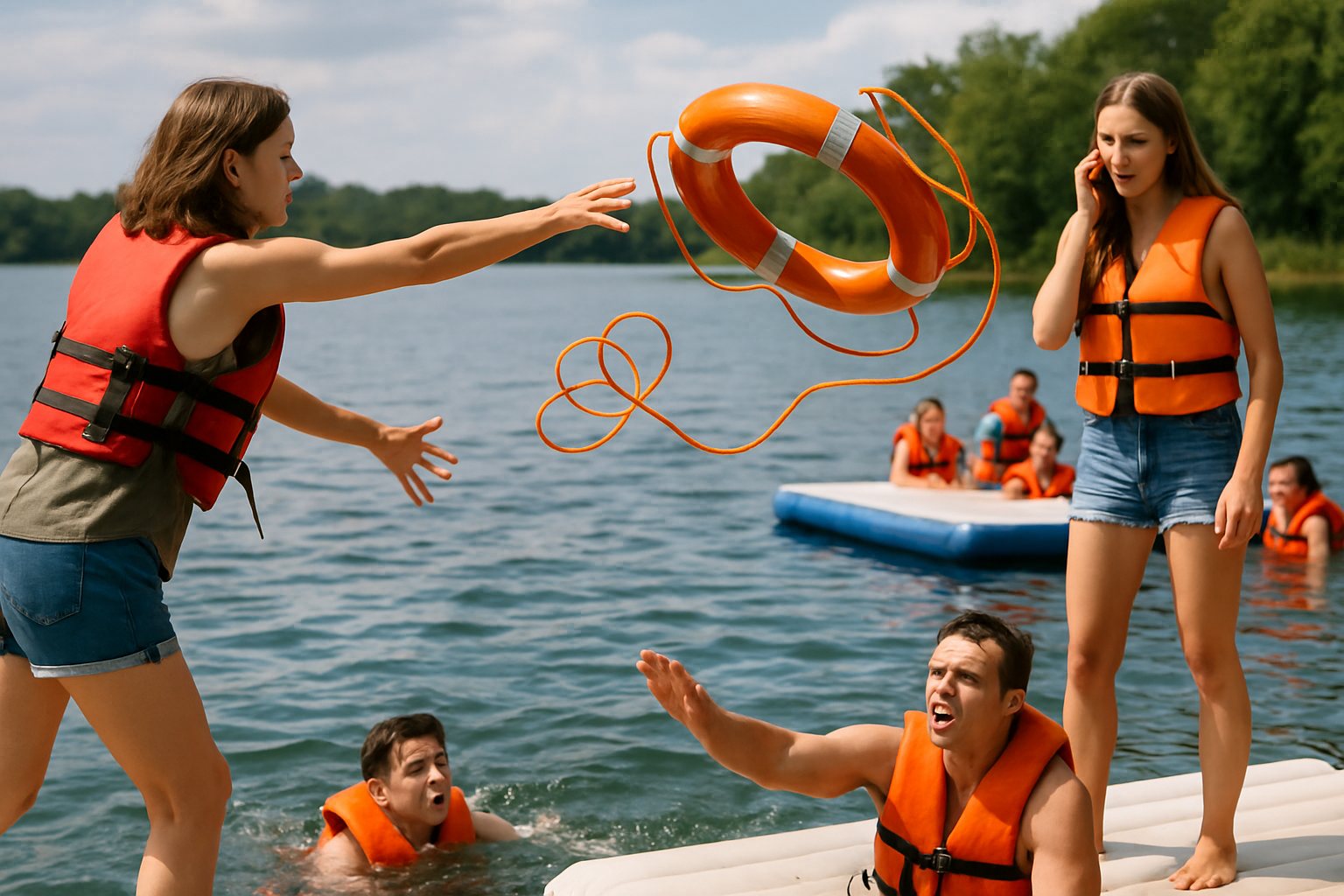
A kid slips off the far side of the platform, comes up behind it and doesn’t call out; he just isn’t making progress back. An uncle is already pulling his shirt off to dive in, the instinct rescuers are trained to resist. If you are searching water emergency what to do, here is the sequence the Red Cross, the American Heart Association and the Coast Guard teach, adapted to a day on a platform or at anchor.
In short: spot the trouble and shout for help. Reach or throw, don’t go: hand out a pole or paddle or throw something that floats rather than swimming out. Get someone to call 911, or use VHF channel 16 on the water. Once the person is out, start CPR with rescue breaths if they aren’t breathing normally, use an AED if there is one, and get them to a hospital even if they seem fine.
Water emergency: what to do, step by step
The American Red Cross says a drowning person has the greatest chance of survival if these steps are followed:
- Recognize the signs of someone in trouble and shout for help.
- Rescue and remove the person from the water without putting yourself in danger.
- Ask someone to call emergency medical services. If you are alone, give 2 minutes of care, then call.
- Begin rescue breathing and CPR.
- Use an AED if one is available and hand over to advanced life support.
The signs to watch for, per the Red Cross: a swimmer who isn’t making forward progress, who is vertical in the water but can’t move or tread water, or who is motionless and face down. Our swimming and supervision page explains how a water watcher keeps eyes on exactly this.
Reach or throw, don’t go
“Reach or throw, don’t go” is the Red Cross’s short version of step 2. A panicking swimmer can push a rescuer under. Wisconsin’s DNR gives the same advice: call for help and throw a lifesaving device or anything else that floats, avoid entering the water if possible, and if you must go in, wear a life jacket. On a platform day you usually have options:
| Option | On a platform or boat |
|---|---|
| Reach | Extend a paddle, boat hook or pole from the platform or boat while you stay out of the water |
| Throw | The boat’s throwable ring or cushion (required on boats 16 ft and longer and meant to be within arm’s reach), or a spare life jacket; the Red Cross also lists a cooler or inflatable ball |
| Go (last resort) | Only wearing a life jacket and taking something that floats; better still, someone trained |
Two platform-specific cautions. Never let anyone swim under a platform to look for someone: RAVE’s manuals call that a drowning hazard, with nowhere to come up for air. And if the person is near the boat’s stern, make sure the engine is off before anyone goes near the propeller; the Coast Guard calls shutting off the engine the safest action when people are in the water.
Calling for help: 911, VHF channel 16 and a float plan
Near shore, a phone call to 911 is usually fastest; keep a charged phone in a waterproof pouch with the water watcher. Further out, the Coast Guard recommends carrying a VHF marine radio and says it doesn’t consider cell phones a substitute for the maritime distress system, though they help as an extra. Channel 16 is the primary VHF calling and distress channel, and it isn’t for chatting or radio checks.
The Coast Guard’s VHF Mayday procedure, in short: on channel 16, say “MAYDAY” three times, “THIS IS,” the boat’s name three times and its registration number or call sign once; repeat “MAYDAY” and the name; give your position (latitude and longitude or distance from a known landmark); the number of people aboard; the nature of the distress; the help you need; other details such as hull color and the number of people needing medical attention; then “OVER.” A radio with Digital Selective Calling, connected to GPS and registered with an MMSI number, can send a distress alert with your position by holding the red button for 5 seconds.
Before the trip, leave a float plan with someone ashore: where you’re going and when you’ll be back. The Coast Guard Auxiliary offers a free form at floatplancentral.cgaux.org.
CPR after drowning: breaths matter
Drowning is different from a sudden collapse on land. In a November 2024 update, the American Heart Association and the American Academy of Pediatrics said rescuers should give CPR with both rescue breaths and chest compressions to people in cardiac arrest after drowning. If you can’t or won’t give breaths, give compressions only until help arrives. Rescue breathing in the water should be done only by rescuers trained in that skill, and only if it doesn’t put them at risk. An AED can be used once the person is out of the water, but it shouldn’t delay starting CPR. Anyone who needs any level of resuscitation after drowning should go to a hospital for evaluation.
Don’t give up early in cold water. The Coast Guard notes documented cases of people revived after long immersions, especially in cold water, and says to start CPR immediately and get the person to a hospital as quickly as possible.
Where to learn CPR and first aid
The CDC puts it simply: your CPR skills could save someone’s life in the time it takes paramedics to arrive. The American Red Cross runs first aid, CPR, AED and water safety classes, including a free online water safety course for parents and caregivers, and the American Heart Association also offers CPR courses. Lifeguards at commercial sites need full lifeguard certification.
After a cold-water rescue
The National Weather Service, citing Red Cross steps, says to monitor breathing and give rescue breathing and CPR if needed, then warm the person slowly with blankets or dry clothing, warming the trunk first rather than the hands and feet. Don’t put them in warm water: rapid warming can cause dangerous heart rhythms. More on cold water in weather, wind and cold water. For someone who is dizzy, nauseous or confused near the stern, think carbon monoxide first; see carbon monoxide near boats.
An emergency kit for platform days
Keep a throwable on deck facing the platform, a marine first-aid kit where everyone can find it, and the phone or radio with the water watcher.
WELL-STRONG Boat First Aid Kit, Roll-Top Dry Bag
- Roll-top dry bag (listing)
- Extra waterproof inner pouch
- Hanging strap
Bradley Type IV Boat Cushion
- USCG approved Type IV (listing)
- About 16 x 14.5 x 2.5 in
- Doubles as a seat
Taylor Made Coast Guard Approved Life Ring 20 in
- USCG approved Type IV (listing)
- 20 in OD, 3.5 in thick
- Floating grab line
About $24 for the WELL-STRONG kit, $36 for the Bradley cushion and $88 for the Taylor Made ring, seen October 2026. A first-aid kit isn’t a federal requirement on recreational boats; the throwable is, on boats 16 ft and longer.
Emergency questions
Should I jump in to save someone?
Only as a last resort. The Red Cross teaches “reach or throw, don’t go,” and Wisconsin’s DNR says to avoid entering the water and, if you must, to wear a life jacket.
Is hands-only CPR OK for a drowning?
The American Heart Association’s 2024 guidance is CPR with rescue breaths for drowning. If you can’t or won’t give breaths, compressions alone are better than nothing until help arrives.
What VHF channel do I use in an emergency?
Channel 16, the primary VHF-FM calling and distress channel. Channel 9 is a supplementary calling channel for recreational boats, but the Coast Guard says boaters should still call the Coast Guard on channel 16.
Does someone need a hospital if they seem fine after being pulled out?
If they needed any resuscitation, even just rescue breaths, the AHA says yes: they should be taken to a hospital for evaluation, monitoring and treatment.
What if I’m alone with the person?
The Red Cross says to give 2 minutes of care first, then call emergency services.
Back to the water safety hub. To prevent the emergency in the first place, see life jackets on platforms and the safety checklist.