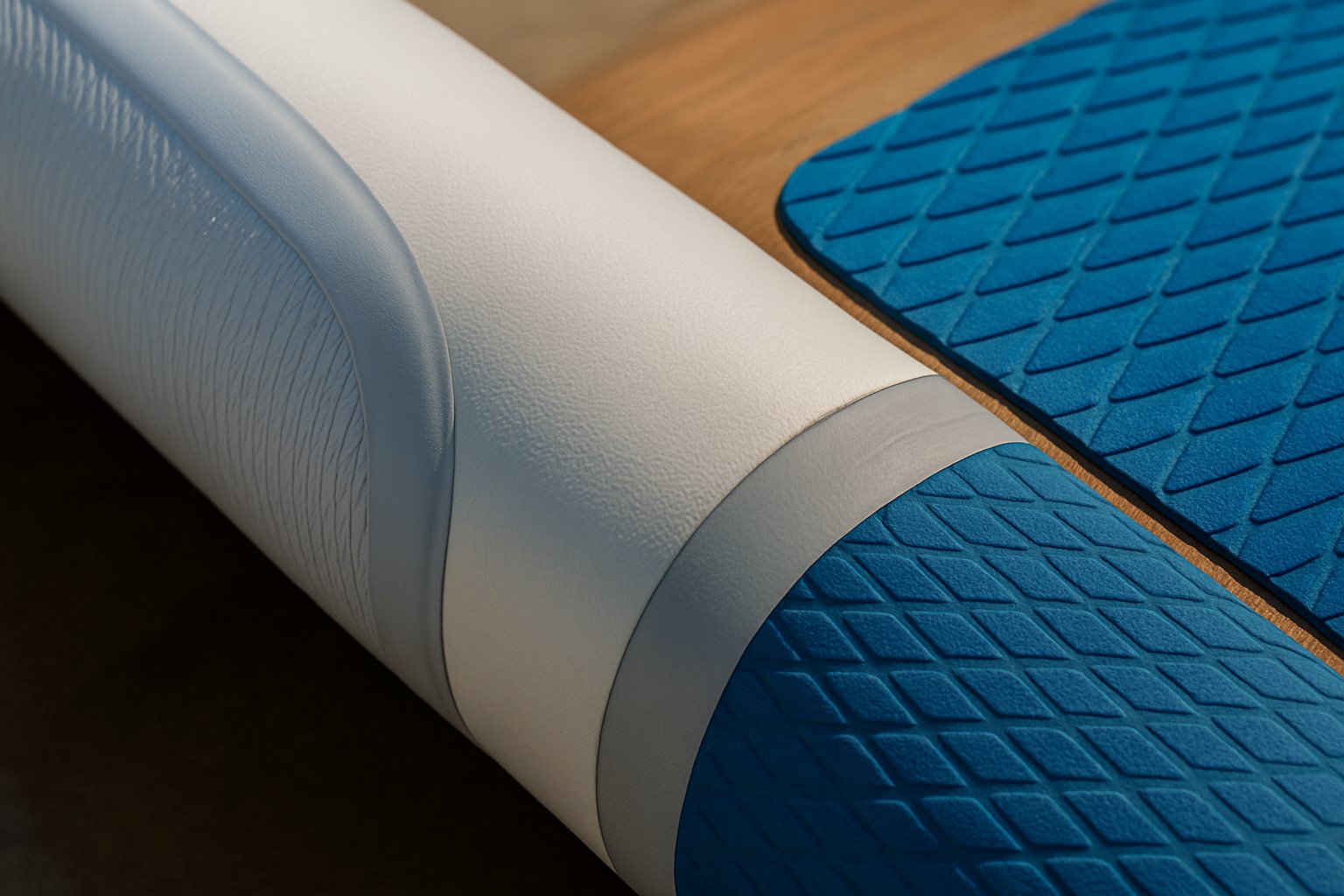
Run your hand over a platform that has spent three summers tied off a boat in the Caribbean and one that has lived in a garage in Michigan, and you can feel the difference before you read a label. One is chalky where the sun hit it; the other still has its factory sheen. Much of that comes down to the fabric: what the drop stitch material is coated with, how heavy it is and how the seams are joined. This guide explains the materials inflatable platforms are made from, compares PVC, Hypalon and TPU using what makers and boat builders publish, and shows what each means for sun, salt, repairs and warranty.
In short: almost every inflatable platform we found is PVC-coated polyester drop-stitch, welded at the seams. Hypalon (CSM rubber) is the premium coating in inflatable boats, chosen for strong sun and heavy use, but it has to be glued rather than welded and costs more; on platforms we only found it on bespoke superyacht pieces. TPU is lighter and used in packrafts and some kayaks, but we found no platform maker publishing a TPU platform. For most buyers, the questions that matter are fabric weight, seam type, UV care and warranty.
What drop stitch material is made of
A drop-stitch panel has three parts. The core is two woven base fabrics joined by thousands of polyester or nylon threads that set the thickness. Each base fabric is coated to make it airtight, and that coating (PVC, CSM or TPU) is what people mean by “the material”. On top, many platforms add a deck layer: EVA foam pads, a teak-look PVC sponge or a diamond-pattern non-skid. Our what is drop stitch guide covers the core and why it stays flat; this guide is about the skin.
Glide, a paddleboard maker, describes two core types: knitted drop stitch, which it says most entry-level boards use and which is cheaper and more elastic under load, and woven (cross-woven) drop stitch, which it says reduces internal stretch. It also notes that how the PVC layers are bonded matters more than how many there are.
PVC vs Hypalon vs TPU at a glance
| PVC | Hypalon (CSM) | TPU | |
|---|---|---|---|
| What it is | Polyvinyl chloride coating on polyester | Chlorosulfonated polyethylene rubber coating (Hypalon was DuPont’s trade name; makers now often say CSM) | Thermoplastic polyurethane coating |
| Seams | Welded (Zodiac: PVC “needs to be welded”) | Glued only; can’t be welded | Heat-welded |
| Cost | Lowest; Zodiac says two to three times cheaper than Hypalon | Highest | Higher than PVC (in the kayak and packraft market) |
| Sun and heat | Highfield: strong UV or certain chemicals can shorten its life; best stored under cover | Highfield: excellent UV and chemical resistance; recommended for tropical and high-UV regions | Promoted as supple and durable; we found no platform data |
| Weight | Baseline | Zodiac: slightly heavier, a small difference on a whole boat | Lighter per square meter (kayak and packraft sources) |
| Repair glue | PU-based or PVC adhesive | Neoprene-based glue with hardener | TPU-specific kits |
| Where we found it on platforms | Nearly every platform, dock and mat | Bespoke superyacht pieces (Henshaw jet-ski dock tube base) | Not found on a platform |
PVC: what nearly every platform uses
PVC wins on platforms for practical reasons: it can be welded, which suits large flat panels, and it’s cheaper. The labels to look for are the fabric weight and the base cloth:
- Aquaglide: Duratex Cx3 PVC, listed at 0.90 mm / 31 oz on its six-person lounge, with welded drop-stitch.
- FunAir: 0.9 mm 1000-denier PVC on its work platform, described as fire-retardant and UV rated.
- NautiBuoy: PVC with Kevlar reinforcement on its yacht platforms; a retailer names Mehler as the PVC supplier.
- Island Hopper: reinforced 1000-denier outer fabric, which the maker says handles UV exposure, oil stains and abrasion, with heat-welded seams.
- FreeStyle Dock: welded drop-stitch or 28 oz Firmatex PVC, custom sizes.
“Denier” is the thickness of the base yarn (1000D is heavy); ounces per square yard and millimeters describe the coated fabric. Higher numbers usually mean a tougher skin, but there’s no common standard, so compare like with like and ask the maker. Be wary of “commercial grade” in listings: no standard sits behind the term.
Zodiac, which builds in both materials, says PVC that is correctly maintained will last almost as long as neoprene-Hypalon, but needs cleaning two or three times a year to remove plasticizer residue, and suits seasonal use with winter storage indoors. Highfield, another boat builder, calls PVC an economical choice for light or occasional use that performs best stored under cover.
PVC vs Hypalon: when the premium coating is worth it
Hypalon earned its reputation on inflatable boats. Highfield says it is ideal for frequent outings and challenging environments, with excellent resistance to UV and chemicals, and recommends it for tropical or high-UV regions. Its warranty puts a number on that confidence: 10 years on seams and airtightness for ORCA Hypalon tubes against 5 years for Valmex PVC (non-commercial use, registered within 60 days). Zodiac recommends Hypalon for year-round or professional use, and PVC for smaller boats used seasonally.
The catch for platforms is construction. Zodiac says Hypalon “can only be assembled by gluing,” so a big flat deck can’t be welded the way PVC can, and the quality depends on the person doing the assembly. That’s one reason we found Hypalon on bespoke superyacht pieces, such as the 1300 gsm Hypalon-coated tube base Henshaw describes on a jet-ski dock with a drop-stitch top, rather than on catalog platforms. If a maker offers a Hypalon option, ask what’s Hypalon (tubes, edges, the whole deck?) and how the seams are made.
TPU: lighter, but not on platforms yet
TPU is a thermoplastic coating that can be heat-welded like PVC and is described as lighter and more supple. In inflatables it’s mostly found in packrafts and lightweight kayaks; one specialist inflatable-kayak blog describes TPU as much less heavy per square meter than PVC while being strong enough. We found no inflatable platform maker publishing a TPU platform, and the durability claims for TPU come mostly from brands selling it. If you’re offered one, ask for the fabric spec, the warranty and which repair kit it needs.
Seams: welded vs glued
On a platform, the seam is the edge band that seals the top and bottom skins around the drop-stitch core. Welded seams fuse the material with heat and pressure; Zodiac notes that welded PVC can’t separate once fused, while glued seams depend on adhesive that ages. Aquaglide’s listings advertise “3-layer” welded seams, Island Hopper heat-welded seams, and Glide heat-fused rails. When you compare platforms, ask: welded or glued, how many layers on the rail, and what the seam warranty covers.
Care by material
- Cleaning: mild soap and fresh water. RAVE’s manuals forbid petroleum-based products, solvents and power washers on its PVC. Highfield says to avoid solvents and petrol on PVC and use solvents sparingly on Hypalon.
- Sun: store out of the sun; RAVE recommends a UV protectant and shaded storage, and SeaRaft and NautiBuoy sell vented, UV-reflective covers for platforms left inflated.
- Glue: use the adhesive for your coating. Highfield specifies PU-based adhesive for its PVC tubes and neoprene-based glue with hardener for Hypalon, which can’t be bonded with plastic adhesives. Our repair guide has the step-by-step.
Questions to ask about a platform’s material
- What is the coating (PVC, CSM, TPU) and who makes the fabric?
- What’s the fabric weight (oz, gsm or mm) and base yarn (denier)?
- Knitted or woven drop stitch, single or double layer?
- Are seams welded or glued, and how many layers on the rail?
- Is it UV-stabilized or fire-retardant, and to what test?
- What does the warranty cover for seams and airtightness, and for how long in residential vs commercial use?
For the other buying factors (size, thickness, pressure, anchoring) see how to choose an inflatable platform and our size guide.
Platform material questions
Is Hypalon better than PVC for an inflatable platform?
For inflatable boats in strong sun and heavy use, boat builders such as Highfield and Zodiac say yes. For platforms, PVC is what almost every maker uses because it can be welded into large flat panels; we found Hypalon only on bespoke superyacht pieces.
Is CSM the same as Hypalon?
Hypalon was one of the names DuPont sold chlorosulfonated polyethylene (CSM) rubber under. DuPont announced in 2009 that it was leaving that business, and the rubber has since come from other producers, so many builders now say CSM. Highfield, for example, uses ORCA fabric from Pennel and Flipo and still labels it Hypalon.
How long does a PVC platform last?
Makers don’t publish lifespans; warranties are the best guide (Aquaglide gives 3 years residential on its lounges, RAVE a limited lifetime on some products). Storage out of the sun and correct cleaning matter as much as the fabric.
What does 1000D mean on a platform?
It’s the denier of the base yarn under the coating, a measure of thickness. FunAir and Island Hopper list 1000-denier fabric. Compare it alongside the coated weight and the seam type.
Can I use PVC glue on a Hypalon platform?
No. Highfield says Hypalon can’t be bonded with plastic adhesives and needs a neoprene-based glue with hardener. Use the kit your maker supplies.
Keep exploring
Find more construction guides on our Learn page, look up terms in the glossary, see which pump reaches your platform’s pressure, or browse all guides.
Leave a Reply