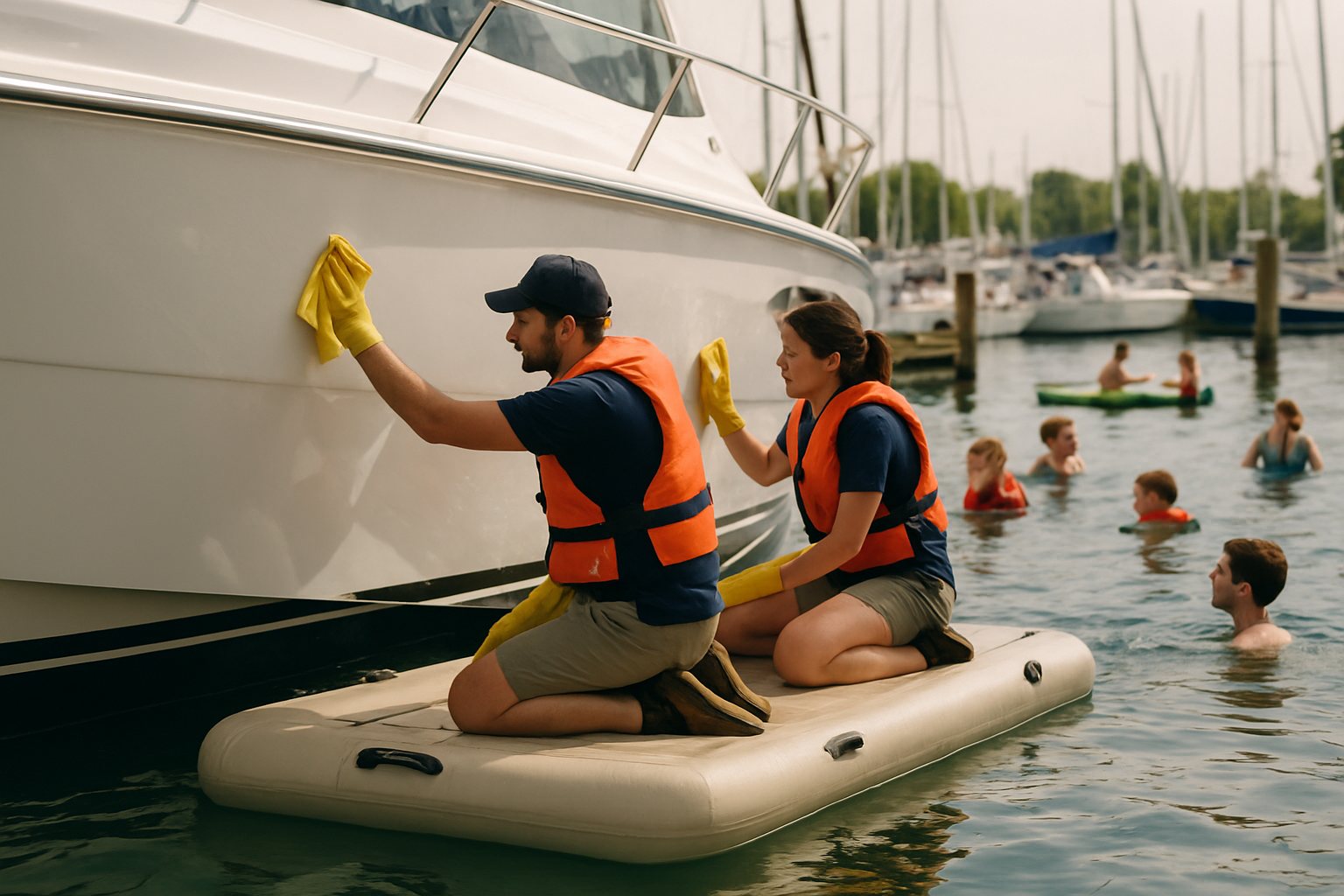
Seven in the morning at anchor, guests still asleep, and the deck crew is already down at the waterline. Overnight the hull has picked up a brown tidemark and a few fingerprints from yesterday’s tender runs. One deckhand kneels on a flat, firm raft tied alongside, a bucket hooked to the edge, wiping the topsides while another passes down polish from the swim platform. That raft is a hull cleaning platform, and on many yachts it has replaced the old routine of working from a wobbling tender or treading water with a sponge. This guide covers what makers sell for the job, how the products differ, what rules apply to cleaning a hull in the water, and how crews set one up safely.

In short: a yacht maintenance platform is an inflatable drop-stitch deck, usually 2.5 to 4 m long, tied alongside so crew can wash, polish and touch up the topsides at the waterline. NautiBuoy and SeaRaft sell maintenance covers and packs for their yacht platforms; VersiFloat and FunAir make platforms sold for work. Topside cleaning is routine, but scrubbing antifouling below the waterline is restricted in many places because of copper, so check your marina’s and state’s rules first.
What a hull cleaning platform is
Most are the same drop-stitch platforms yachts use as swim decks, fitted for work. Drop-stitch fabric (two airtight skins joined by thousands of internal threads) inflates into a flat deck you can kneel and stand on. For maintenance, makers add a protective work cover over the deck, holders for hoses and buckets, and water-ballast bags underneath to keep the platform from pitching as crew move around. Off duty, the same platform goes back to being a lounge or swim platform, which is a big part of the appeal on a yacht where space in the tender garage is tight. Our yacht platforms guide covers the leisure side.
Yacht maintenance platforms compared
| Product | Size | Load (as stated) | Maintenance features |
|---|---|---|---|
| NautiBuoy 375 with Maintenance Cover | 2.5 x 1.5 m | Not stated for this size | Cover with diamond non-skid surface, four hose holders, Velcro strips for accessories |
| NautiBuoy Voyager 800 | 4 x 2 x 0.2 m | 700 kg, 5 people | Four water-ballast bags; maintenance package with cover, can hooks, buckets, suction cups |
| SeaRaft PL525 | 3.5 x 1.5 m | Not published | Underside water ballast; fitted cover with UV-reflective ripstop and vents |
| VersiFloat 5 x 10 ft / 6 x 12 ft | 5 x 10 ft; 6 x 12 ft | 2,149 lb; 3,306 lb | 15 psi drop-stitch, Velcro non-skid boards, suction cups, repair kit |
| FunAir work platform | 3 x 1.5 m, 40 cm thick | 300 kg | 0.9 mm 1000-denier PVC, fire-retardant and UV rated |
NautiBuoy Voyager 800
by NautiBuoy Marine
- Size (as stated): 4 x 2 x 0.2 m
- Stated capacity: 700 kg; 5 people
- Thickness: 20 cm drop-stitch
SeaRaft PL525 platform
by SeaRaft
- Size (as stated): 3.5 x 1.5 m
- Thickness: 20 cm drop-stitch (retailer)
VersiFloat 5 x 10 ft
by VersiFloat
- Size (as stated): 5 x 10 ft
- Stated capacity: 2,149 lb
VersiFloat 6 x 12 ft
by VersiFloat
- Size (as stated): 6 x 12 ft
- Stated capacity: 3,306 lb
FunAir work platform
by FunAir
- Size (as stated): 300 x 150 x 40 cm
- Stated capacity: 300 kg
- Thickness: 40 cm
The products, one by one
NautiBuoy maintenance cover and pack. NautiBuoy, a yacht-platform maker founded in 2014, sells a Maintenance Cover that a Maltese dealer describes as turning its 375 platform into a hull-maintenance raft, so crew can “paint, polish, anti-foul or wash” the yacht from a stable platform instead of a crew tender. The cover has a diamond non-skid surface in a light, reflective color, four hose holders, and leaves the valves and connection loops accessible. For the larger Voyager 800 (4 x 2 m, 700 kg, 5 people, 40 kg), a Greek retailer lists a maintenance package with a cover, hooks for water cans, collapsible buckets and two suction cups. The Voyager 800 Teak was listed at €5,995 excluding VAT on back-order when we checked.
SeaRaft. This German maker’s brochure calls its range “Yacht (Maintenance) Platforms”, in sizes from 2.5 x 1.5 m (PL375) to 4 x 2 m (PL800), with water-ballast bags underneath and a teak-look or diamond deck. Its fitted maintenance cover is made of ripstop with a UV-reflective coating and vents, and a retailer says it shields a platform left inflated from sun, salt and bird droppings. SeaRaft doesn’t publish a load rating that we could find, so ask.
VersiFloat. A US drop-stitch platform inflated to 15 psi, in 5 x 10 ft (2,149 lb) and 6 x 12 ft (3,306 lb). Yachts International described it in 2012 as a way to do some hull maintenance “without taking a swim or having to unload the tender”, with Velcro non-skid deck boards, suction cups, a repair kit and a wheeled case. Check current availability with the maker.
FunAir work platform. FunAir, the Texas maker of custom yacht inflatables, lists a work platform of 300 x 150 x 40 cm rated 300 kg, made from 0.9 mm 1000-denier PVC described as fire-retardant and UV rated. It’s built to order. For heavier site work, see our comparison of floating work platforms and barges.
In-water hull cleaning rules: topsides vs antifouling
Wiping the topsides is one thing. Scrubbing the bottom paint is another, because most antifouling paints release copper. Washington State’s Department of Ecology explains why it matters: pollutants from in-water cleaning of copper-based paint can push water above the copper standard, which in marine waters is lower than 5 parts per billion. Ecology’s 2014 guidance also says the state’s Fish and Wildlife department does not allow in-water cleaning of ships covered by EPA’s vessel permit when the hull carries barnacles, mussels or tube worms, only slime and grass.
Marinas often go further. The Port of Port Angeles, in Washington, says hulls with soft or ablative antifouling paint shall not be scrubbed in its marina by divers or underwater devices, and tells boaters not to do paint or minor hull work from a float or small boat. So before the crew climbs down with brushes:
- Read the marina’s environmental rules; they can ban the work outright.
- Check the rules where you’re anchored. State and national rules on in-water cleaning differ, and a yacht crosses many of them in a season.
- Keep bottom cleaning and antifouling for a permitted yard or a licensed in-water service where required, and keep the platform for topside work.
- Use products that are allowed in the water you’re on, and keep spills, suds and paint off it.
Setting up a yacht maintenance platform, step by step
- Engines and generators off. The CDC warns that carbon monoxide can collect under the stern and near the swim deck, and that it can kill in seconds. Crew kneeling at the waterline are right in that zone.
- Inflate to the maker’s pressure and fill the ballast bags if the platform has them. Our pump guide covers 12 V pumps for high-pressure decks.
- Fit the work cover so cleaners and polish stay off the deck surface.
- Tie it alongside with lines at both ends from the platform’s D-rings, snug enough that it can’t drift off and soft against the hull.
- Stage the gear: hoses in their holders, buckets and cans hooked on, nothing loose that can roll overboard.
- Work in pairs, one on the platform and one on deck, with a life jacket or work vest for the person at the waterline.
- Finish clean: rinse the platform with fresh water, let it dry, and cover or deflate it. A platform left inflated in the sun benefits from a fitted cover.
How to choose a hull cleaning platform
- Length vs your waterline: a longer deck means fewer moves along the hull; a smaller one stows more easily. NautiBuoy and SeaRaft name sizes by area (375 is 2.5 x 1.5 m, 800 is 4 x 2 m).
- A published load rating for crew plus gear. If it isn’t published, ask in writing.
- Ballast to cut pitching while people move and lean over the edge.
- A work cover and holders, so one platform does both swim and work duty.
- Packed size against your tender garage (the Voyager 800 packs to 220 x 35 x 35 cm, 40 kg). Our size guide compares footprints.
- Fabric and repair: what it’s made of and what the repair kit covers. See PVC vs Hypalon vs TPU.
These platforms are sold through yacht dealers and provisioners or built to order, not off the shelf. For help comparing them for your yacht or fleet, request more information. We’re an independent guide and don’t sell platforms.
Hull cleaning platform questions
Can I use my swim platform as a maintenance platform?
Many yacht platforms do double duty: NautiBuoy and SeaRaft sell maintenance covers for their swim platforms. Stay within the stated load, and protect the deck surface from cleaners and polish.
Is in-water hull cleaning legal?
Topside washing usually is; scrubbing antifouling below the waterline is restricted in many marinas and waters because of copper. Check the marina and the local rules before you start.
How much weight does a yacht maintenance platform hold?
Only what the maker states: 700 kg and 5 people for the NautiBuoy Voyager 800, 300 kg for the FunAir work platform, 2,149 and 3,306 lb for the two VersiFloat sizes. SeaRaft doesn’t publish one.
Why do these platforms have water ballast bags?
A retailer describes NautiBuoy’s four corner bags as holding the platform down to reduce pitching from waves and people moving, which matters when someone is leaning over the edge with a polisher.
Can I leave the platform inflated alongside?
Many crews do between jobs; a fitted cover such as SeaRaft’s protects it from sun, salt and bird droppings. Bring it in before weather builds.
Keep exploring
See the hull maintenance and inspection hub, life at anchor on boating and yachts, and our platform repair guide.
Leave a Reply