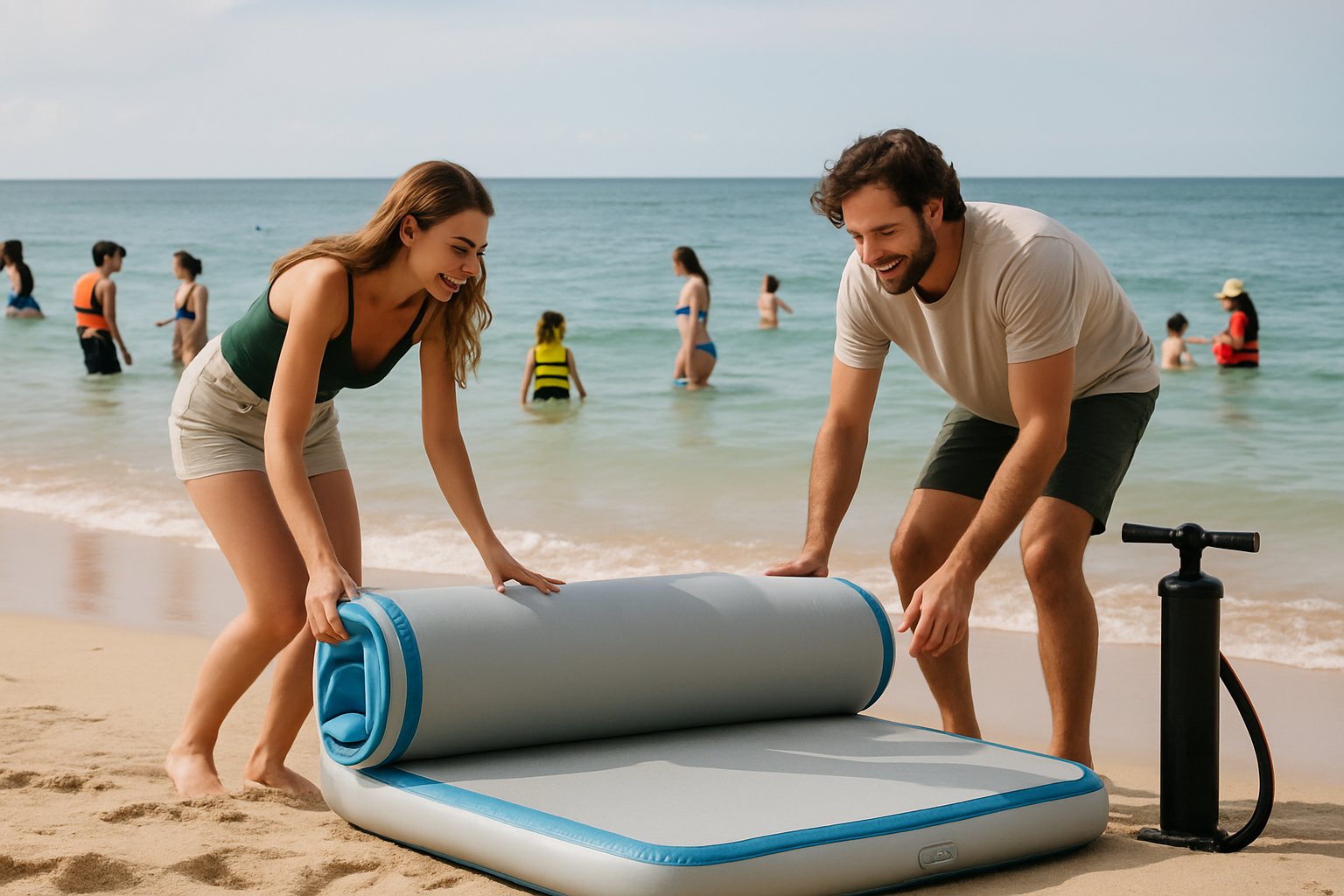
Someone at the lake presses a thumb into a fully pumped platform and is surprised: it’s hard, nearly like a board, even though it rolled out of a bag an hour ago. Then come the questions. How does air make it flat? What does “drop-stitch” mean? Why does one deck say 5 psi and another 15? How many people can it really take? This hub answers how inflatable platforms work, and sends you to the guide that goes deeper on each part.

In short: most inflatable platforms are drop-stitch panels: two coated fabric skins tied together by thousands of threads, so that pumped-up air makes a flat, stiff slab rather than a balloon. Thread length sets the thickness (about 8 to 20 cm, or 3 to 8 in, on the products we track) and the maker sets the pressure (about 5 to 18 psi). Capacity, anchoring and care all come from the maker’s own figures, not from the size.
Construction: what’s inside an inflatable platform
Drop-stitch was patented by Goodyear in the 1960s and is now standard for docks, swim platforms, paddle boards and fitness mats. Air pushes the two skins apart; the threads stop them bulging. The skins are usually PVC-coated polyester (Aquaglide’s Duratex Cx3 is 0.9 mm, or 31 oz), with Hypalon on some heavy-duty tubes and TPU as a lighter, costlier alternative coating. Seams are welded or glued. Start with what is drop-stitch, then the glossary for the materials words you’ll see in listings.
| Thickness class | Examples | Typical stated pressure |
|---|---|---|
| 8 cm (about 3 in) | FloatDeck; drop-stitch water mats | Up to 10 psi (FloatDeck) |
| 10 cm (about 4 in) | Aquaglide Half Deck | 3.5 to 5 psi |
| 15 cm (about 6 in) | Aquaglide Solarium, most 6 in consumer decks, fitness mats | 5 to 10 psi (decks); 10 to 18 psi (fitness mats) |
| 20 cm (about 8 in) | Jobe, NautiBuoy and SeaRaft yacht platforms | 12 to 15 psi (Jobe Infinity Island Small) |
Sizes and specs: reading a spec sheet
US consumer platforms come in feet (6 x 5, 8 x 5, 10 x 10); European yacht platforms often use area codes (375, 525, 675, 800 for 2.5 x 1.5 m up to 4 x 2 m). Capacity is never standardized: listings for the same product can disagree (we’ve seen 1,500 vs 2,000 lb for one RAVE mat), and some makers rate by people, some by weight, some both. Read the number on the maker’s own page and the label. How to choose an inflatable platform turns those numbers into a size decision, and inflatable platform vs floating mat explains how drop-stitch compares with foam.
Aquaglide Half Deck 7.5
by Aquaglide
- Size (as stated): 2.28 x 1.55 x 0.1 m
- Thickness: 10 cm welded drop-stitch
Jobe Infinity Island
by Jobe
- Size (as stated): 2.96 x 4.48 m
- Stated capacity: 800 kg recommended load
- Thickness: 20 cm single-layer drop-stitch
Jobe Infinity Island Small
by Jobe
- Size (as stated): 2.17 x 3.32 m
- Stated capacity: 390 kg
- Thickness: 20 cm
NautiBuoy Voyager 800
by NautiBuoy Marine
- Size (as stated): 4 x 2 x 0.2 m
- Stated capacity: 700 kg; 5 people
- Thickness: 20 cm drop-stitch
RAVE Aqua Dock 10 (as a swim platform)
by RAVE Sports
- Size (as stated): 10 x 10 ft x 6 in
- Stated capacity: 10 adults; 1,800 lb
- Thickness: 6 in drop-stitch
SeaRaft PL525 platform
by SeaRaft
- Size (as stated): 3.5 x 1.5 m
- Thickness: 20 cm drop-stitch (retailer)
Accessories: anchors, pumps, connectors and covers
- Anchoring. Makers publish anchor points and, in Aquaglide’s case, minimum anchor weights (250 kg for its Solarium, 2,000 kg across four points for the Ohana). See how to anchor an inflatable platform.
- Pumps. Hand pumps for consumer decks; 12/24 V pumps or the ship’s air on yachts; breathing-apparatus cylinders for rescue paths.
- Connection systems. Aquaglide Vario-Lock straps, Jobe double D-rings, NautiBuoy’s Air Toggle beam. They link pieces within one brand; see modular platforms.
- Ballast bags, covers and repair kits. Water-ballast bags steady yacht and work platforms; UV covers protect platforms left inflated; most makers include a repair kit.
Ownership and safety
Inflate on a clean surface to the maker’s pressure, check it again after it warms in the sun, anchor it at its stated points and depth, and bring it in before wind and storms. Wash with mild soap, dry fully, store cool and shaded. For patches, use an adhesive matched to the coating (PVC and Hypalon need different glues) and let it cure. The inflatable platform safety checklist puts the whole routine on one page. If you’re deciding between an inflatable and a fixed structure, read inflatable vs rigid floating platforms, and for a pond or lake shore, platforms for ponds and lakes.
Every guide in one place
- Basics: Start Here, FAQ, glossary.
- Construction: what is drop-stitch, platform vs floating mat, inflatable vs rigid.
- Choosing: how to choose, ponds and lakes, platforms for jet skis, buying guides.
- Setup and safety: anchoring, safety checklist.
- Best-of lists: floating islands, water mats, water trampolines, water parks, lake floats.
- By type, use and business: platform types, Explore by Use, commercial.
Quick questions
How do inflatable platforms stay flat?
Thousands of threads join the top and bottom skins inside the chamber. When it’s pumped up, the threads hold the skins at a fixed distance, so it stays flat instead of rounding out.
Why do pressures differ so much between platforms?
Each maker sets its own. Lake lounges and decks are often 5 to 10 psi, yacht and work platforms 12 to 15 psi, fitness mats up to 18 psi and Paratech’s rescue path 7.8 psi. Use the figure printed for your model.
Is “commercial grade” a standard?
No. Many listings use the phrase, but no standard sits behind it. Ask for the rated load, warranty terms for commercial use and any certification.
Where do I start if I’m new?
Read Start Here, then how to choose, and keep the FAQ handy.