This article contains affiliate links: if you buy through them we may earn a commission, at no extra cost to you. Read our affiliate disclosure.
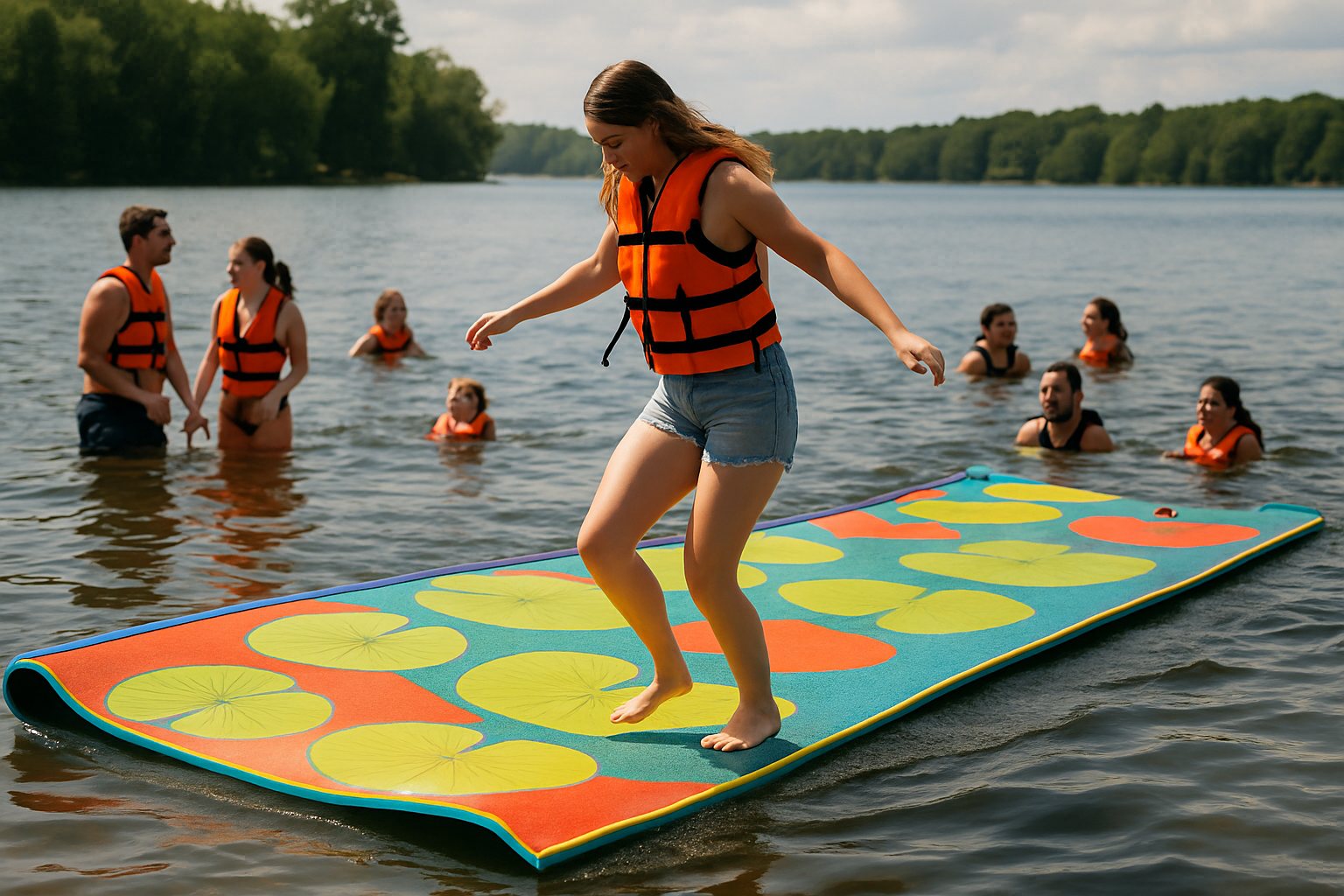
Saturday on the lake, about eleven in the morning. The boat is anchored in the cove, the music is low, and a long green-and-yellow roll comes off the swim deck. Two of the kids unroll it on the water, clip it to a cleat, and within a minute four of them are racing down it and belly-flopping off the end. The adults wait their turn and then just lie on it, feet in the water. That roll is a lily pad float, and this guide explains what it is, what the foam layers do, which size fits your crew and how to make it last for many summers.
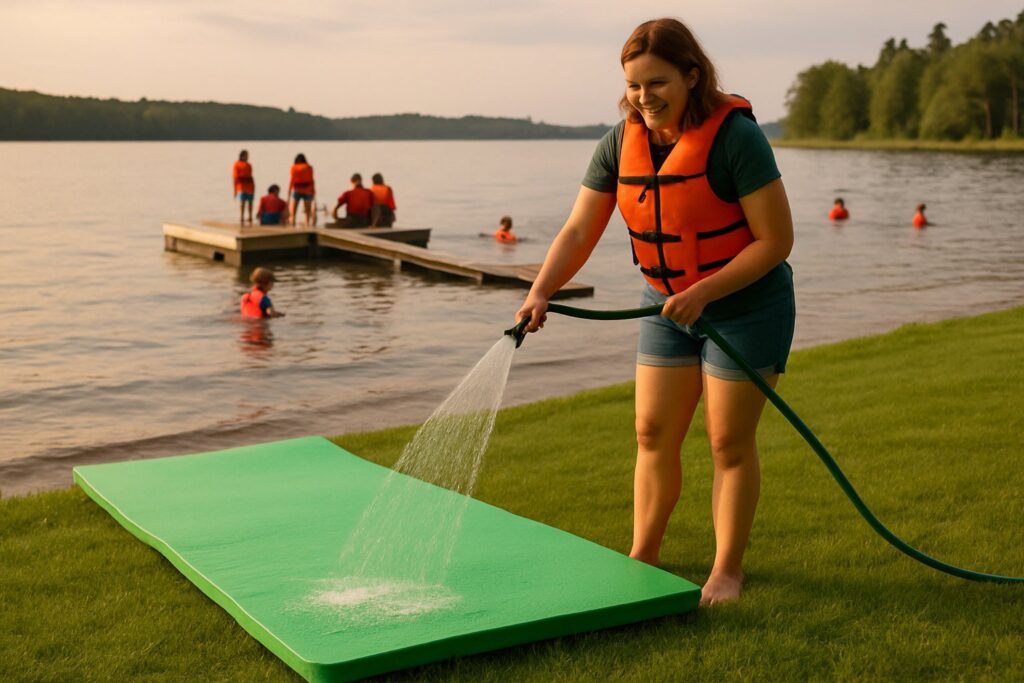
In short: a lily pad float is a thick, flexible mat of closed-cell foam, usually 6 ft wide and 9 to 20 ft long, that floats without any air. Pick the length by how many people the maker rates it for, use it in water at least as deep as the maker asks (Aqua Lily Pad says 6 ft), tie it off, and roll it up dry and out of the sun after each use.
What is a lily pad float?
“Lily pad” started as a brand name: the Aqua Lily Pad, an American-made foam mat that became so common on lakes that people now use the name for any floating foam mat. You’ll also see it sold as a floating water mat, floating pad, water pad or foam mat. They are all the same idea: a soft, bouncy sheet that floats because of what it’s made of, not because of air inside it.
That is the key difference from the inflatable mats and platforms covered elsewhere on this site. There’s no pump and no valve, and a cut doesn’t sink it. The trade-off is feel: a foam pad flexes and dips under each step, so it’s a playground and a lounger more than a deck you stand still on. If you want a firm surface, read foam vs drop-stitch floating mats before you buy.
The Original Aqua Lily Pad and the other makers
When people search for the “original Aqua Lily Pad”, this is what they’re looking for. The maker describes it as two layers of cross-linked polyethylene foam with its patented FlexCore design, 1.375 in thick, with a UV-stabilized graphic layer on top. It is made in the United States, comes in 9, 12, 15, 18 and 20 ft lengths, and clips on with a tether snap system that the maker says uses no sharp metal hardware. The maker states a range of 500 to 1,800 lb of distributed weight, depending on size.
Other makers build the same kind of mat in different ways. Rubber Dockie uses two-ply closed-cell foam with a nylon “Tear-Stop” layer inside and a “Tuff-Hide” outer treatment. Goplus sells a three-layer XPE (cross-linked polyethylene) pad with a reinforcing net and a rolled “pillow” at one end. SOWKT, a Florida company, makes a two-layer XPE mat in the USA. The names differ, but the parts are the same: foam layers, something inside to stop a tear from running, and a sun-resistant top.
Lily pad floating mat sizes and how many people
Almost every lily pad floating mat is 6 ft wide; length is how you size up. Here is how the makers rate their own mats. Read “adults” as spread out, not bunched at one end.
| Length (x 6 ft wide) | Maker rating | Mat weight (maker) | Suits |
|---|---|---|---|
| 9 ft | 1 to 4 adults (Aqua Lily Pad); 550 lb (Goplus) | 13 lb | Couples, small kids, small boats |
| 12 ft (Goplus: 11.5 ft) | 5 to 6 adults (Aqua Lily Pad); 880 lb (Goplus) | 17 to 18 lb | A family of four or five |
| 15 ft | 7 to 8 adults (Aqua Lily Pad) | 23 lb | Bigger families, cousins’ weekends |
| 18 ft | 9 to 10 adults (Aqua Lily Pad); about 9 adults or 1,500 lb spread equally (Rubber Dockie); 1,323 lb (Goplus) | 25 to 30 lb | Lake houses, groups of kids |
| 20 ft | 10 to 12 adults (Aqua Lily Pad) | 28 lb | Big groups with a big storage space |
Two cautions. First, listings for the same mat don’t always agree: Amazon’s page for the Goplus pad shows different capacity figures in different places, and Aqua Lily Pad’s own pages have given more than one figure for the 18 ft. When figures differ, go by the lowest. Second, the extra length only helps if people use it. If you’re between sizes, Aqua Lily Pad’s own tip is to size up.
What the foam layers do
Most good lily pads are about 1.375 to 1.5 in thick. The thickness is similar across brands, so the differences are in the layers:
- Closed-cell foam (cross-linked polyethylene, often called XPE) is what floats it. Closed cells don’t soak up water, which is why makers call these mats non-absorbent and mildew-resistant.
- Two or three layers are bonded together. More layers doesn’t automatically mean better; what matters is how they’re bonded and what sits between them.
- A tear-stop layer (a nylon mesh or reinforcing net) keeps a small nick at the edge from turning into a long rip. Torn corners are one of the two things that end a mat’s life.
- A UV-protected top slows down the other thing that ends a mat’s life: sun. Aqua Lily Pad calls its top a UV-stabilized graphic layer.
- The tether point is where the mat clips to a line. Look for a reinforced grommet or snap; this is where the pull from wind and wake goes.
One thing to know about “no roll memory”: some foam mats curl at the ends after being stored rolled. Aqua Lily Pad says its two-layer FlexCore mat has no roll memory. Other makers don’t say, so if a new mat curls, lay it flat in the sun for a while before people get on.
Lily pad mats worth a look
Two foam mats we found in stock on Amazon, plus the tether kit that keeps one in place. For a full ranked list, see best floating water mats. Prices are what we saw in October 2026 and change often.
Aqua Lily Pad Original
- 9, 12, 15, 18 and 20 ft
- 2-layer FlexCore foam, 1.375 in
- Made in USA
Goplus Floating Water Pad
- 9, 12 and 18 ft sizes
- 3-layer XPE foam
- 2 bungee tethers included
Rubber Dockie Spare Tether Kit
- 12 ft elastic tether
- Carabiner and grommet
- Adds a second tie point
The Aqua Lily Pad Original was about $550 on Amazon when we checked (the listing covers several sizes, so the price depends on which you pick). The Amazon listing for the 18 ft states 9 to 10 adults and 1,350 to 1,500 lb distributed, with a one-year warranty. The Goplus Floating Water Pad was about $210 for the listing’s default size; Goplus gives it a 90-day warranty and includes two short bungee tethers and storage straps. The Rubber Dockie tether kit (about $40) is a factory spare with a 12 ft elastic tether, galvanized carabiner and a grommet you install, useful for adding a second tie point to a long mat.
Check the Aqua Lily Pad price on Amazon
For makers that sell mats through dealers and their own stores, browse the product catalog:
RAVE Aqua Mat Deluxe 20 ft
by RAVE Sports
- Size (as stated): 20 x 5 ft x 3 in
- Stated capacity: 1,500 lb (one listing says 2,000 lb)
- Thickness: 3 in drop-stitch
Where a lily pad works best
Lakes are home turf: calm water, a dock or a boat to tie to, and enough depth to jump. Aqua Lily Pad says its mat should never be used in water less than 6 ft deep, and that depth matters where people land, not just where the mat sits. Check it again in late summer when lake levels drop. Sheltered coastal water works too, though waves and current make a mat hard to hold in place, so tie it short and rinse off the salt afterwards. For setups by water type, see floating mat for lake and floating mat for boat.
A lily pad is not a towable. Aqua Lily Pad says plainly that its mat is not designed to be towed, so the engine is off and the boat is anchored before it goes in.
Care: how to make a foam mat last
- Rinse it. Fresh water after salt water or a muddy day keeps grit out of the surface.
- Let it dry. Closed-cell foam doesn’t absorb water, but a mat rolled up wet traps water and dirt in the roll.
- Roll, never fold. Folding creases the foam. Roll it from one end and cinch it with the storage straps.
- Store it out of the sun. Aqua Lily Pad suggests a garage shelf, a pontoon storage bay or a covered dock box; Goplus says to avoid direct sunlight when storing.
- Keep it off sharp things. Boat hardware, rocks, propellers and docks with exposed screws cause most corner tears.
- Fix small tears early. Aqua Lily Pad sells a Tear-Aid Type A repair kit for its mats. Ask your maker what patch or adhesive suits its foam before you try anything else.
Dogs are welcome on most mats. Aqua Lily Pad says minor surface marks from claws don’t affect how the mat performs, but asks owners to watch for sharp nails and chewers.
Safety on a lily pad
A foam mat floats, but it is not a life-saving device, and makers say so. Young or weak swimmers should wear a U.S. Coast Guard approved life jacket, and an adult should be watching whenever kids are on the mat. If you tie it to the boat, keep everyone clear of the stern while any engine or generator runs: the U.S. Coast Guard warns that carbon monoxide can collect around the back of a boat. And if you hear thunder, the National Weather Service’s advice is to get out of the water. Our safety checklist covers the rest.
More on this type: floating mats (sizes and ways to play), inflatable platform vs floating mat, and how to anchor a platform. All our mat articles are in floating mats and lounges.
Lily pad float questions
Is an aqua lily pad the same as a lily pad float?
Aqua Lily Pad is a brand; “lily pad float” is what most people call any floating foam mat. The Aqua Lily Pad is one of them, made in the USA, and other makers such as Rubber Dockie, Goplus and SOWKT sell similar mats.
What size lily pad do I need?
Count the people who’ll usually be on it together. Aqua Lily Pad rates its 9 ft for 1 to 4 adults, 12 ft for 5 to 6, 15 ft for 7 to 8, 18 ft for 9 to 10 and 20 ft for 10 to 12. Then check you have room to store the roll.
Does a lily pad floating mat need a pump?
No. A foam lily pad floats because of the foam. You unroll it and clip it on. Only inflatable (drop-stitch) mats need a pump.
How deep should the water be for a lily pad?
Follow your maker. Aqua Lily Pad says never less than 6 ft. Measure where people will jump in, and measure again later in the season.
Can you leave a lily pad in the water overnight?
Makers describe rolling it up after use and storing it out of the sun, which is also what keeps the foam in good shape. If you leave it out, tie it securely and bring it in before wind or storms.
Can a lily pad pop or sink?
No. There is no air to lose, so a cut or tear won’t sink it. A tear can grow, though, which is why tear-stop layers and early repairs matter.
Leave a Reply