This article contains affiliate links: if you buy through them we may earn a commission, at no extra cost to you. Read our affiliate disclosure.
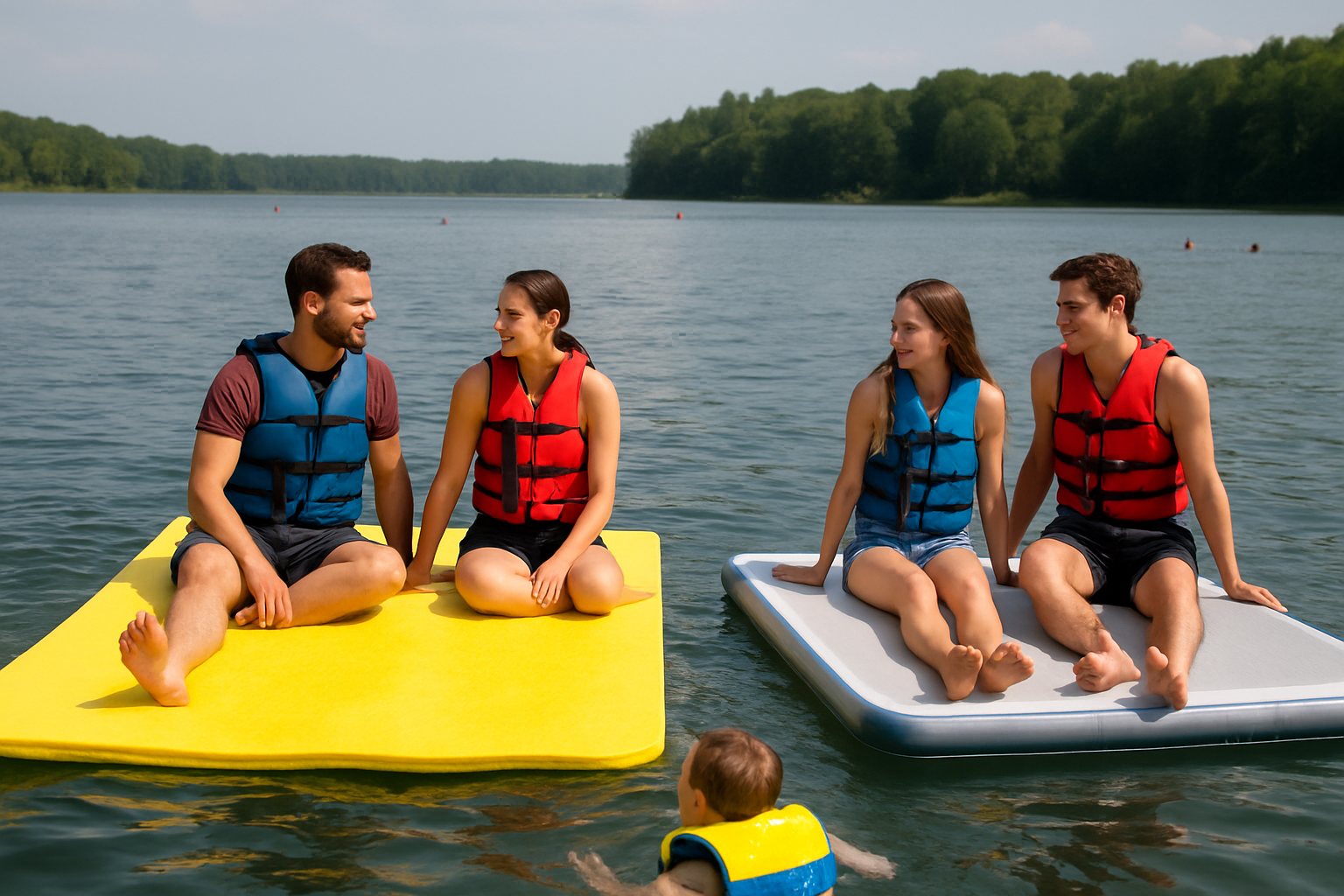
Two families, two docks, same lake. At one, the kids are sprinting down an 18 ft foam mat that ripples under every step, and the youngest is lying flat on it, riding the waves. At the other, three adults are sitting in camp chairs on a stiff, white-and-blue mat that barely moves, coffee cups on the deck, while a teenager balances on the end waiting for a wakeboard pull. Both are a floating mat, both are about 18 ft long, and they could hardly feel more different. One is closed-cell foam. The other is an inflatable drop-stitch mat. Here is how to choose.
In short: foam floating mats are lighter, need no pump and can’t go flat, and they feel soft and bouncy: best for kids and play. Inflatable drop-stitch water mats are 3 to 4 in thick, firm enough to stand and sit on, pack smaller and need less depth by their makers’ figures, but they weigh about twice as much and need pumping. Choose by how your group uses the water.
Two ways to build a floating mat
Foam mats (lily pads) are layers of closed-cell cross-linked polyethylene foam bonded into a sheet about 1.4 to 1.5 in thick. They float because the foam itself is buoyant. Makers add a tear-stop layer inside and a UV-resistant top. Our lily pad guide goes layer by layer.
Inflatable water mats use drop-stitch: two layers of coated fabric tied together by thousands of fine threads. Pump the chamber up and the threads hold the two skins flat and parallel, so the mat becomes a firm slab instead of a pillow. RAVE describes its Aqua Mat as high-pressure PVC drop-stitch inflated to 5 psi. For how the threads work, read what is drop-stitch.
This article compares long mats only, the 15 to 20 ft kind families use for play and lounging. If you’re weighing a mat against a square inflatable platform or dock, that’s a different choice, covered in inflatable platform vs floating mat.
Foam vs drop-stitch floating mats, by the numbers
Real 18 ft mats, using the figures each maker states for its own product:
| Mat (18 ft class) | Build | Thickness | Mat weight | Rating (maker) | Min. depth (maker) | Warranty |
|---|---|---|---|---|---|---|
| Aqua Lily Pad Original 18 | Foam, 2 layers | 1.375 in | 25 lb | 9 to 10 adults | 6 ft | 1 year |
| Rubber Dockie 18 x 6 | Foam, 2-ply + tear-stop | 1 3/8 in | 30 lb | About 9 adults / 1,500 lb spread equally | Not stated on product page | 1 year |
| Goplus 18 x 6 | Foam, 3 layers | 1.5 in | 26 lb | 1,323 lb | Not stated on product page | 90 days |
| RAVE Aqua Mat LTD 18 | Drop-stitch, 5 psi | 4 in | 56 lb | 8 adults or 14 kids / 1,500 lb | 4 ft | Limited lifetime (personal use) |
RAVE also makes Aqua Mat Deluxe versions: 15 x 5 ft x 4 in rated 1,100 lb, and 20 x 5 ft x 4 in rated 1,500 lb on RAVE’s own comparison table (one retailer lists the 20 ft as 3 in thick, so check the listing you buy from). Notice that inflatable mats are usually 5 ft wide, while foam mats are 6 ft.
How each one feels on the water
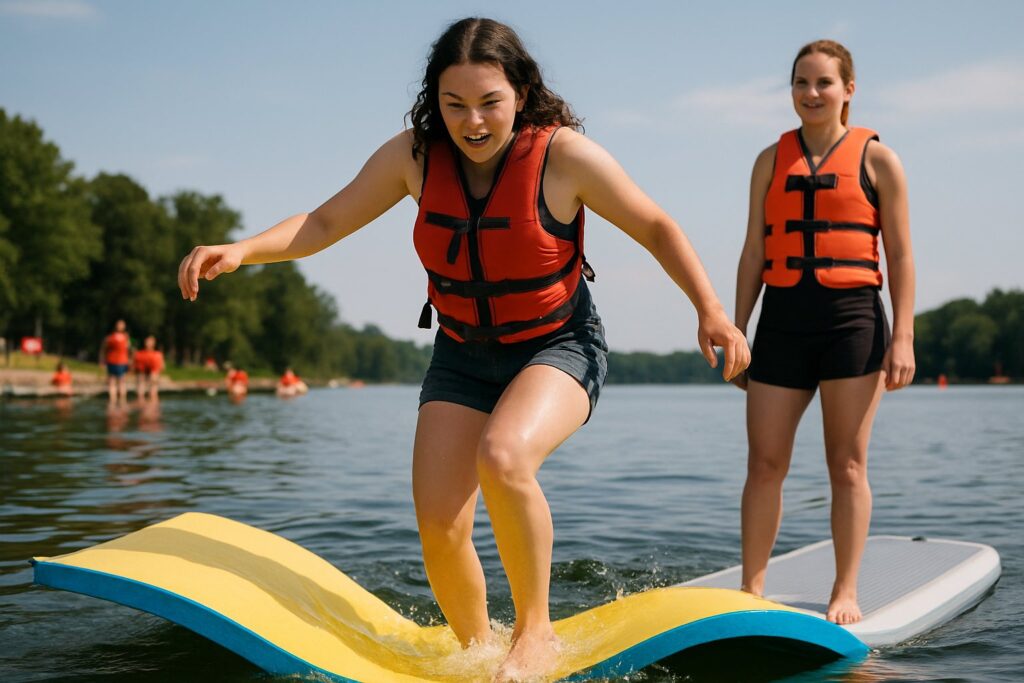
A foam mat flexes. Each step pushes a dip into it, water washes over the edges when people gather, and running on it feels like running on a waterbed. That’s the whole point for kids: it’s a bouncy, slippery playground. Adults lie on it happily but rarely stand still on it.
A drop-stitch mat stays flat. RAVE calls its Aqua Mat “extremely rigid and stable” and suggests bringing a lawn chair and a cooler, and uses it as a starting platform for water skiing and wakeboarding. (Aqua Lily Pad also markets its foam mat as a launch pad for water sports, so both get used that way.) If the people on your mat are mostly grown-ups who want to sit, stand, do yoga or read, firm wins.
Setup, weight and packing
- Setup: foam is unroll and clip, about a minute. RAVE says its Aqua Mat takes 5 to 10 minutes with the included dual-action hand pump; an electric pump shortens that.
- Weight: the 18 ft foam mats above weigh 25 to 30 lb; the 18 ft drop-stitch mat weighs 56 lb. One adult can carry the foam; the inflatable is easier with two.
- Packed size: foam rolls into a 6 ft log (Rubber Dockie says about 26 x 26 x 72 in for its 18 ft). Drop-stitch folds and rolls to what RAVE compares to a sleeping bag. On a small boat, that difference decides it; see floating mat for boat.
Durability: tears vs punctures
The two types fail in different ways, and that’s worth knowing before you buy.
- Foam can’t go flat. A cut or a torn corner doesn’t stop it floating, but a tear can spread, which is why makers build in tear-stop mesh or netting. Sun slowly wears the surface, so storage out of the sun matters. Aqua Lily Pad sells a Tear-Aid Type A repair kit for small tears.
- Drop-stitch loses air if it’s punctured, until it’s patched. RAVE says its mat “won’t rip, curl, or sink”, which is the maker’s claim; in practice, carry a PVC repair kit, and check pressure on hot days because the air inside expands in the sun. RAVE’s warranty excludes damage from over- or under-inflation and punctures in normal use, so follow the stated 5 psi.
Warranties also tell you something: the foam mats above carry 90 days to one year, and RAVE gives its inflatable mat a limited lifetime warranty for personal use.
Inflatable water mats vs foam: cost
For an 18 ft mat, the two types cost about the same at the top of the range. We saw foam from about $210 (Goplus, on Amazon, default size) to about $550 (Aqua Lily Pad on Amazon) and about $650 (Aqua Lily Pad’s own list price for 18 ft, early October), and RAVE’s 18 ft drop-stitch mat at about $600 with its pump. Budget foam mats are the cheapest way in; once you’re spending $500 or more, the choice is about feel and storage rather than price.
Foam and drop-stitch mats to compare
One of each, plus a repair kit for the inflatable. In stock on Amazon when we checked in October 2026; prices change often. For more mats ranked, see best floating water mats.
Aqua Lily Pad Original
- 1.375 in, 2-layer foam
- 18 ft: 9 to 10 adults (maker)
- No pump needed
Goplus Floating Water Pad
- 1.5 in, 3-layer XPE
- 9, 12 and 18 ft
- 90-day warranty
RAVE Aqua Mat LTD 18
- 18 x 5 ft x 4 in at 5 psi
- 1,500 lb (maker)
- Pump included
JLF Repair Kit with HH-66 Vinyl Cement
- 5 PVC patches, 3 x 6 in
- 1 oz HH-66 vinyl cement
- Valve wrench (6-prong)
The JLF kit (about $40) is sold for inflatable paddle boards and rafts; check that your mat’s maker allows PVC patches and vinyl cement, and that your valve takes a 6-prong wrench, before you use it.
Check the RAVE Aqua Mat LTD 18 price on Amazon
RAVE Aqua Mat Deluxe 20 ft
by RAVE Sports
- Size (as stated): 20 x 5 ft x 3 in
- Stated capacity: 1,500 lb (one listing says 2,000 lb)
- Thickness: 3 in drop-stitch
Can you use both together?
Plenty of lake houses end up with one of each: the foam mat for the kids’ end of the swim area, the firm mat as the grown-ups’ deck. That works well as long as each one is tied off on its own. Don’t count on linking them. RAVE says its Aqua Mat LTD is meant as a standalone product and doesn’t connect to its water trampolines or bouncers, and foam mats have no connection system beyond their tether point. If you want pieces that lock together into one larger surface, look at modular systems instead, where the maker designs the connections and states what the combined layout can carry; see modular platforms.
Keep the two apart on the water, too. A soft mat and a stiff one move differently in wind and wake, and the edge where they bump is a pinch point for fingers and toes.
Which one should you buy?
| If you… | Choose |
|---|---|
| Have kids who want to run, jump and wrestle | Foam |
| Want to sit in a chair, stand, do yoga or start a wakeboard | Drop-stitch |
| Have a small boat with little storage | Drop-stitch (packs smaller) |
| Want zero setup and no pump | Foam |
| Swim where it’s 4 to 6 ft deep | Check each maker’s minimum; RAVE states 4 ft, Aqua Lily Pad 6 ft |
| Are on a tight budget | Budget foam |
Whichever you pick, the same rules apply: stay within the maker’s rating, life jackets for kids and weak swimmers, tie it off, and bring it in when the weather turns. See floating mat for lake, the floating mats overview and the safety checklist.
Foam vs drop-stitch questions
Are inflatable water mats better than foam?
Not better, different. Inflatable mats are firmer and pack smaller; foam mats are lighter, quicker to set up and can’t go flat. For kids’ play, foam; for adults lounging and standing, inflatable.
Can a drop-stitch floating mat pop?
It can be punctured and lose air until it’s patched. It won’t burst from normal use if you keep to the maker’s pressure, but check it on hot days because heat raises the pressure.
Which floating mat is better for dogs?
Both get used with dogs. Aqua Lily Pad says claw marks don’t affect its foam mat’s performance; RAVE suggests its firm mat for dogs too. Watch sharp nails on either.
Which lasts longer, foam or drop-stitch?
No maker publishes a lifespan in years. Both last longest stored dry and out of the sun. Warranties run 90 days to one year for the foam mats here and limited lifetime (personal use) for RAVE’s inflatable.
Do inflatable water mats need an electric pump?
Not necessarily. RAVE includes a dual-action hand pump and says setup takes 5 to 10 minutes. An electric pump is faster if you set up often.
Leave a Reply