This article contains affiliate links: if you buy through them we may earn a commission, at no extra cost to you. Read our affiliate disclosure.
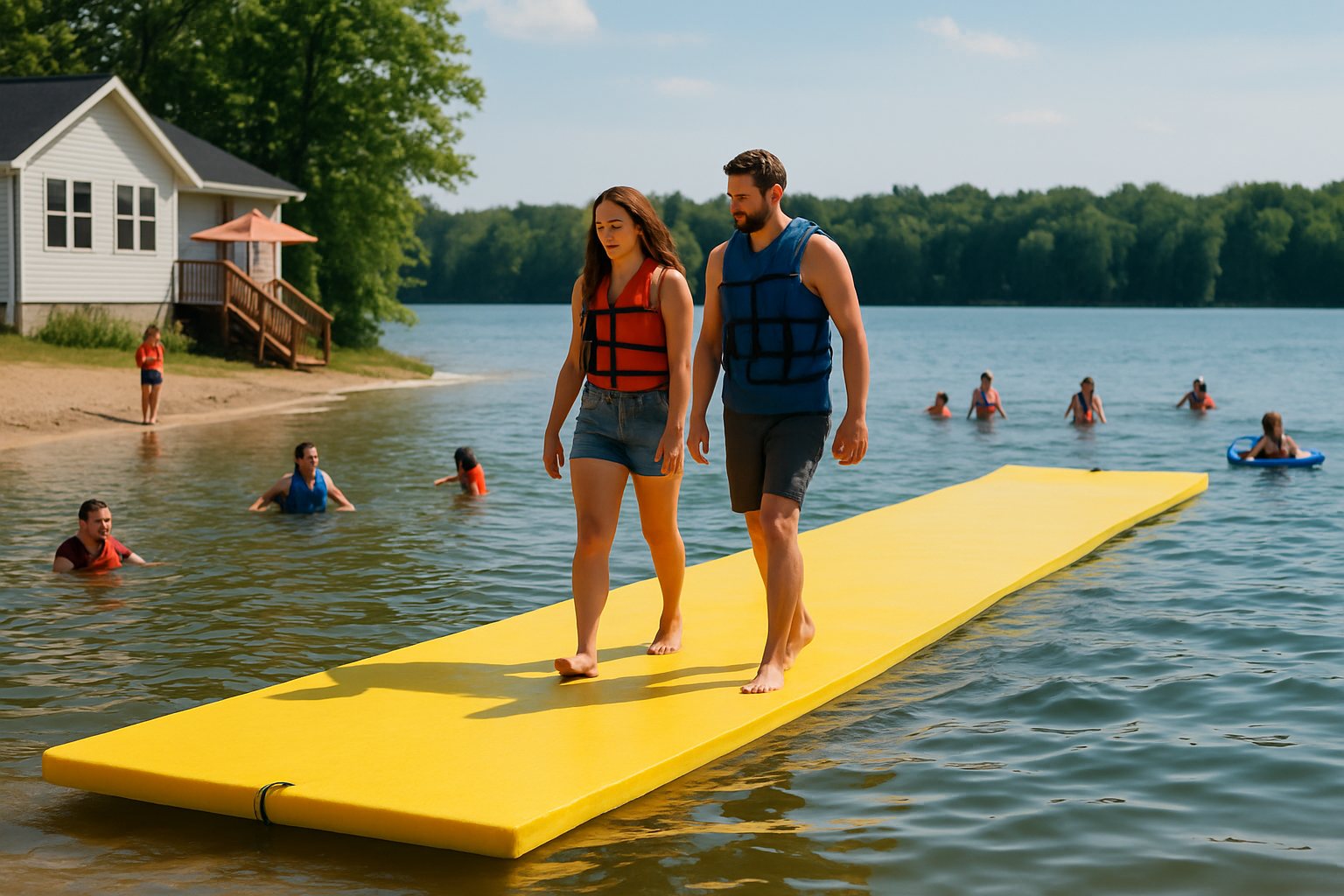
The lake house has a short dock, a strip of sand and a view of the water that everyone fights over at breakfast. By noon the cousins have dragged a long foam mat down to the shore, waded it out past the drop-off and tied it to the dock post, and the afternoon sorts itself out: kids sprinting and jumping off one end, grandparents floating on the other. A floating mat for lake days is the simplest piece of floating space you can own, and the lake itself decides most of how you set it up. This guide is about that part: depth, where to put it, how to keep it there, and what to do when the wind comes up.

In short: for a lake, choose a mat sized to your group, put it where the water is at least as deep as the maker asks (6 ft for Aqua Lily Pad, 4 ft for RAVE’s inflatable Aqua Mat), and keep it tied to the dock or a weighted anchor rather than letting it drift. Bring it in when wind, storms or heavy boat traffic arrive, and roll it up dry at the end of the day.
Choosing a floating mat for lake use
Lake buyers search for this in a lot of ways (floating pad for lake, floating water mat, lake mat), but there are only two kinds:
- Foam mats (lily pads): layered closed-cell foam about 1.4 in thick, 6 ft wide, 9 to 20 ft long. No pump. Soft and bouncy: made for running, jumping and lounging. Our lily pad guide covers sizes and foam layers.
- Inflatable mats: drop-stitch PVC, about 3 to 4 in thick, pumped hard. Firm enough to stand on, set a chair on, or start a wakeboard from. Heavier, and they need a pump. See foam vs drop-stitch floating mats.
For a lake house where the mat lives at the dock, either works. For a lake you reach by boat, think about where the mat rides; that’s covered in floating mat for boat.
Check the depth first
Depth is the number that matters most on a lake, because people jump off the end of a mat. Makers state different minimums for their own products:
| Mat (example) | Type | Minimum depth the maker states |
|---|---|---|
| Aqua Lily Pad Original | Foam | Never less than 6 ft |
| RAVE Aqua Mat LTD 18 | Inflatable drop-stitch | 4 ft (1.2 m) |
| Aquaglide Half Deck 7.5 (small inflatable deck) | Inflatable drop-stitch | 0.97 m (about 3.2 ft), retailer listing |
Measure where people will land, not just where the mat floats. A weighted line marked every foot, dropped off the end of the dock, takes two minutes. Measure again in late summer: many lakes drop over the season, and a spot that was deep enough in June may not be in August. If your shoreline is shallow for a long way out, the mat has to go further out, which changes how you hold it in place.
Where to put a floating pad for lake swimming
- Off the end of a dock. The easiest spot. Tie the mat to a post or cleat so its far end points to deep, open water, and nobody jumps toward the dock.
- Out in a swim area. Anchored on its own, a mat becomes a destination swimmers paddle to. It needs a proper anchor, and it should be easy to see from boats.
- Off a beach. Wade it out past the drop-off and anchor it. Keep it out of any channel or path that boats and personal watercraft use to reach the shore.
Whatever spot you choose, keep it away from boat traffic. Wakes from passing boats rock a mat hard and can throw people off, and a low foam mat is hard for a driver to see. Many lakes, lake associations and parks also have their own rules about what can be anchored where and for how long, so ask before you leave a mat out in open water.
How to anchor a floating mat on a lake
A mat that isn’t tied off becomes a sail. Even a light breeze pushes it across the lake, usually with someone still on it. There are two ways to hold it:
- Tie it to the dock. Clip the mat’s tether to a post or cleat. Keep the line short enough that the mat can’t swing into the dock or a boat, but long enough that it isn’t yanked when someone lands on it. Elastic tethers, like the 12 ft bungee Rubber Dockie supplies, absorb some of the jolt.
- Anchor it in open water. Aqua Lily Pad suggests a standard mushroom anchor with rope for open water. SeaSense, for example, sells its mushroom anchor for sandy, muddy or weedy bottoms. Use a line long enough for the depth, and add a float so swimmers and boaters can see the line.
Mat makers mostly don’t publish an anchor weight for their foam mats, so we won’t guess one. For inflatable platforms, some do: Aquaglide states a minimum anchor weight for its lakefront lounges (250 kg for the Solarium, for example), and RAVE lists two anchor points on its Aqua Mat. Use your own mat’s manual first. For anchor types, line length and layouts, see how to anchor an inflatable platform.
Mats and anchor gear for the lake
A foam mat, an inflatable mat, and the anchor and line to hold either one. All were in stock on Amazon when we checked in October 2026; prices change often. For a ranked list of mats, see best floating water mats.
Aqua Lily Pad Original
- 9 to 20 ft lengths
- 6 ft minimum depth (maker)
- Made in USA
RAVE Aqua Mat LTD 18
- 18 x 5 ft x 4 in
- 8 adults, 1,500 lb (maker)
- 4 ft minimum depth
SeaSense Mushroom Anchor 10 lb
- 10 lb mushroom anchor
- Black vinyl coated
- Sold for sandy, muddy or weedy bottoms
Better Boat Anchor Rope 100 ft
- 3/8 in double-braided nylon
- 820 lb working load (listing)
- Stainless thimble
We saw the Aqua Lily Pad Original at about $550 (price depends on the size you choose) and the RAVE Aqua Mat LTD 18 at about $600. RAVE includes a dual-action hand pump and puts two anchoring D-rings underneath. The SeaSense 10 lb mushroom anchor was about $32, and the Better Boat 100 ft line about $46. Check your mat maker’s anchoring advice before you rely on any anchor.
Check the RAVE Aqua Mat LTD 18 price on Amazon
Mats sold through dealers and makers’ own stores are in our catalog:
RAVE Aqua Mat Deluxe 20 ft
by RAVE Sports
- Size (as stated): 20 x 5 ft x 3 in
- Stated capacity: 1,500 lb (one listing says 2,000 lb)
- Thickness: 3 in drop-stitch
Wind, storms and leaving it out
A floating water mat is light and wide, so wind is its main enemy. A few habits keep it on your lake and in one piece:
- Bring it in when the wind picks up, and always when a storm is coming. The National Weather Service’s advice is to get out of the water when a thunderstorm approaches.
- Roll a foam mat up at the end of the day. Aqua Lily Pad’s care advice is to roll it after it dries and store it out of the sun.
- On a hot day, check an inflatable mat’s pressure. Air expands in the sun, and RAVE’s mat is meant to run at 5 psi.
- Rinse off lake weed and silt before rolling or folding, so grit isn’t ground into the surface.
Safety for lake mat days
Lakes feel calm, but depth can change quickly from one spot to the next. Kids and weak swimmers wear a U.S. Coast Guard approved life jacket on and around the mat; Aqua Lily Pad also recommends one and reminds owners its mat is not a life-saving device. Keep one adult watching who isn’t on the mat. One person at a time jumps off the end, feet first until everyone knows the depth. Keep the mat clear of boat propellers and engine exhaust if a boat is nearby. Our safety checklist has the full list.
Want more than a mat at the lake? A firm drop-stitch lake swim platform gives swimmers a deck to rest on, a swim raft is the classic anchored float, and families planning a whole season start with family lake days. If you’re comparing mats with fixed floating docks for your shoreline, InflatableDocks covers floating docks for ponds and lakes. The type overview is at floating mats.
Floating mat for lake questions
What is the best floating mat for a lake?
It depends on your group and how you’ll use it. A foam lily pad is best for kids running and jumping; an inflatable drop-stitch mat is best for adults who want a firm place to sit or stand. Size it by the maker’s people rating. Our best floating water mats list compares specific models.
How far from shore should a floating mat be?
Far enough that the water is at least as deep as your maker asks where people jump in. On a gently sloping shore that may be well out; on a steep one it may be just past the dock. Keep it out of boat lanes either way.
Can I leave a floating pad on the lake all summer?
Makers describe rolling foam mats up after use and storing them out of the sun, which is what keeps them lasting. If you leave one out, anchor it properly, check the lake’s rules and bring it in before storms.
What anchor do I need for a floating water mat?
Aqua Lily Pad suggests a standard mushroom anchor with rope for open water. Most foam-mat makers don’t publish an anchor weight, so follow your manual and see our anchoring guide for layouts.
Will a floating mat work on a pond?
Only if the pond is deep enough where people jump in. Many ponds are shallow at the edges, so measure first and follow the maker’s minimum depth.
Leave a Reply