This article contains affiliate links: if you buy through them we may earn a commission, at no extra cost to you. Read our affiliate disclosure.
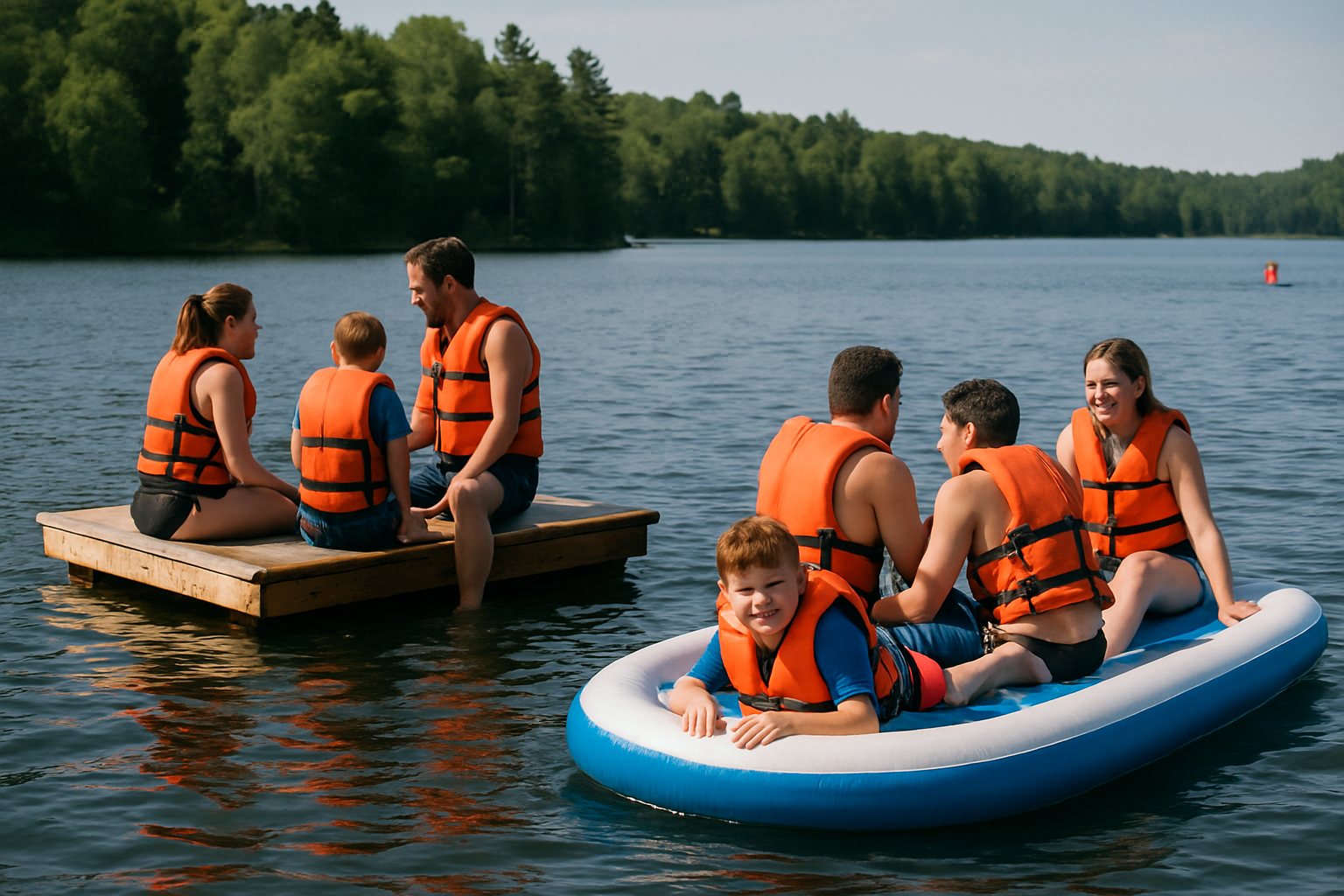
Ask anyone who spent summers at a lake camp and they’ll remember the raft: a square of sun-warmed boards anchored out past the ropes, the goal of every swim. You swam out, hauled yourself up the ladder, lay there dripping, then cannonballed off the side and swam back. A swim raft still does exactly that, but today you can choose between that classic anchored deck and a drop-stitch inflatable that rolls into a bag. This guide explains both, how they differ, what makers state about size and capacity, and how to pick one for your water.
In short: a swim raft is a floating swimming platform anchored in deeper water for swimmers to rest on and jump from. Classic rafts are rigid decks on floats that stay out all season; inflatable rafts are drop-stitch platforms, often 8 x 5 ft to 10 x 10 ft, that set up in minutes and pack away. Choose by how long it stays out, how you’ll anchor it, and how people will climb aboard.
What is a swim raft?
A swim raft is a free-floating platform held in one spot by an anchor, not attached to shore. That’s the difference from a dock: a dock is for getting on and off boats at the shoreline; a raft is a destination out in the swim area. People also call it a floating swimming platform, a swim float or a swim deck. On this site, a raft you swim out to is covered here and in lake swim platforms; a platform you tie behind a boat is covered in inflatable swim platforms for boats.
Classic rigid raft vs inflatable swim raft
| Classic rigid raft | Inflatable (drop-stitch) swim raft | |
|---|---|---|
| Built from | A wood or composite deck on sealed floats | High-pressure drop-stitch PVC, usually 6 in thick |
| Typical use | Anchored all season | Set up for the day or the weekend, or anchored for the season |
| Setup | A build or a kit, then placed and anchored | Inflate in minutes; Island Hopper says about 8 minutes for its 10 x 6 ft |
| Weight | Heavy; usually moved by boat | About 35 to 83 lb for the 7 x 7 to 10 x 10 ft models below (maker figures) |
| Climbing on | A fixed ladder | Side handles, a low edge or a soft ladder |
| Off-season | Usually pulled out; follow local rules | Deflated and stored indoors |
| Capacity | Depends entirely on how it’s built; ask the builder | Stated by the maker (examples below) |
The classic raft wins on permanence: once it’s out, it’s out. The inflatable wins on everything else: no build, no boat needed to move it, and it goes home in a bag when the season ends. If you’re comparing rigid and inflatable floating structures in more depth, InflatableDocks covers inflatable vs rigid floating docks.
Floating swimming platform sizes and ratings
Here is what the makers of popular inflatable swim rafts state for their own products. Use the number on your raft’s label and manual, not one worked out from its size.
| Raft | Size | Rating (as stated) | Weight | Notes |
|---|---|---|---|---|
| Solstice 8 x 5 ft | 8 x 5 ft x 6 in | 4 to 6 people recommended (Amazon listing) | Not on the listing | Sold with bag and pump; 1-year warranty |
| Island Hopper Yacht Dock | 10 x 6 ft x 6 in | 1,500 lb | 53 lb | 8 to 15 psi; rubber corner bumpers |
| BOTE Hangout Dock 7 | 7 x 7 ft x 8 in | 1,050 lb | 35 lb | 6 to 8 psi |
| RAVE Aqua Dock 10 | 10 x 10 ft x 6 in | 10 adults or 14 children, 1,800 lb | 69 lb | 5 psi; 10 handles; 4 ft minimum depth |
| BOTE Hangout Dock 10 | 10 x 10 ft x 8 in | 2,100 lb | 83 lb | 8 to 10 psi |
A few things stand out. Makers state very different pressures, from 5 psi (RAVE) to 15 psi (Island Hopper), so use a gauge and your own maker’s figure. Thicker isn’t always rated higher. And people ratings and pound ratings don’t always line up, so go by whichever is lower for your crowd.
Swim rafts worth a look
Two inflatable rafts at different sizes and a ladder for rigid rafts and platforms. In stock on Amazon when we checked in October 2026; prices change often.
Solstice Drop-Stitch Swim Raft 8 x 5 ft
- 8 x 5 ft x 6 in drop-stitch
- 4 to 6 people recommended (listing)
- Bag and pump included
RAVE Aqua Dock 10
- 10 x 10 ft x 6 in
- 1,800 lb (maker)
- 10 side handles, 8 D-rings
Amarine Made 4-Step Telescoping Ladder
- 304 stainless steel
- Hinged bracket folds over platform
- 900 lb (listing)
The Solstice 8 x 5 was about $350; its listing calls it a 6 in drop-stitch swim raft with a non-slip deck. The RAVE Aqua Dock 10 was about $800; RAVE adds four non-slip foam corners, a carry strap and a dual-action hand pump, and gives it a limited lifetime warranty for personal use. The Amarine ladder (about $60) is a stainless boat ladder with a hinged mounting bracket; it’s for rigid decks with a solid edge to mount on, not for inflatables. Check that it fits your raft’s edge before you buy.
Check the RAVE Aqua Dock 10 price on Amazon
Aquaglide Half Deck 7.5
by Aquaglide
- Size (as stated): 2.28 x 1.55 x 0.1 m
- Thickness: 10 cm welded drop-stitch
Jobe Infinity Island
by Jobe
- Size (as stated): 2.96 x 4.48 m
- Stated capacity: 800 kg recommended load
- Thickness: 20 cm single-layer drop-stitch
Jobe Infinity Island Small
by Jobe
- Size (as stated): 2.17 x 3.32 m
- Stated capacity: 390 kg
- Thickness: 20 cm
NautiBuoy Voyager 800
by NautiBuoy Marine
- Size (as stated): 4 x 2 x 0.2 m
- Stated capacity: 700 kg; 5 people
- Thickness: 20 cm drop-stitch
RAVE Aqua Dock 10 (as a swim platform)
by RAVE Sports
- Size (as stated): 10 x 10 ft x 6 in
- Stated capacity: 10 adults; 1,800 lb
- Thickness: 6 in drop-stitch
SeaRaft PL525 platform
by SeaRaft
- Size (as stated): 3.5 x 1.5 m
- Thickness: 20 cm drop-stitch (retailer)
Anchoring a swim raft
A raft that drifts is worse than no raft. Inflatable rafts have anchor points (RAVE lists two stainless anchor points on the Aqua Dock 10; Island Hopper puts D-rings around and underneath its Yacht Dock), and the anchor and line are almost always bought separately. Some makers of larger lakefront pieces publish minimum anchor weights; Aquaglide, for example, states them per product. Where your maker gives a figure, use it. For anchor types and layouts, see how to anchor an inflatable platform.
Classic rigid rafts are a heavier job and usually stay put for the season. Lakes, towns and states often have rules about what can be anchored in a swim area, how far out, and how it must be marked, so check with your state’s natural resources agency or your lake association before you put one in.
Climbing aboard
Getting out of deep water onto a raft is the hard part, especially for kids and older swimmers. Inflatables help with a low edge and handles: RAVE says its ten neoprene-covered handles are placed for access from deep water. Island Hopper sells a soft rope ladder separately for its docks. Rigid rafts usually have a fixed ladder. Whatever you choose, make sure the weakest swimmer in your group can climb on without help.
What a swim raft costs
Inflatable swim rafts from established brands are listed from a few hundred dollars to about $1,550. In October 2026 we saw the Solstice 8 x 5 ft at about $350 on Amazon, Island Hopper’s 10 x 6 ft Yacht Dock at $749 and RAVE’s Aqua Dock 10 at $799.99 on the makers’ sites, and BOTE’s Hangout Docks at $999 (7 ft) and $1,549 (10 ft) earlier in the month. Budget for an anchor, line and, for larger rafts, an electric pump on top. Classic rigid rafts vary too much to price: the cost depends on the deck, the floats and whether someone builds and places it for you. Ask for the rated load in writing if you buy one built.
Swim raft safety
- Depth: follow the maker’s minimum (RAVE says 4 ft for the Aqua Dock 10) and check where people jump, not just where the raft sits. Feet first until everyone knows the depth.
- Life jackets and supervision: weak swimmers wear U.S. Coast Guard approved life jackets, and an adult watches from the raft or shore.
- Boats: keep rafts out of boat traffic and make the anchor line visible; tethering near boats raises the risk of injury, RAVE’s manual warns, so keep away from engines and propellers.
- Weather: get out of the water when a thunderstorm approaches, as the National Weather Service advises.
Our full safety checklist has more. For the platform type overview, see boat and swim platforms; for family ideas, family lake days; and if you’d rather have something soft for kids to run on, see floating mats for lakes.
Swim raft questions
What is the difference between a swim raft and a dock?
A dock connects to shore and is for boarding boats; a swim raft floats on its own, anchored out in the swim area, for swimmers to rest on and jump from. Many inflatable “docks” are sold for both jobs.
How big should a swim raft be?
Big enough for the people who’ll use it at once, by the maker’s rating. An 8 x 5 ft raft suits a few people resting; a 10 x 10 ft raft is rated by RAVE for 10 adults or 14 children.
Can I leave an inflatable swim raft out all summer?
Many owners do, anchored properly and checked often for pressure and wear. RAVE’s manual advises deflating and storing its dock when not in use, so read your own maker’s advice, and bring it in before storms.
Do I need a permit for a swim raft?
It depends on your state, lake and town. Rules on anchored rafts vary, so ask your state natural resources agency, lake association or local authority before placing one.
How deep should the water be under a swim raft?
At least the maker’s minimum, measured where people jump in. RAVE states 4 ft for its Aqua Dock 10. Measure again in late summer, when many lakes are lower.
Leave a Reply