
This article contains affiliate links: if you buy through them we may earn a commission, at no extra cost to you. Read our affiliate disclosure.
The pool is quiet at seven in the morning, apart from the soft slap of water against a row of mats tied between the lane ropes. The instructor calls “downward dog,” and eight people find out at the same moment that their core does a lot more work when the floor floats. Someone wobbles, laughs, and topples in with a splash; everyone else holds the pose a second longer. A floating yoga mat turns a familiar class into something new, whether it’s one board at a lake house or a dozen in a resort pool. This guide explains what these mats are, how the main models compare on the makers’ own specs, how pools and lakes keep them in place, and what gyms and resorts should check before starting a class.
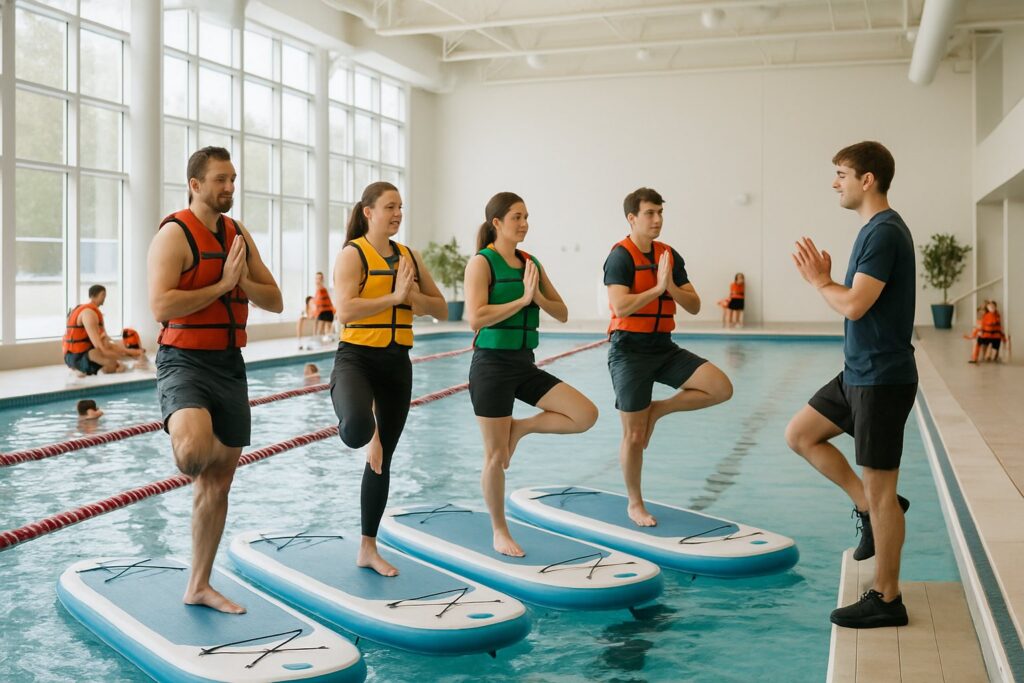
In short: a floating yoga mat is a short, wide drop-stitch board, typically about 7.5 to 8 ft long, 3 ft wide and 6 in thick, inflated to around 10 to 15 psi and tied in place so it doesn’t drift. Home models such as Solstice’s SolFit sell for a few hundred dollars; class models such as Glide FIT are sized to fit between pool lanes and come with training. Use the maker’s pressure and weight limit, tether it, and wear a life jacket on open water.
What a floating yoga mat is (and how it differs from a paddleboard)
It’s built like an inflatable paddleboard: drop-stitch fabric, where thousands of internal threads hold the top and bottom flat when inflated (our drop-stitch guide explains it). The difference is the shape and the deck. A yoga mat is shorter and wider than a touring board, with a soft full-length pad and handles that double as anchor points for resistance bands. Most aren’t meant to be paddled any distance; they’re meant to stay put while you move on them.
Floating yoga mats compared, on the makers’ specs
| Mat | Size | Pressure | Weight limit | Made for |
|---|---|---|---|---|
| Solstice SolFit | 7’10” x 36″ x 6″; 26 lb | Up to 10 psi (maker) | 275 lb | Home, pool or lake; D-rings to tie to lane lines |
| Aqua Marina Peace | 8’2″ x 35″ x 6″; 19.8 lb | 15 psi | 330 lb | Fitness and yoga on calm water |
| Glide FIT | 7’8″ x 35.5″ x 6″; 25 lb | 15 psi | Not stated | Indoor and outdoor pools; fits between lanes |
| NSP NSPiration | 6 in thick | 15–18 psi | Not stated | Gyms and resorts |
| Waterflex Aquafitmat | 220 x 81 x 12 cm; 10 kg | Not stated | 120 kg (265 lb) | Pool classes; clips between lane lines and to other mats |
Prices on the makers’ sites when we checked: SolFit $379.99 with a pump and repair kit; Aqua Marina Peace $569 (listed as sold out); Glide FIT $1,169, which includes an online portal with workouts, marketing support and a free online safety certification. One pressure note: Amazon’s SolFit listing says “suggested 15 PSI”, while Solstice’s own page says up to 10 psi. Follow the maker’s page and the label on your board.
Floating yoga mats you can buy on Amazon
For a home pool, a dock or a calm lake, these were on sale on Amazon when we checked in October 2026. Prices change often, so check the current price before you buy.
Solstice SolFit Inflatable Yoga Mat
- 7 ft 10 in x 36 in x 6 in
- 275 lb (maker)
- 5 handles double as band anchors
RAVE Sports Aqua Dock 10
- 10 x 10 ft x 6 in drop-stitch
- 10 adults or 1,800 lb (maker)
- 8 D-rings, 2 anchor points
The SolFit is the purpose-built yoga board: a non-slip mat surface, five neoprene handles and D-rings for tying off. If you’d rather share a session, RAVE’s 10 x 10 ft Aqua Dock gives a small group room to move at 5 psi; it’s a general-purpose platform rather than a yoga mat, so expect a bare deck without a full-length pad and plan to anchor it at both anchor points.
Check the Solstice SolFit price on Amazon
Keeping a floating yoga mat in place
- In a pool: tie to the lane lines. Solstice says the SolFit’s D-rings are for tying off to pool or lane lines; Glide sizes the FIT to fit between standard lanes; Waterflex’s Aquafitmat attaches between two lane lines with its kit and clips to other mats.
- At a dock: a short line to a cleat or ladder, long enough that the board can’t bump the dock edge.
- On open water: a small anchor on a line from the nose ring, in calm, sheltered water. Our anchoring guide covers anchor types and line length.
For gyms, pools and resorts: running a class
The class models are designed around lane lines, so a pool’s lane layout sets how many mats fit. Before the first session:
- Pick the mat for your pool. Ask each maker for the dimensions against your lane width and the tether kit it supplies.
- Train the instructors. Glide includes a free online safety certification and workout library with the FIT; ask other makers what they provide.
- Plan inflation. A dozen boards at 15 psi means an electric pump with an auto-stop. See our pump guide.
- Set the rules. Swimming ability, lifeguard cover and maximum weight per mat, in line with your pool’s supervision rules and insurer.
- Plan storage and cleaning. Rinse with fresh water and mild soap and dry before storing; makers such as RAVE warn against petroleum-based cleaners and solvents on PVC.
Equipping a studio or resort pool with several mats? Request more information and we’ll point you to makers who sell to gyms. Our resorts and hospitality page covers guest activities more broadly.
Your first session at home, step by step
- Inflate on land to the pressure printed on the board, then check the valve cap is closed.
- Tie it off before you climb on: a lane line, a dock cleat or an anchor line, so you aren’t drifting while you balance.
- Start low. Kneel in the center, find the balance point, then try seated and four-point poses before standing ones.
- Keep the center of the board under you. Wide stances and slow transitions do more than speed; falling in is part of the fun, so pick a spot with clear, deep-enough water around you.
- Finish with a rinse in fresh water, dry it in the shade, and roll it loosely for storage.
Floating yoga mat or a bigger platform?
A yoga mat suits one person moving on the spot. If you want to sit two people for a stretch session or use the same deck for swimming and lounging, a larger drop-stitch platform does more, at the cost of size and weight. A foam water mat is softer and bendier and much less stable for standing poses. Our platform vs floating mat comparison and size guide help you decide, and the water sports and fitness hub shows the other ways people train on the water.
Safety on a floating yoga mat
- Life jackets: the U.S. Coast Guard considers a stand-up paddleboard a vessel when it’s used beyond the narrow limits of a swimming, surfing or bathing area, which means carrying a Coast Guard-approved wearable life jacket. A yoga board on open water is in the same position; in a supervised pool, follow the pool’s rules.
- Cold water: the National Weather Service warns that cold-water shock causes involuntary gasping; a dawn class on a mountain lake can be colder than it looks.
- Weight and pressure: stay within the stated weight limit, and inflate to the maker’s figure before every session.
- Space: leave room between mats so a fall lands in water, not on the next board. Our safety checklist covers the rest.
Floating yoga mat questions
How big is a floating yoga mat?
The models we compared run from 7’8″ to 8’2″ long, about 35 to 36 in wide and 6 in thick. Waterflex’s pool mat is smaller and thinner at 220 x 81 x 12 cm.
What psi should a floating yoga mat be?
Whatever the maker states: up to 10 psi for the SolFit (maker page), 15 psi for the Aqua Marina Peace and Glide FIT, and 15 to 18 psi for the NSP NSPiration.
Can I paddle a floating yoga mat?
Some, like the SolFit, are sold as a combined yoga and stand-up board and have a bow mount. They’re short and wide, so expect slow, gentle paddling rather than touring.
How much weight can a floating yoga mat hold?
Published limits we found: 275 lb (SolFit), 330 lb (Aqua Marina Peace) and 120 kg (Aquafitmat). Glide and NSP don’t list one on the pages we checked.
Do I need a life jacket for floating yoga?
On open water beyond a swimming area, the Coast Guard’s paddleboard rule points to carrying an approved wearable life jacket. In a pool class, follow the facility’s rules.
Keep exploring
Read what platforms are made of, learn to fix a pinhole with our repair guide, or browse more in Uses and the FAQ.
Leave a Reply