This article contains affiliate links: if you buy through them we may earn a commission, at no extra cost to you. Read our affiliate disclosure.
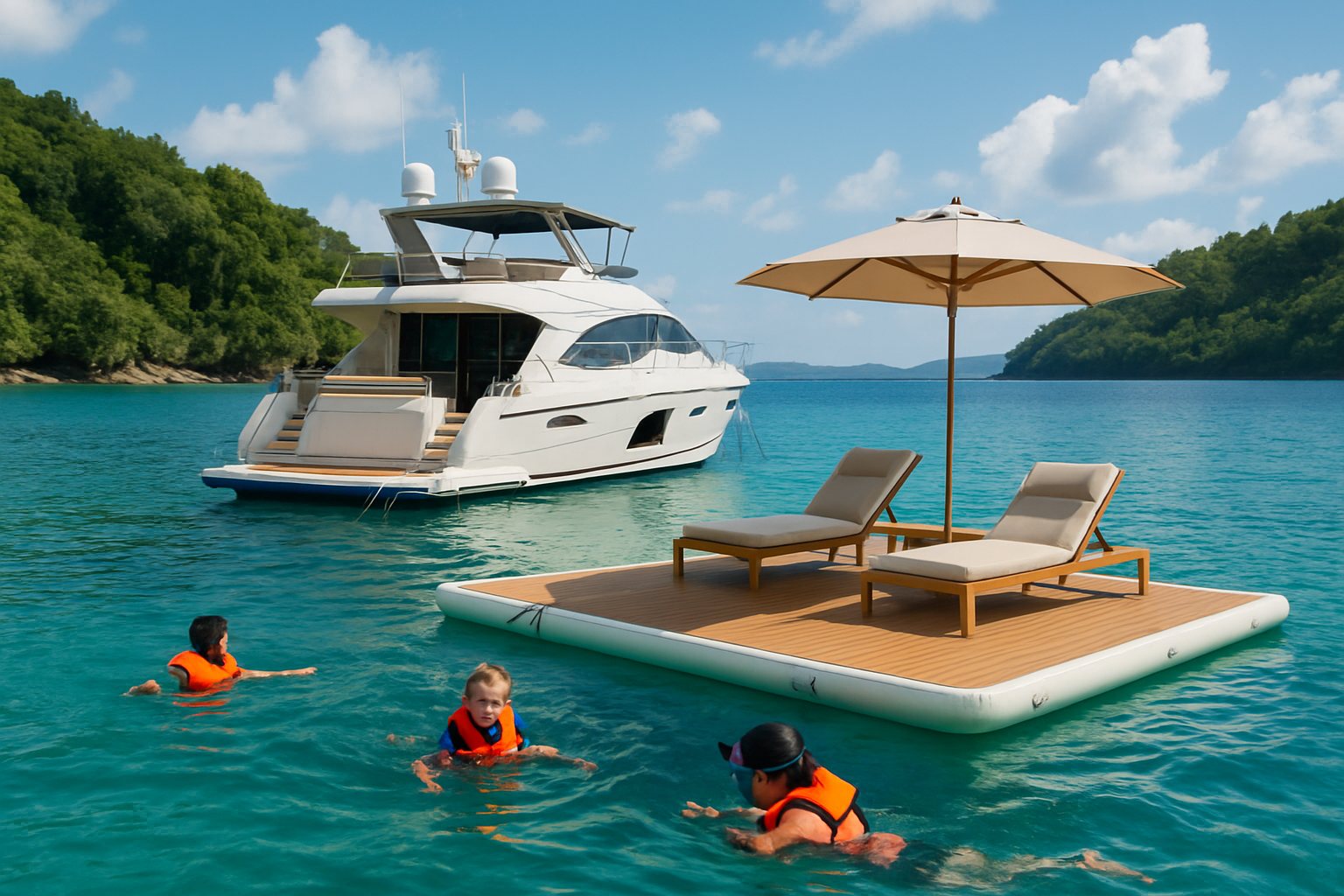
The anchor is down off a white beach and a deckhand is carrying a rolled bundle the size of a sail bag to the stern. A few minutes of pumping, a hiss from the ballast bags filling, and there’s a 13 ft teak-look deck floating level with the swim platform. A second piece clips to it in an L, a jet ski is tied to the far end, and two guests are already stretched out with their feet in the water. That is a yacht swim platform extension, the inflatable deck that turns a small swim step into a floating beach club, and on many yachts it’s the most used toy on board.
In short: yacht platforms are thick drop-stitch decks, typically 20 cm (about 8 in), with water-ballast bags underneath, non-slip teak-look or textured tops and linking systems that build bigger layouts. NautiBuoy, SeaRaft, Jobe, FunAir and Henshaw make them in standard sizes from 2.5 x 1.5 m (8 x 5 ft) to 4 x 2 m (13 x 6.6 ft), plus custom docks and islands. Ratings are as each maker states them, for example 700 kg and 5 people for NautiBuoy’s 4 x 2 m platform. Most are bought through resellers or by quote, so request more information is usually the first step.

What a swim platform extension does on a yacht
Most yachts have a swim step or swim platform built into the stern, and on larger yachts the area at the waterline is fitted out as a “beach club”. It’s rarely big enough for a group. An inflatable extension ties to the stern and floats beside it, giving guests space to sun, sit with their feet in the water, launch paddle boards and park toys. Crews use the same deck as a work raft for hull cleaning in port. When the day is over it deflates and rolls into a bag sized for a locker or the tender garage.
NautiBuoy shows how much space that adds on its own site: a single 2.5 x 1.5 m platform gives 3.75 m² (about 40 sq ft) on a 46 ft sailing yacht, and a jet-ski dock plus watersports platform gives 22.75 m² (about 245 sq ft) on a 50 m motor yacht. Smaller boats usually use lighter consumer decks, covered on boat swim platforms, and our post on the extended swim platform for a boat compares inflatable and rigid extensions.
Sizes: what 375, 525, 675 and 800 mean
European yacht platforms are named by their area. In NautiBuoy’s range, 375 means 2.5 x 1.5 m (3.75 m²), 525 means 3.5 x 1.5 m, 675 means 4.5 x 1.5 m and 800 means 4 x 2 m. All four are 20 cm (7.5 in, as NautiBuoy rounds it) thick. Here are the maker’s own figures.
| NautiBuoy size | Inflated | Max users | Max load | Weight (out of bag) | Stowed | Inflate to 250 mb |
|---|---|---|---|---|---|---|
| 375 | 2.5 x 1.5 m (8’2″ x 4’11”) | 3 | 410 kg (903 lb) | 20 kg (44 lb) | 155 x 30 x 30 cm | about 1 min 30 s |
| 525 | 3.5 x 1.5 m (11’5.5″ x 4’11”) | 4 | 480 kg (1,058 lb) | 26 kg (57 lb) | 165 x 33 x 33 cm | about 1 min 40 s |
| 675 | 4.5 x 1.5 m (14’9″ x 4’11”) | 5 | 600 kg (1,322 lb) | 31 kg (68 lb) | 165 x 38 x 38 cm | about 2 min 40 s |
| 800 | 4 x 2 m (13’1″ x 6’6″) | 5 | 700 kg (1,543 lb) | 42 kg (92 lb) | 220 x 32 x 32 cm | about 3 min 30 s |
Other makers size differently. Jobe’s Infinity Island is 2.96 x 4.48 m (9’8″ x 14’8″), 20 cm thick, with a recommended load of 800 kg (1,764 lb) and a weight of 45 kg (99 lb); the smaller Infinity Island Small is 2.17 x 3.32 m and rated 390 kg. FunAir’s Floating Island is a 7.43 x 6.62 m custom island for six guests on detachable loungers around a central dipping pool. SeaRaft and Henshaw build to the yacht. Two decks of the same size can carry different ratings, so use only the figure the maker gives for your model.
Construction and materials
- Drop-stitch core. Two fabric skins tied together by thousands of threads, so the deck stays flat and stiff when pumped (our drop-stitch guide explains it). NautiBuoy builds a drop-stitch core with borders of Mehler German PVC; Jobe uses lightweight single-layer drop-stitch at 12 to 15 psi. NautiBuoy, by contrast, inflates its platforms to only 3.6 psi (250 mb), so pressure figures aren’t comparable between brands: follow your own maker.
- Reinforcement and fabrics. NautiBuoy lists PVC with Kevlar reinforcement and doubles the material where the ladder rubs. FunAir uses 0.9 mm, 1000-denier PVC with fire-retardant and UV ratings, 316 stainless hardware and hot-air welded seams. Henshaw’s jet-ski docks combine a 1,300 gsm Hypalon-coated tube base with a 100 mm double-wall drop-stitch top. Our PVC vs Hypalon vs TPU guide compares the fabrics.
- Water ballast. Bags under the deck fill with sea water so the platform sits level and resists flipping. NautiBuoy fits four, one in each corner, with a manual dump system that empties them in one movement for recovery; Jobe fits five to the Infinity Island; FunAir fits ballast bags to its docks to stop them skating on the water.
- Deck finish. Teak-look foam or a diamond-pattern non-skid PVC (NautiBuoy, SeaRaft), or a 5 mm EVA foam deck (Jobe). NautiBuoy says its teak finish is UV tested to 3,000 hours and heat resistant to 110 °C (230 °F), while its light-grey diamond finish is cheaper, repels heat and folds as well as rolls.
- Valves and safety details. NautiBuoy fits Halkey Roberts inflation valves and 5.5 psi pressure-relief valves to release pressure when air expands in hot sun, and uses only soft loops on the underside and edges to protect topsides and varnish.
The yacht platform makers, and how each one sells
NautiBuoy Marine (founded 2014, British-designed by ex-superyacht crew, made in Europe) has the broadest standard system: Sport and Voyager platforms in the four sizes above, J-Dock jet-ski docks, a C-Dock for Seabobs, an E-Foil Dock, SeaPool enclosures, a C-Shade canopy, steps and maintenance packs. It sells through resellers; one Greek retailer listed the Voyager 800 Teak at €5,995 before VAT and a Maltese one at €7,074.10 in October 2026.
SeaRaft (engineered in the Netherlands, hand-built in Europe) now presents itself and NautiBuoy as two brands of one family: NautiBuoy for standard modular sizes, SeaRaft for fully custom platforms, seapools and docks engineered around one vessel after a consultation. SeaRaft says its platforms go from rolled to fully inflated in under five minutes. Its earlier brochure listed PL375 to PL800 platforms with underside ballast, which retailers still sell.
Jobe (Netherlands) is the one owners can simply order online: the Infinity Island was €2,799.99 and the Island Small €1,999.99 on its official store, with a 3-year warranty, and the same range includes PWC, Seabob and foil stations and a gangway.
FunAir (Austin, Texas) builds custom and in-stock QuickShip yacht inflatables: the Floating Island, which it says deploys in about 20 minutes with minimal crew, jet-ski docks, sea pools and the Super Dock, a fully custom modular dock it designs alongside new builds and refits. Press coverage quoted its jet-ski docks “from US$5,500”; the island is priced on application. Henshaw Inflatables (UK, part of WING since 2016) builds bespoke drop-stitch platforms and jet-ski docks, and says its sales team can give an estimate from basic measurements.
Aquaglide Half Deck 7.5
by Aquaglide
- Size (as stated): 2.28 x 1.55 x 0.1 m
- Thickness: 10 cm welded drop-stitch
Jobe Infinity Island
by Jobe
- Size (as stated): 2.96 x 4.48 m
- Stated capacity: 800 kg recommended load
- Thickness: 20 cm single-layer drop-stitch
Jobe Infinity Island Small
by Jobe
- Size (as stated): 2.17 x 3.32 m
- Stated capacity: 390 kg
- Thickness: 20 cm
NautiBuoy Voyager 800
by NautiBuoy Marine
- Size (as stated): 4 x 2 x 0.2 m
- Stated capacity: 700 kg; 5 people
- Thickness: 20 cm drop-stitch
RAVE Aqua Dock 10 (as a swim platform)
by RAVE Sports
- Size (as stated): 10 x 10 ft x 6 in
- Stated capacity: 10 adults; 1,800 lb
- Thickness: 6 in drop-stitch
SeaRaft PL525 platform
by SeaRaft
- Size (as stated): 3.5 x 1.5 m
- Thickness: 20 cm drop-stitch (retailer)
| Spec | NautiBuoy Voyager 800 | Jobe Infinity Island | SeaRaft PL525 platform |
|---|---|---|---|
| Size (as stated) | 4 x 2 x 0.2 m | 2.96 x 4.48 m | 3.5 x 1.5 m |
| Thickness | 20 cm drop-stitch | 20 cm single-layer drop-stitch | 20 cm drop-stitch (retailer) |
| Stated capacity | 700 kg; 5 people | 800 kg recommended load | not published |
| Construction | PVC with Kevlar reinforcement; patented water-ballast bags with dump system; artificial teak or diamond deck | Drop-stitch with 5 mm EVA deck; 5 ballast bags | Underside water-ballast bags; teak or diamond finish |
| Weight | 40 kg | 45 kg | not published |
| Packed size | Bag 220 x 35 x 35 cm | not published | not published |
| Anchoring / attachment | Air Toggle inflatable link beam; 316 stainless D-rings | Double D-rings link to other Infinity platforms; ladder mounts | not published |
| Price signal | €5,995 ex VAT, Teak version (Greek retailer, when checked) | €2,799.99 / £2,351.99 on the official store (when checked) | not published |
| See it at Onaqua | See it at Jobe | See it at Ritz Marine |
Figures as each maker states them; makers measure capacity differently. Check the product page for sources and dates.
Building a yacht beach club layout
Most yacht set-ups grow from one platform. NautiBuoy’s Voyager series links end to end, side by side, in an L and in a T, while its Sport series links end to end only. Its own suggestions are a good starting map: end to end for a long walkway or maintenance raft (two 675s make a 9 m runway), side by side for a private dock or a dinner on the water, an L as a drop-off point for the tender, and a T as a jet-ski dock. Add a sea pool for jellyfish-free swimming on one side and a slide from the upper deck (our sister site BoatSlide compares the best yacht slides), and you have a beach club.
Before you order, check four things with the supplier: that every piece links with the same maker’s connectors (makers don’t support mixing brands), how the layout ties to your stern cleats, the packed size against your storage, and how it inflates (hand pump, 12/24 V pump or the ship’s air supply). Our modular platforms page covers linking systems in more depth.
Setup and anchoring
- Unroll on the swim platform or aft deck, inflate to the maker’s pressure with a gauge, then slide it into the water.
- Let the ballast bags fill before anyone steps on.
- Tie off at the maker’s D-rings to the stern cleats with two lines, with transom bumpers or fenders between deck and hull. NautiBuoy sells inflatable transom bumpers for this.
- Add links, docks and ladders one at a time and check every connection.
- To recover, dump the ballast, lift, rinse with fresh water, dry and roll.
A platform tied to the stern swings with the yacht. If you anchor one off a beach on its own, size the anchor to the maker’s instructions; our guide on how to anchor an inflatable platform explains anchors, rope and scope.
Advantages and trade-offs
| Advantages | Trade-offs |
|---|---|
| Adds deck space at the waterline without rebuilding the stern | Only usable at anchor or in port, in calm water |
| Packs into a bag; NautiBuoy’s biggest stows at 220 x 32 x 32 cm | Weight in the bag still needs two people (46 kg for the 800) |
| Doubles as a crew work raft for hull cleaning | Most systems are sold through resellers or by quote |
| Grows into docks, walkways and pools on one system | Connectors only work within one brand |
| Published maker ratings on standard sizes | Custom builds need ratings asked for in writing |
The fun part: a day on the floating beach club
Mid-morning, the platform is out and the paddle boards are leaning on the far edge. Two guests swim laps between the deck and the boat’s ladder. Someone spreads a towel on the teak-look surface, which stays comfortable on skin, and stays there until lunch. In the afternoon the jet ski goes out from the T-dock, comes back, and ties up again without anyone climbing over the transom. At sunset the crew puts out cushions and the platform becomes the best seat on the yacht, a few inches above the water with the hull glowing behind. When everyone has gone up for dinner, the deckhand dumps the ballast and the whole thing is back in its bag before dessert.
Safety at anchor
- Carbon monoxide. The U.S. Coast Guard says never to sit or hang on the back deck or swim platform while engines run, and warns that carbon monoxide can stay around a boat at dangerous levels after the engines, or a neighbor’s engines, have stopped. Shut down engines and generators while the platform is in use and keep it clear of exhaust outlets.
- Life jackets. A recreational boat must carry a U.S. Coast Guard approved wearable life jacket for each person on board, and the Coast Guard notes that most boating drownings happen on nice days. Children need child sizes.
- The maker’s limit. Keep guests to the maker’s stated users and load, and never move the boat or tow the platform with anyone on it.
- Wind, swell and cold water. We found no yacht platform maker that publishes a wind limit, so watch the NOAA marine forecast and bring the platform in when it builds. The National Weather Service warns that cold shock can make even strong swimmers gasp and inhale water.
- Entrapment. Gaps between linked platforms can trap fingers and feet. NautiBuoy says its Air Toggle links are designed to stop platforms riding up on each other in swell and to prevent entrapment between them; keep layouts within one system.
More is in our safety section: Coast Guard requirements, carbon monoxide near boats and wind and cold water. The safety checklist is a quick list for the day.
For smaller yachts: a deck you can order online
Owners of smaller yachts and sailboats often start with a consumer drop-stitch deck. These were in stock on Amazon when we checked in October 2026; prices change often.
Island Hopper Yacht Dock 10 x 6 ft
- 1,500 lb (maker)
- 8 to 15 psi
- D-rings to link and tie off
Seamax SUP20D Electric Air Pump
- Up to 20 psi
- Extra fittings included
- Built-in temperature sensor
We saw the Island Hopper Yacht Dock at about $749 (only a few left), the Seamax SUP20D pump at about $144 and the Better Boat 100 ft rope at about $46, seen October 2026. A consumer deck is rated for recreation by its maker; it is not a yacht-system platform and doesn’t link to NautiBuoy or Jobe pieces.
Check the Island Hopper Yacht Dock price on Amazon
Gear for a yacht platform
- A pump that reaches the maker’s pressure, and a gauge; for big layouts, a 12/24 V pump or an adapter for the ship’s air.
- Transom bumpers or fenders, two mooring lines and the maker’s connectors.
- A boarding ladder that fits the platform’s mountings.
- A UV cover if the platform stays inflated for days, and the maker’s repair kit.
- For crew use: a maintenance cover, hose holders and buckets that can’t go over the side (see yacht hull cleaning platforms).
What yacht platforms cost
| Option | Price seen (October 2026) | How to buy |
|---|---|---|
| Consumer drop-stitch deck, 10 x 6 ft | About $749 (Island Hopper on Amazon) | Online |
| Jobe Infinity Island Small / Infinity Island | €1,999.99 / €2,799.99 | Jobe store and dealers |
| NautiBuoy Voyager 800 Teak | €5,995 ex VAT (Greece); €7,074.10 (Malta) | Resellers |
| NautiBuoy Air Toggle link, 1.5 m | €295 (Malta) | Resellers |
| FunAir jet-ski docks | “From US$5,500” (press) | Quote |
| FunAir islands, Super Dock, SeaRaft and Henshaw custom | Not published | Quote |
We don’t sell or install platforms. If you’d like help comparing quotes or reaching a maker, use Request more information and tell us the yacht’s length, stern layout, storage space and what you want the platform to do.
Care and storage
Rinse with fresh water after salt, dry fully before rolling, and store in the bag out of sun and heat. Empty the ballast before lifting. NautiBuoy says its teak finish washes clean of sunscreen, coffee and wine stains, and its diamond finish is the easier one to keep clean as a work deck. Platforms left inflated for days need a cover; SeaRaft and NautiBuoy both sell fitted covers. Warranties signal expected life: Jobe gives 3 years on the Infinity Island and FunAir 5 years limited on the products we checked. Patch small punctures with the maker’s kit (see inflatable platform repair) and send seam or valve problems back to the maker.
Related: plan the day with boating and yachts, see every type on floating platform types, or read about operating platforms for charter guests in commercial recreation platforms.
Latest guides
Yacht platform questions
What is a yacht beach club platform?
An inflatable deck, or several linked together, tied to the stern so the yacht’s waterline “beach club” extends onto the water for lounging, swimming and keeping toys close.
How big is a swim platform extension?
Standard sizes run from 2.5 x 1.5 m (8 x 5 ft) to 4 x 2 m (13 x 6.6 ft) for NautiBuoy, and 2.96 x 4.48 m for Jobe’s Infinity Island. Custom makers build larger.
How many people fit on a yacht swim platform?
As the maker states it. NautiBuoy gives 3 users and 410 kg for its smallest platform and 5 users and 700 kg for its 4 x 2 m one; Jobe gives an 800 kg recommended load for the Infinity Island.
Why do yacht platforms have ballast bags?
They fill with sea water under the deck so the platform stays level and resists flipping when people stand at one edge or a jet ski comes alongside. Dump them before lifting it out.
Can I connect platforms from different brands?
Plan on one system. NautiBuoy’s Air Toggle and Jobe’s D-ring and Velcro connectors are made for their own pieces, and gaps between mismatched platforms can trap feet and fingers.
How long does a yacht platform take to set up?
NautiBuoy gives about 1.5 to 3.5 minutes to inflate depending on size, SeaRaft under five minutes, and FunAir about 20 minutes for its six-guest Floating Island.
Can crew use the platform for hull cleaning?
Several makers design for it: NautiBuoy sells maintenance covers and packs, and SeaRaft says its platform works as a work deck as well as a swim deck. Follow the maker’s users and load limits for crew work too.
What does a yacht platform cost?
From about $750 for a consumer deck to about €2,000 to €2,800 for Jobe’s islands and around €6,000 to €7,000 for a 4 x 2 m NautiBuoy, with custom docks and islands priced by quote.