This article contains affiliate links: if you buy through them we may earn a commission, at no extra cost to you. Read our affiliate disclosure.
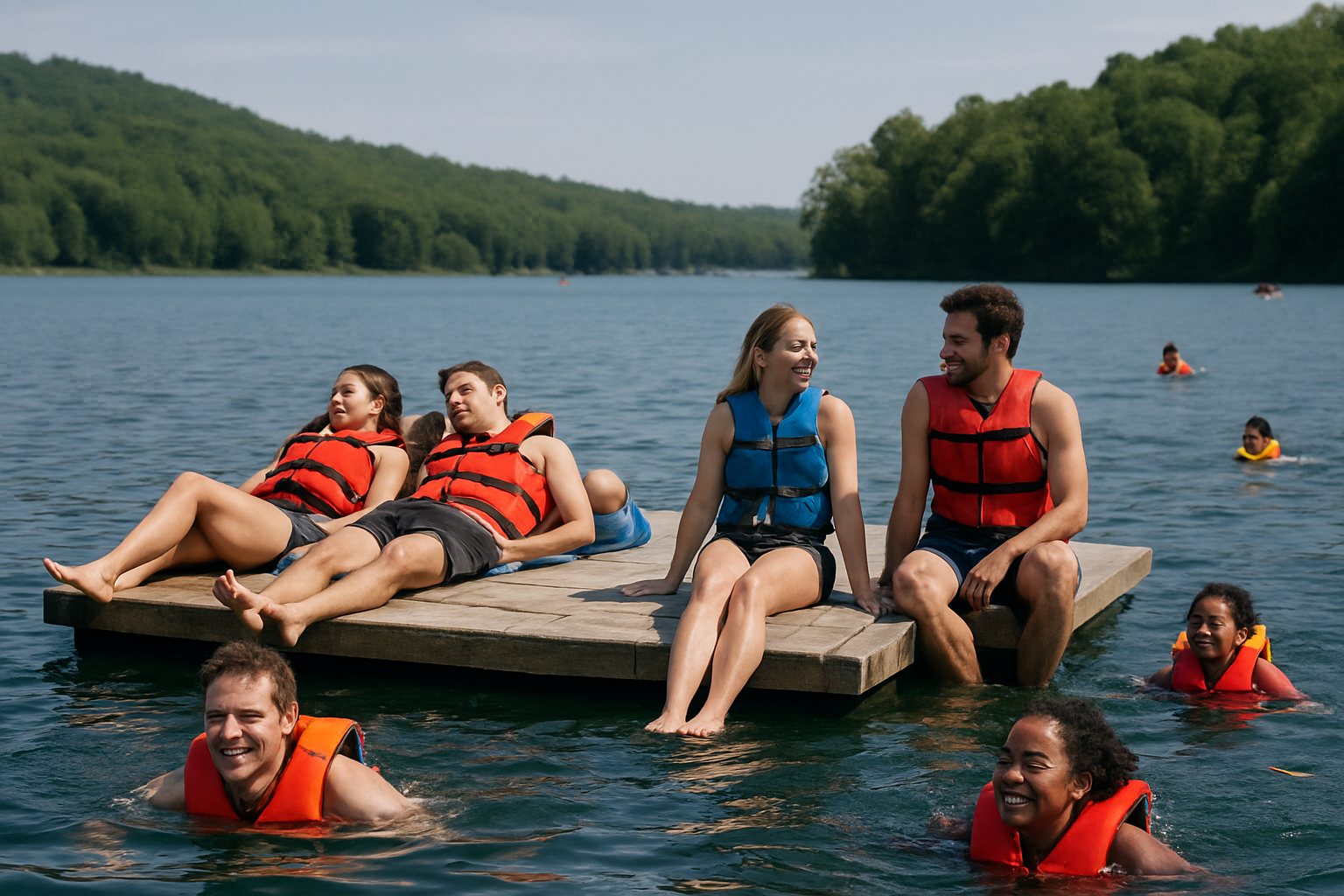
Memorial Day weekend at the lake house. The dock is back in, the boat is uncovered, and the last job before the cousins arrive is the one everyone looks forward to: carrying the rolled-up platform down to the water, pumping it hard, and paddling it out to its spot past the drop-off. By lunchtime there are kids sunbathing on it and a line of swimmers waiting to jump. A floating platform anchored off your shore becomes the center of the summer. This guide is about setting one up well for the season: choosing it, where it goes, how it stays there, and how to look after it until fall.
In short: for a lake, choose a drop-stitch swim platform sized by the maker’s rating, place it where the water is at least the maker’s minimum depth and away from boat traffic, anchor it to the maker’s stated anchor points and weight, and check pressure and lines through the season. Bring it in before storms and store it dry for winter.
Choosing a floating platform for lake use
Most lake swim platforms today are drop-stitch inflatables: two fabric skins tied together by thousands of threads, pumped up until the deck is firm enough to stand on. Three things decide the right one for your shore:
- How many people at once. Use the maker’s rating: RAVE states 10 adults or 14 children (1,800 lb) for its 10 x 10 ft Aqua Dock; Island Hopper states 1,500 lb for its 10 x 6 ft Yacht Dock; Aquaglide states 5 adults (1,000 lb) for its Solarium lounge.
- Whether it stands alone or links up. Some platforms are made to connect into a bigger layout (Aquaglide’s Vario-Lock straps, Jobe’s double D-rings). Others aren’t: RAVE says its Aqua Dock doesn’t connect to its other products. Decide now if you might add a trampoline or a second deck later; see modular platforms.
- Who has to climb on. Handles and a low edge help swimmers out of deep water. RAVE puts ten neoprene handles on the Aqua Dock 10.
If you’re still deciding between a platform, a swim raft and a soft floating mat, start with those guides; the general method is in how to choose an inflatable platform.
Where to put a lake swim platform
Placement is where most lake setups go right or wrong. Use the maker’s numbers first:
| Platform (example) | Minimum depth (maker) | Other placement rule (maker) |
|---|---|---|
| RAVE Aqua Dock 10 | 4 ft (1.2 m) | 2 anchor points |
| Aquaglide Solarium | 1 m (about 3.3 ft) | 1 anchor point; at least 250 kg anchor weight |
| Aquaglide Ohana 6-person lounge | Not stated in our source | At least 3 m from shore; 4 anchor points; at least 2,000 kg anchor weight |
| Aquaglide C Lounge | 4.8 ft | At least 4,400 lb total anchor weight |
Then add your own checks:
- Measure where people will jump, on every side, not just under the middle. A weighted line marked in feet does the job.
- Plan for the water dropping. If your lake falls through the summer, place the platform for August levels, not May.
- Look for hazards below: rocks, stumps, old cribs, weed beds. Swim the spot before anyone dives.
- Stay out of boat traffic. Keep it clear of channels, the path to your dock and any ski or tube route. A low platform is hard to see from a boat.
- Check the rules. Lakes, towns and states may limit what can be anchored, where, and how it’s marked. Ask your lake association or state natural resources agency.
Anchoring a swim platform for lake season
A platform left out for weeks needs more than a quick tie-off. Use every anchor point the maker provides, and where the maker states a minimum anchor weight, meet it. Aquaglide is the clearest about this: on its product pages (the Supertramp 17, for example) it says its anchor-weight recommendations are for extreme weather, waves and other abnormal conditions, and recommends a dock and mooring specialist for installation. RAVE’s manual notes that anchors and tethers keep wind from swinging the platform around.
SeaSense, for one, sells its mushroom anchor for sandy, muddy or weedy bottoms; for heavy lounges with large anchor-weight figures, follow the maker’s advice to get specialist help. Make lines long enough for the depth plus slack, mark them with a float, and check the attachment points regularly for chafe. Our step-by-step anchoring guide has layouts for one, two and four anchor points.
Getting it out to its spot
Set the anchors first. Drop them where you want the platform, with their lines buoyed, while the platform is still on shore. Then inflate on the beach or the dock, on a clean surface away from sharp stones, to the maker’s pressure (RAVE’s manual says to inflate on flat ground). Carry or float it out with two people, clip the lines to the anchor points, and adjust them so the platform sits where you measured. Last, walk around it in the water and check the depth on every side once more.
Platforms and anchor gear for the lake
Two drop-stitch platforms and the anchor and line to hold one. In stock on Amazon when we checked in October 2026; prices change often.
RAVE Aqua Dock 10
- 10 x 10 ft x 6 in
- 10 adults or 1,800 lb (maker)
- 4 ft minimum depth
Island Hopper Yacht Dock 10 x 6 ft
- 10 x 6 ft x 6 in, 8-15 psi
- 1,500 lb (maker)
- Packs to 40 x 16 x 14 in
SeaSense Mushroom Anchor 10 lb
- 10 lb mushroom anchor
- Black vinyl coated
- Sold for sandy, muddy or weedy bottoms
Better Boat Anchor Rope 100 ft
- 3/8 in double-braided nylon
- 820 lb working load (listing)
- Stainless thimble
We saw the RAVE Aqua Dock 10 at about $800 and the Island Hopper Yacht Dock at about $749, the SeaSense 10 lb anchor at about $32 and the Better Boat 100 ft line at about $46. Neither platform maker states an anchor weight on its product page, so ask the maker what it recommends for your conditions before relying on one small anchor for a season.
Check the RAVE Aqua Dock 10 price on Amazon
Aquaglide Half Deck 7.5
by Aquaglide
- Size (as stated): 2.28 x 1.55 x 0.1 m
- Thickness: 10 cm welded drop-stitch
Jobe Infinity Island
by Jobe
- Size (as stated): 2.96 x 4.48 m
- Stated capacity: 800 kg recommended load
- Thickness: 20 cm single-layer drop-stitch
Jobe Infinity Island Small
by Jobe
- Size (as stated): 2.17 x 3.32 m
- Stated capacity: 390 kg
- Thickness: 20 cm
NautiBuoy Voyager 800
by NautiBuoy Marine
- Size (as stated): 4 x 2 x 0.2 m
- Stated capacity: 700 kg; 5 people
- Thickness: 20 cm drop-stitch
RAVE Aqua Dock 10 (as a swim platform)
by RAVE Sports
- Size (as stated): 10 x 10 ft x 6 in
- Stated capacity: 10 adults; 1,800 lb
- Thickness: 6 in drop-stitch
SeaRaft PL525 platform
by SeaRaft
- Size (as stated): 3.5 x 1.5 m
- Thickness: 20 cm drop-stitch (retailer)
Through the season: a weekly check
- Pressure: check with a gauge against your maker’s figure (RAVE 5 psi, Island Hopper 8 to 15 psi). Heat raises the pressure in the afternoon sun and cool nights lower it.
- Lines and anchor points: look for chafe where lines meet D-rings, and make sure the platform hasn’t dragged.
- Deck and seams: rinse off bird droppings and algae, and look along seams and valves for slow leaks (soapy water shows bubbles).
- After storms: better still, bring it in before them. The National Weather Service says to get out of the water when a thunderstorm approaches, and an empty platform in high wind strains its anchors.
RAVE’s manual advises deflating and storing its platform when it’s not in use, and its warranty doesn’t cover damage from over- or under-inflation, sun fading or improper storage. If you leave a platform out all summer, that’s your call to make knowing those terms.
End of season and winter storage
Pull the platform before the water gets cold and before ice. Wash it with fresh water, let it dry completely in the shade, deflate it, and fold or roll it the way the maker shows (Island Hopper’s Yacht Dock folds on a marked center line). Store it somewhere cool, dry and out of the sun, away from sharp objects and rodents. Pull the anchors too, or mark them clearly if you leave them for next year and local rules allow it.
Lake platform safety
Make it a house rule: kids and weak swimmers wear U.S. Coast Guard approved life jackets, an adult watches whenever someone is on the platform, and it’s feet first until everyone knows the depth. Stay within the maker’s rating. Keep boats and engines well away from swimmers. More in our safety checklist, and ideas for the whole summer in family lake days. The type overview is boat and swim platforms.
Lake swim platform questions
How far from shore should a floating platform be?
Far enough to reach the maker’s minimum depth on every side, and at least any distance the maker states (Aquaglide says 3 m for its Ohana lounge). Keep it out of boat routes.
Can I leave a swim platform in the lake all summer?
Many owners do, anchored to the maker’s figures and checked weekly. Some makers, like RAVE, advise deflating and storing when not in use, so read your manual and warranty terms.
What is the best floating platform for a lake?
The one rated for your group that suits your depth and how you’ll anchor it. A 10 x 10 ft deck suits big families; a 10 x 6 ft deck folds smaller; firm lounges suit adults. Compare makers in our catalog.
How heavy an anchor does a lake swim platform need?
Use your maker’s figure. Aquaglide publishes them (250 kg for the Solarium, 4,400 lb for the C Lounge); where a maker doesn’t, ask it before the platform goes out for the season.
Can I add a slide or trampoline to my lake platform?
Only if the maker designed them to connect. Some systems link; others, like RAVE’s Aqua Dock, are standalone. See water trampoline vs water bouncer if you’re planning to add one nearby.
Leave a Reply